Theodulf of Orléans

A Visigothic scholar at Charlemagne's court
Theodulf was born around 750 or 760, most likely in Zaragoza in Visigothic Spain, and made his way to the court of Charlemagne at a moment when the emperor was actively recruiting the best scholars he could find across Europe to drive what historians now call the Carolingian Renaissance — a deliberate revival of learning, education, and textual scholarship centered on the imperial court. Theodulf rose to become Bishop of Orléans and abbot of Fleury, but his real influence lay in his role as a royal adviser: he succeeded the celebrated Alcuin of York as Charlemagne's chief theological voice, a position that placed him at the center of the empire's intellectual and doctrinal life for years. He is also widely credited as the principal author of the Libri Carolini, a substantial theological work on the veneration of religious images that Charlemagne commissioned — serious, sustained theological writing produced at the highest level of Carolingian court culture.
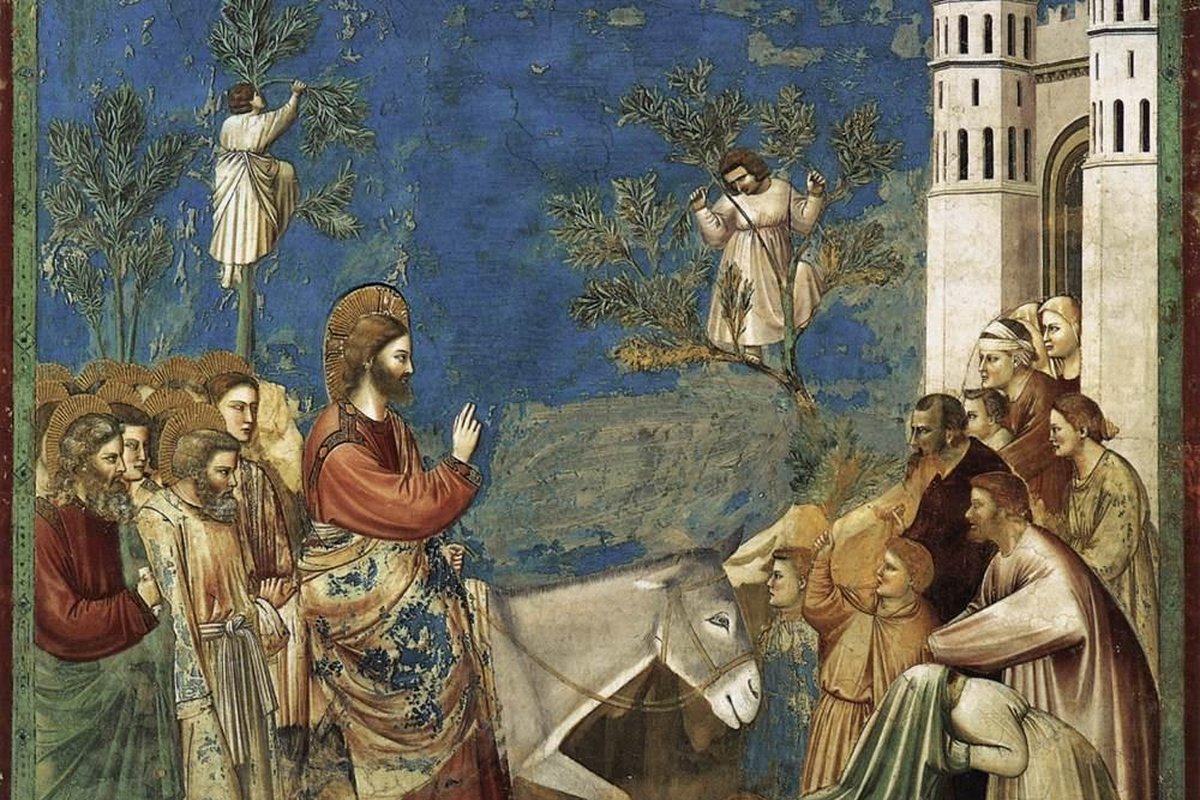
Giotto di Bondone, Entry into Jerusalem, Scrovegni Chapel, Padua, c. 1304–1306 — public domain.
The hymn that outlasted the empire
Whatever else Theodulf accomplished, his most enduring legacy by far is a single hymn: "Gloria, laus et honor," known to English-speaking congregations today as "All Glory, Laud, and Honour." Written for Palm Sunday, the hymn commemorates Christ's entry into Jerusalem — the crowds, the palm branches, the cloaks laid across the road — and it has been sung in that same liturgical context for roughly 1,200 years, long after the Carolingian court that produced it, and the empire it served, had disappeared from the map. Few pieces of writing from any era achieve that kind of continuous, functional survival. It's a remarkable thing to have written, and it says something about the durability of good liturgical poetry that it needed no revival, no rediscovery — just uninterrupted use, century after century, right up to the present.
A conspiracy, a deposition, and exile
Theodulf's career did not end well. He was accused of conspiring with King Bernard of Italy against Emperor Louis the Pious, Charlemagne's son and successor, and whatever the truth of the charge, the consequences were swift and permanent: he was deposed from his bishopric in 817 or 818 and sent into exile. He never recovered his position. He died in or shortly after exile at Angers on December 18, 821 — a genuine fall from grace for a man who had once stood at the intellectual center of Charlemagne's court, advising an emperor on matters of doctrine and theology.
A churchman, not a settled saint
It's worth being direct about something that popular retellings of Theodulf's story often gloss over: his standing as a canonized saint is genuinely doubtful. The Catholic Encyclopedia's own entry on him is titled simply "Theodulf," without the "St." that its articles on actually canonized figures consistently carry, and it records no canonization at all. Where modern calendars list him as a saint, that recognition appears to rest on thin, late, or locally confined veneration rather than any well-documented formal process — the kind of gap that's worth naming plainly rather than smoothing over. None of that diminishes what he actually was: a major Carolingian scholar-bishop, Charlemagne's leading theological adviser after Alcuin, the probable author of the Libri Carolini, and the writer of a Palm Sunday hymn still sung today. He doesn't need an unearned title to be worth remembering.
The world the hymn was written for
To appreciate what Theodulf was doing when he wrote "Gloria, laus et honor," it helps to picture the Carolingian court he served. Charlemagne, crowned Holy Roman Emperor in 800, had assembled scholars, poets, and theologians from across Europe — Alcuin from England, Paul the Deacon from Italy, Theodulf from Spain — into something like a traveling academy attached to the royal household, producing standardized texts, reformed handwriting, and a wave of new liturgical poetry meant to bring order and consistency to worship across a sprawling, newly unified empire. Theodulf's hymn was written for exactly that purpose: a processional text for Palm Sunday, meant to be sung as clergy and congregation moved together re-enacting Christ's entry into Jerusalem, carrying branches the way the Gospel crowds had once carried palms before him. Giotto's fresco of that biblical scene, which illustrates this article, captures the same moment Theodulf's hymn was written to accompany liturgically — the crowd, the branches, the cloaks laid in the road.
What the hymn actually says
The original Latin runs to some three dozen verses, though most modern hymnals use only a handful, alternating a repeated refrain — "Gloria, laus et honor tibi sit, Rex Christe, Redemptor" ("Glory, praise, and honor to you, Christ the King, Redeemer") — with verses addressing Christ directly as the one to whom "the array of angels in the highest" and "the company of Hebrews with palms" once sang praise together, uniting the Old Testament crowd at Jerusalem's gates with the heavenly court in a single act of worship. Its durability likely owes something to that structure: a simple, singable refrain repeated between verses is exactly the kind of form that survives centuries of liturgical use, translation, and adaptation into different musical settings, which is precisely what happened to Theodulf's hymn across the many centuries since he wrote it.
A legend attached to his final years
One popular story claims that while Theodulf sat imprisoned at Angers during his exile, he composed the Palm Sunday hymn from his cell, and that Louis the Pious, passing beneath the window during a Palm Sunday procession and hearing the song, was so moved that he ordered Theodulf released. It's a vivid image — a disgraced bishop's own hymn winning back his freedom — but historians generally treat it as later legend rather than documented fact, not unlike the uncertainty already noted around his sainthood. What is certain is less romantic: Theodulf died in exile without ever recovering his position, and it was the hymn itself, not any deathbed reprieve, that carried his name forward into the following twelve centuries of Christian worship.
Trivia
Who was Theodulf of Orléans?
Was Theodulf of Orléans ever officially canonized as a saint?
What is Theodulf of Orléans's most famous hymn?
What was the Libri Carolini, and did Theodulf write it?
Why did Theodulf of Orléans fall from power?
You May Also Like
Related Reading