Venerable Fulton Sheen

A scholar before a broadcaster
Fulton J. Sheen was born in 1895 in El Paso, Illinois, the eldest of four sons in a family of Irish Catholic farmers and shopkeepers. He was ordained a priest in 1919 and, unusually for an American cleric of his generation, went on to earn a doctorate in philosophy from the University of Louvain in Belgium, one of the oldest and most respected Catholic universities in Europe, where his dissertation won the university's top academic prize. He spent decades teaching philosophy and theology at the Catholic University of America before radio, and later television, drew him toward the far larger audience that would define his public reputation. That academic grounding shows up clearly in his broadcasting style: even at the height of his television fame, Sheen leaned on serious philosophical and theological argument rather than simplifying his message into slogans, trusting that a mass audience could follow a real line of reasoning if it was delivered with enough clarity and warmth.
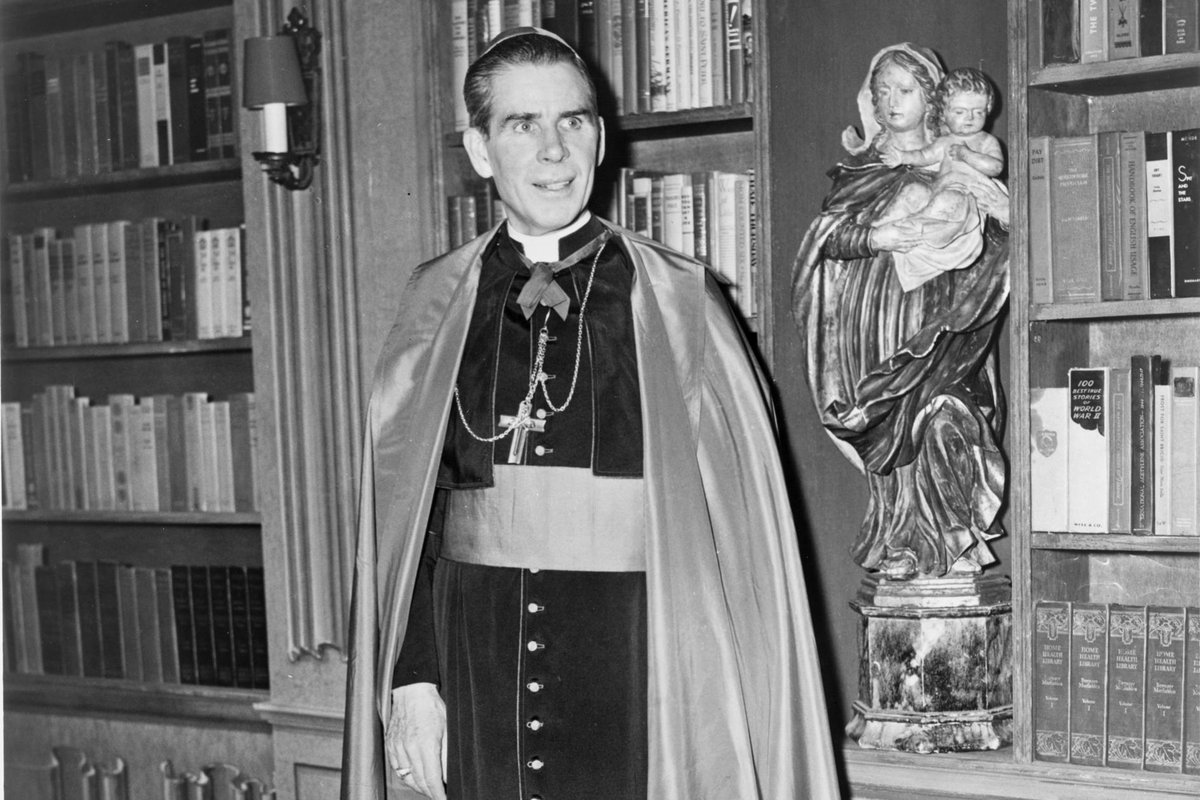
Photograph of Bishop Fulton J. Sheen, 1952, Fred Palumbo, New York World-Telegram & Sun Collection, Library of Congress — public domain.
A bishop who beat a comedian in the ratings
Sheen built a long career as a Catholic priest, theologian, and — most famously — one of the first major figures of American religious broadcasting, beginning with a popular radio program, "The Catholic Hour," in the 1930s that reached millions of listeners years before he ever appeared on television. His television program, "Life Is Worth Living," ran from 1951 to 1957 and, at its peak, drew an estimated 30 million viewers a week, an audience large enough that Sheen was, for a time, genuinely competing for ratings against the comedian Milton Berle in the same broadcast slot. Berle himself was reportedly gracious about it, joking that he and Sheen had the "same writer" — the Holy Spirit, as he sometimes put it, and Sheen apparently returned the compliment good-naturedly in interviews of his own.
There were no special effects and no format tricks — just a bishop in his cassock and cape, a chalkboard, and a sustained ability to hold a mass television audience's attention while talking about philosophy, morality, and faith. He won an Emmy Award in 1952 for "Most Outstanding Television Personality," beating out several established entertainment figures, a recognition that still surprises people unfamiliar with just how large his audience genuinely was. It remains one of the more improbable success stories in the early history of American television.
A cause slowed by a dispute over his own remains
Sheen died in 1979, and his cause for canonization moved forward over the following decades — until it ran into an unusually mundane obstacle. A dispute arose over where his remains should rest: New York, where he had died and was originally buried, or Peoria, Illinois, the diocese where his sainthood cause had been formally opened and was based. The disagreement dragged on for years and complicated the cause's progress in ways that had nothing to do with his life or holiness.
Renewed scrutiny during his years as a bishop
Separately, his cause has also faced scrutiny connected to his tenure as Bishop of Rochester, New York, from 1966 to 1969, specifically regarding how he responded to clergy sexual abuse allegations during that period — the kind of question the Church has taken far more seriously in recent decades than it once did, and one that any modern sainthood cause must be able to withstand.
Cleared for beatification, then abruptly postponed
By 2019, a miracle attributed to Sheen's intercession had been formally investigated and approved by the Vatican, clearing the way for his beatification. The ceremony was scheduled — and then postponed just weeks beforehand, without the beatification taking place. He has remained since at the rank of "Venerable," a stage earlier in the Church's process than "Blessed," which is conferred at beatification, or "Saint," conferred at canonization. His beatification is now scheduled for September 24, 2026; until that ceremony actually takes place, "Venerable" — not "Blessed," and certainly not "Saint" — remains the accurate title for him.
A model for religious broadcasting well before its time
Whatever the outcome of his cause, Sheen's influence on how religious content is presented to a mass audience is hard to overstate — decades before religious television and radio became a familiar genre, he had already proven a sustained, popular audience existed for it. He has no formal universal patronage, but he's informally and widely regarded as a natural touchstone for Catholic broadcasters and media evangelists, a role his own career defined almost by accident, one weekly broadcast at a time.
Beyond television, Sheen left behind a substantial body of writing — dozens of books on philosophy, spirituality, and Catholic apologetics, several of which remain in print today and are still recommended reading in Catholic parishes and universities. He was also known throughout his life for his personal commitment to missionary fundraising, serving for years as national director of the Society for the Propagation of the Faith, through which he helped direct enormous sums toward missionary work in developing countries — a less visible but no less significant part of his legacy than the television career most people associate with his name.
Trivia
How popular was Fulton Sheen's television show, really?
Why has Fulton Sheen's sainthood cause taken so long?
Has Fulton Sheen been beatified yet?
What should Fulton Sheen be called right now — Blessed, or Saint?
What is Fulton Sheen remembered for besides television?
You May Also Like
Related Reading