Saint Gregory of Nazianzus

A friendship that shaped a theology
Gregory's education took him far beyond Cappadocia before it ever brought him back. After early schooling closer to home, he traveled to study rhetoric and philosophy in Caesarea, Alexandria, and finally Athens, then one of the great centers of classical learning in the ancient world, drawing students from across the Mediterranean. It was in Athens that his friendship with Basil deepened into the partnership that would shape both their careers, the two of them reportedly studying so closely together that they described knowing, in effect, only two roads: one to their studies, and one to church. Among their fellow students in Athens was a young Julian, the future emperor, whose later abandonment of Christianity Gregory would go on to write against with real bitterness — a strange thread connecting a shared classroom to a much later, much sharper conflict.
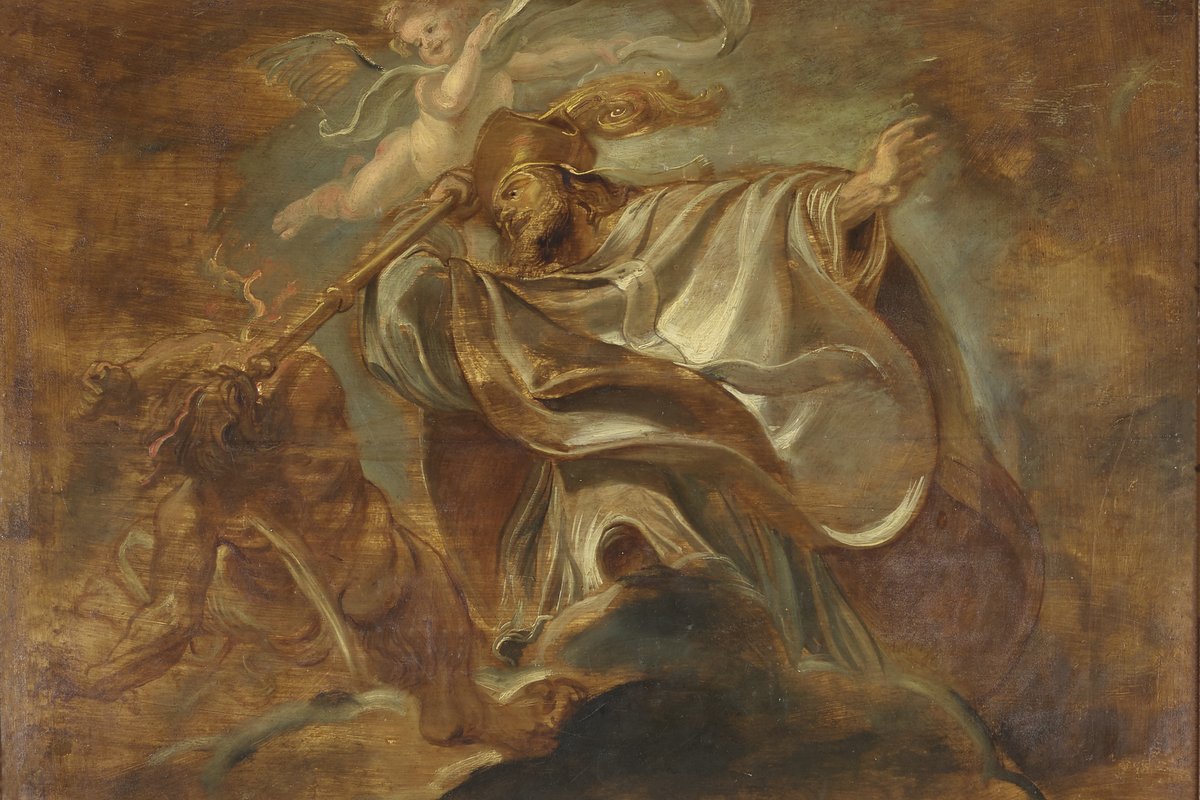
Peter Paul Rubens, Saint Gregory of Nazianzus (modello for the Jesuit church ceiling, Antwerp), 1621; now at Stiftung Friedenstein Gotha, Germany, following its 2024 restitution after decades at the Buffalo AKG Art Museum — public domain.
Gregory was born around 329 near Nazianzus in Cappadocia, a region of Asia Minor that produced an unusual concentration of major Christian thinkers in a single generation. As a young student in Athens, he formed a close, lasting friendship with a fellow Cappadocian named Basil, later known as Basil the Great. Together with Basil's younger brother, Gregory of Nyssa, the three are remembered today as the Cappadocian Fathers — a trio whose theological writing did more than almost anyone else's to clarify and defend the Church's teaching on the Trinity during a century of bitter doctrinal conflict.
Gregory's path to Constantinople wasn't a straightforward rise through Church ranks. His own father, also named Gregory and himself a bishop, had ordained him a priest somewhat against his will, and Gregory fled the responsibility for a time before eventually accepting it — a pattern of reluctance toward public office that would recur throughout his life, and that sits oddly alongside how forcefully he argued theology once he was actually in the pulpit. He also lived through the brief reign of the emperor Julian, later called "the Apostate" for abandoning Christianity and attempting to revive traditional Roman religion; Gregory wrote several sharply critical orations against Julian after his death, defending the faith Julian had tried to sideline.
A lone voice in a hostile capital
In 379, Gregory was called to Constantinople to lead a small Nicene Christian community at a moment when the city's major churches were controlled by bishops who followed Arianism, the teaching that Christ was a created being rather than fully divine. Gregory had no cathedral of his own; he preached instead from a private chapel he named the Anastasia, meaning "Resurrection." It was from that small room that he delivered his celebrated Theological Orations, a series of sermons laying out, with unusual clarity, the case for Christ's full divinity and his equal standing within the Trinity alongside the Father and the Holy Spirit. He briefly served as Patriarch of Constantinople during this period, presiding over a Church whose grandest buildings still belonged to his theological opponents, and he presided for a time over the First Council of Constantinople in 381, the gathering that expanded and reaffirmed the Nicene Creed still recited in churches today, before factional disputes among the assembled bishops over his own election led him to resign the position rather than let the argument over his status distract from the council's actual work.
The only title he shares with the Apostle John
The Council of Chalcedon in 451 gave Gregory a distinction that has rarely been repeated in Christian history: the title "the Theologian." In the Christian East, that specific honor has traditionally been reserved for only two figures — the Apostle John, author of the Fourth Gospel, and Gregory himself. It's a recognition of just how influential his Theological Orations became in shaping the vocabulary and reasoning the Church would use to describe the Trinity for centuries afterward, delivered as they were under genuinely difficult circumstances rather than from a position of comfort or institutional strength.
Doctor of the Church, remembered alongside Basil
Gregory resigned the see of Constantinople not long after arriving, worn down by the political infighting that came with the office, and spent his final years back in Cappadocia in relative retirement, continuing to write. Retirement didn't mean silence: he spent those years producing a large body of poetry, including an unusual autobiographical work in verse recounting his own life and struggles, a form few Church Fathers used as extensively as he did to reflect on faith, friendship, and disappointment. The Church later recognized him as a Doctor of the Church for the lasting theological weight of his writing. His feast day, January 2, is kept jointly with his old friend Basil the Great — a fitting pairing for two men whose friendship, formed as students, helped produce some of the clearest theological thinking the early Church ever put into words.
Trivia
Who was Saint Gregory of Nazianzus?
Why is Gregory of Nazianzus called 'the Theologian'?
What were the Theological Orations?
Who were the Cappadocian Fathers?
When is the feast day of Saint Gregory of Nazianzus?
You May Also Like
Related Reading