Saint Augustine of Hippo

A restless mind before it was a restless heart
Augustine was born in 354 in Thagaste, a small town in Roman North Africa, in what is now Algeria. He was clever, ambitious, and by his own later account, not remotely interested in the Christian faith of his mother — Monica, who spent decades in tears and prayer over a son who kept drifting further from everything she believed. He trained as a teacher of rhetoric, chased a career and a mistress and a following among the Manichaeans, a sect that offered him tidy answers to the problem of evil that Christianity, in his eyes, did not. None of it settled him. By his own account in the Confessions, he moved through Carthage, Rome, and finally Milan still hunting for whatever would make the noise in his own head stop.
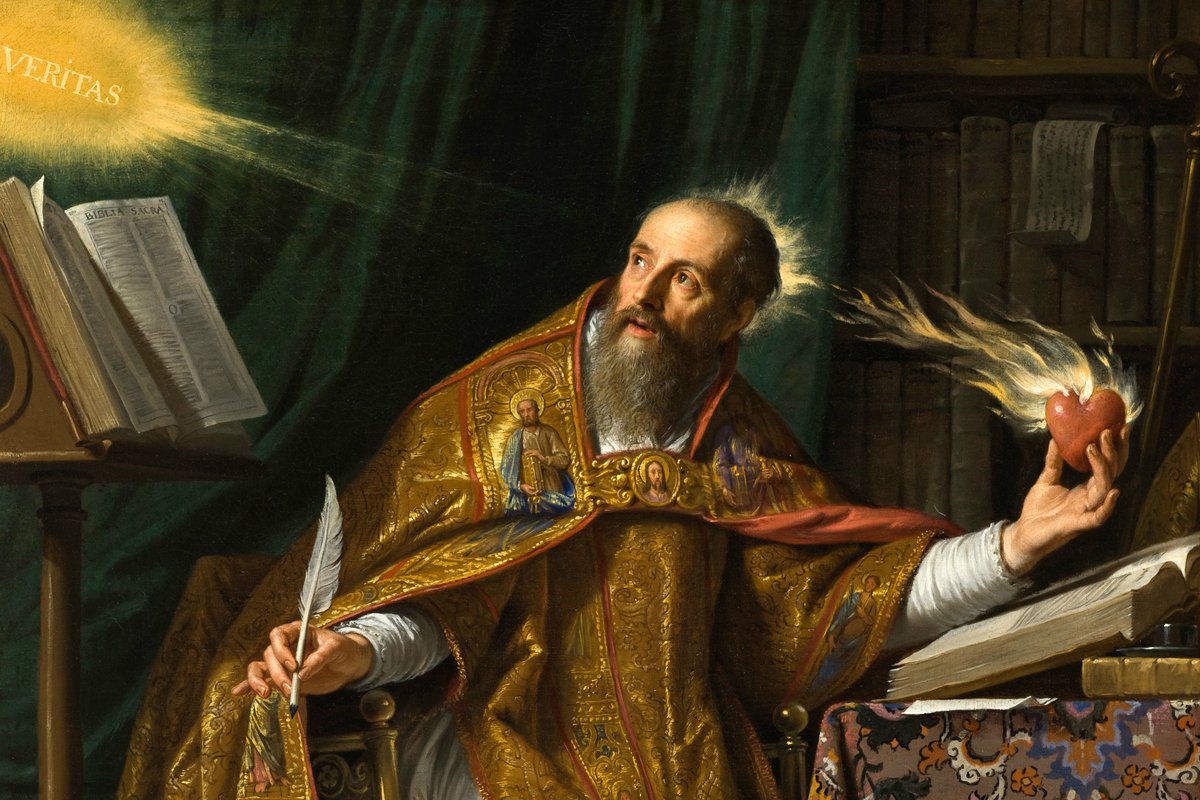
Philippe de Champaigne, "Saint Augustine," c. 1645–1650, Los Angeles County Museum of Art — public domain.
The bishop who kept him listening
In Milan, Augustine went to hear the city's bishop preach — not out of faith, but out of professional curiosity about his technique. What he found in Ambrose was a way of reading Scripture, allegorically rather than literally, that finally gave Augustine's trained mind something to hold onto. It took years more of inner argument before the garden scene of 386, when he heard the child's chant, opened Paul's letters at random, and read a passage about giving up "rioting and drunkenness" and "putting on the Lord Jesus Christ" that struck him as written for him specifically. Ambrose baptized him at the Easter Vigil in 387, alongside Augustine's own son, Adeodatus.
From convert to bishop of a city under siege
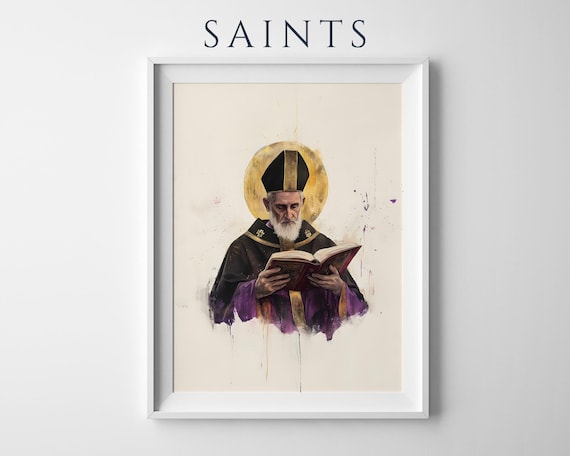
Augustine returned to North Africa, was ordained a priest almost against his will by an insistent congregation in Hippo Regius, and became its bishop around 395 or 396. He spent the rest of his life there, writing constantly and arguing just as constantly — against the Manichaeans he'd once followed, against Donatists who split the North African Church over how to treat clergy who'd wavered under persecution, and against Pelagius, a British monk whose teaching on human self-sufficiency in achieving salvation Augustine spent years methodically dismantling. That last dispute produced some of his deepest writing on grace, and it's why the Church later called him the "Doctor of Grace." He died in 430, inside Hippo, while Vandal armies laid siege to the city outside its walls.
A rule that outlived his diocese
Long before he became famous for his books, Augustine had already gathered a small community of laymen at his family home in Thagaste, living a shared, simple life devoted to prayer and study — the same instinct that later shaped how he organized the clergy living with him at Hippo once he became bishop there. The brief set of guidelines he wrote for that kind of shared life, now known as the Rule of Saint Augustine, turned out to be one of his most quietly influential works, adopted centuries later by religious communities as different as the Dominicans, the Augustinians, and various orders of canons regular. It says something about the range of Augustine's mind that the same man producing dense theological argument against Donatists and Pelagians also found time to write practical, day-to-day instructions on how a group of people should share meals, settle disagreements, and pray together — instructions still followed, in substance, by religious communities today.
Grace, free will, and a debate that still echoes
The dispute with Pelagius deserves a little more unpacking, since it shaped so much of Western Christian thinking about sin and salvation afterward. Pelagius taught, in essence, that human beings had it within their own natural power to choose good and avoid sin without needing God's grace to do so — a position that, to Augustine, badly underestimated how deeply sin had wounded human nature since the Fall. Augustine argued instead that grace wasn't a helpful bonus for people already capable of choosing well on their own, but the very thing that made any turn toward God possible in the first place. The Church ultimately condemned key elements of Pelagius's teaching at the Council of Carthage in 418 and later at the Council of Ephesus in 431, siding substantially with Augustine's account — though later theologians, both Catholic and Protestant, would spend centuries arguing over exactly how far Augustine's own strongest statements on grace and predestination should be pushed, a debate his writing helped start and never fully settled.
Two books that outlasted an empire
Augustine's Confessions, written around 397–400, remains startling for how personal it is — a bishop publicly narrating his own sins and doubts as a way of describing how grace works, centuries before autobiography was even a recognizable form of writing. Its most quoted line captures the whole book's argument in a single sentence: "You have made us for yourself, O Lord, and our heart is restless until it rests in you." His other major work, City of God, was a direct response to critics who blamed Christianity for Rome's fall to the Visigoths in 410, arguing that no earthly city, Rome included, was ever meant to be where human hope actually lived.
A Doctor of the Church, four times over in reputation
Pope Boniface VIII formally named Augustine a Doctor of the Church in 1298, grouping him with Ambrose, Jerome, and Gregory the Great as one of the four original Doctors of the Western Church — though popular veneration of Augustine as a saint had already been in place for centuries by then, well before formal canonization processes existed. His feast day, August 28, marks the anniversary of his death. He's remembered today as patron of theologians, of printers — a nod to how much he wrote — and, by tradition, of brewers, on the logic that a man so honest about his own dissolute youth understood exactly what he was asking people to give up.
Trivia
Who was Saint Augustine of Hippo?
What is the 'tolle lege' moment in Augustine's conversion?
Why is Augustine called the 'Doctor of Grace'?
What are Augustine's most famous works?
Why is Saint Augustine the patron saint of brewers?
Related Reading