Saint Gregory of Nyssa

The youngest voice in a family of saints
Gregory was born around 335 in Caesarea, the Cappadocian capital, into the same remarkable family that produced Basil the Great and their sister Macrina, both venerated as saints. Basil was the elder brother and, for much of Gregory's early life, something like a second father to him — it was Basil who ordained him a bishop, sending him in 372 to the small, unimportant see of Nyssa, partly so the family would have another reliable ally among Cappadocia's bishops during a period of intense doctrinal conflict over the nature of Christ. Gregory proved a less confident administrator than his brother, but a deeper and more original theological mind — a difference that became obvious only after Basil's death, when Gregory came fully into his own as a writer.
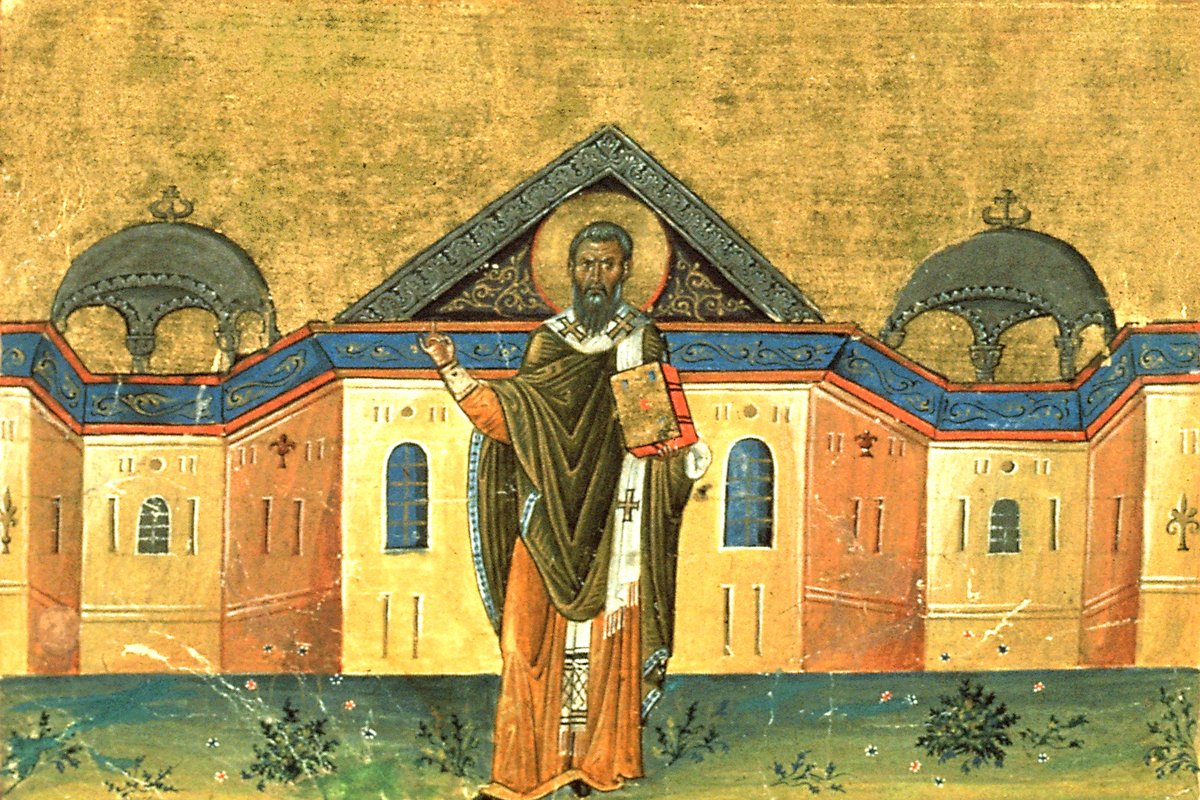
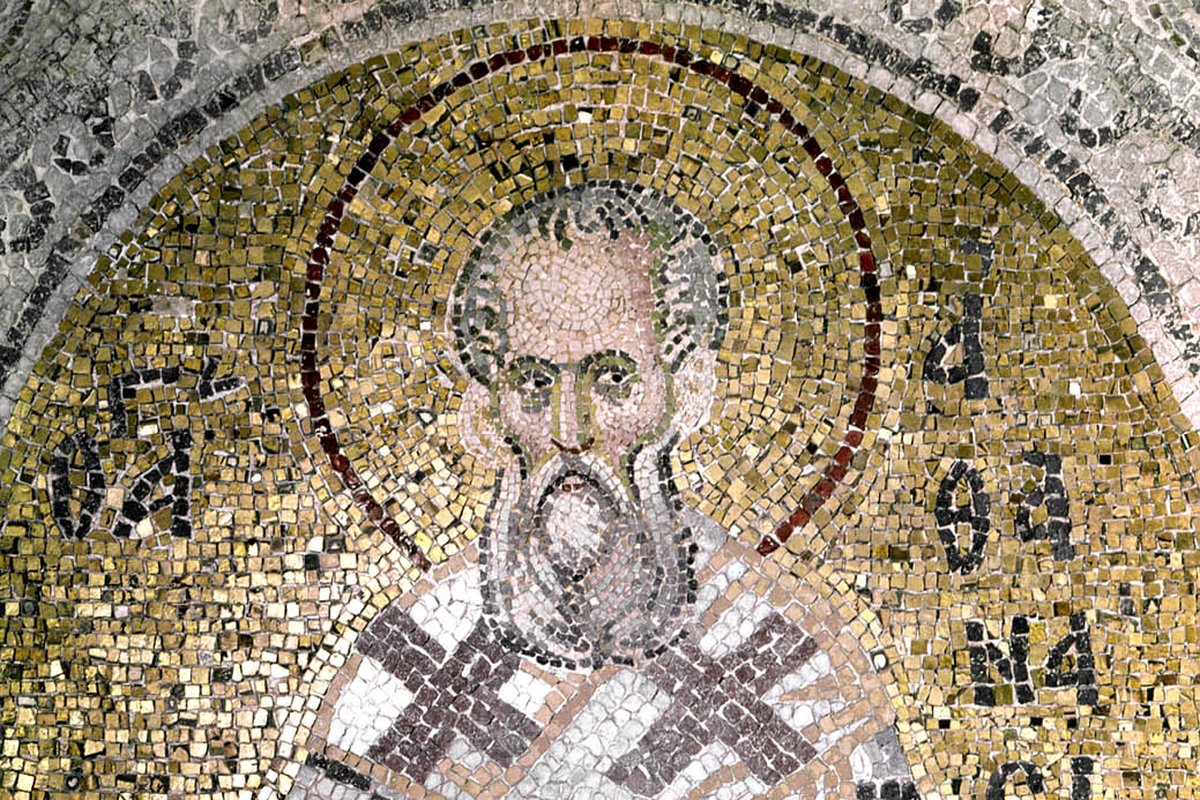
Gregory of Nyssa, miniature from the Menologion of Basil II, Constantinople, c. 985, Vatican Apostolic Library — public domain.
Three stages toward "luminous darkness"
Gregory's most enduring work, The Life of Moses, reads the biblical story of Moses — the burning bush, the ascent of Sinai, the plea to see God's glory — not primarily as history but as a map of the soul's own journey toward God. He describes that journey unfolding in three stages: purification, in which the soul is cleansed of sin and distraction; illumination, in which it begins to perceive God through signs and symbols, much as Moses first encountered him in the light of the burning bush; and finally what Gregory calls a "luminous darkness" — the point at which the mind, having exhausted every concept and image it can form of God, meets him instead in a kind of radiant unknowing, following Moses into the cloud that covered the summit of Sinai. It's a strikingly counterintuitive idea for a theologian to build a whole spirituality around: that the closer the soul draws to God, the less it is able to describe what it finds, and that this very darkness is itself a form of deeper light.
A theologian at the center of the Trinitarian debates
Gregory's mystical writing tends to overshadow the fact that he spent much of his career doing hard, technical doctrinal combat. The 4th century was consumed by the Arian controversy — the dispute, sparked by the priest Arius, over whether Christ the Son was truly equal to and eternal with God the Father, or a created being subordinate to him. The Council of Nicaea in 325 had already condemned Arius's position, but the argument was far from settled by the time Gregory became a bishop, and he threw himself into defending and refining the Nicene position, particularly on the harder question of how the Holy Spirit related to the Father and the Son. His treatise Against Eunomius, a lengthy rebuttal of a prominent Arian theologian, is considered one of the most rigorous pieces of technical theology to survive from the period, and Gregory played a significant behind-the-scenes role at the First Council of Constantinople in 381, which reaffirmed and expanded the Nicene Creed into essentially the form Christians still recite today.
That combination — a precise, combative doctrinal theologian on one hand, and the author of some of the most delicate mystical writing in the early Church on the other — is part of what makes Gregory unusual among the Church Fathers. He didn't treat careful reasoning about doctrine and the more poetic language of mystical experience as separate projects; for him, both were ways of approaching the same reality, one working through argument, the other through image and metaphor, each reaching, in its own way, the limits of what human language could capture about God.
Gregory on the resurrection and universal restoration
Beyond The Life of Moses, Gregory wrote extensively on the resurrection of the body and on what would become one of the more debated aspects of his legacy: a hope, expressed in several of his works, that God's mercy might ultimately extend to the restoration of all rational creatures, a position later theological tradition would call apokatastasis. This idea was treated cautiously by later theologians and was never adopted as settled Church teaching — the Catechism affirms the reality of eternal separation from God as a genuine possibility rather than guaranteeing universal salvation — and Gregory's writing on the subject is generally read today as a hopeful theological reflection rather than a dogmatic claim he intended as binding. It's a useful reminder of the broader rule that applies across the Church Fathers generally: even a deeply respected theologian's personal speculation is not the same thing as defined Catholic doctrine, and the two need to be kept distinct.
Father of Fathers, father of mysticism
Gregory died around 394 or 395, having outlived both his brother Basil and their old family friend Gregory of Nazianzus, the other two Cappadocian Fathers. His theological legacy took longer to be fully recognized than theirs: Rome has never formally declared him a Doctor of the Church, the title given to Basil, but the Second Council of Nicaea in 787 praised him informally as a "Father of Fathers" — high esteem, though not the same formal distinction. It's his mystical writing, above all The Life of Moses, that later generations of theologians came to prize most, and that earned him the title "Father of Mysticism," recognition for having shaped how Christian writers for centuries afterward would try to put into words an experience of God that, by Gregory's own account, ultimately resists being put into words at all. His feast is kept on March 9 in the Western calendar and January 10 in the East.
Trivia
Who was Saint Gregory of Nyssa?
What is 'The Life of Moses' about?
Why is Gregory of Nyssa called the 'Father of Mysticism'?
Was Gregory of Nyssa related to Basil the Great?
Is Gregory of Nyssa a Doctor of the Church?
You May Also Like
Related Reading