Saint John of the Cross

A poor start in Castile
Juan de Yepes y Álvarez was born in 1542 in Fontiveros, in Old Castile, the youngest son of silk weavers. His father had been disinherited for marrying beneath his station and died while Juan was still a small child, leaving the family in real poverty. He was schooled at an institution for poor children in Medina del Campo, tried and failed at a couple of trades, and worked at a hospital for the poor and plague-stricken while studying with the Jesuits. In 1563 he joined the Carmelite order, taking the name John of St. Matthias, and was ordained a priest in 1567 — the same year that a chance meeting would redirect the rest of his life.
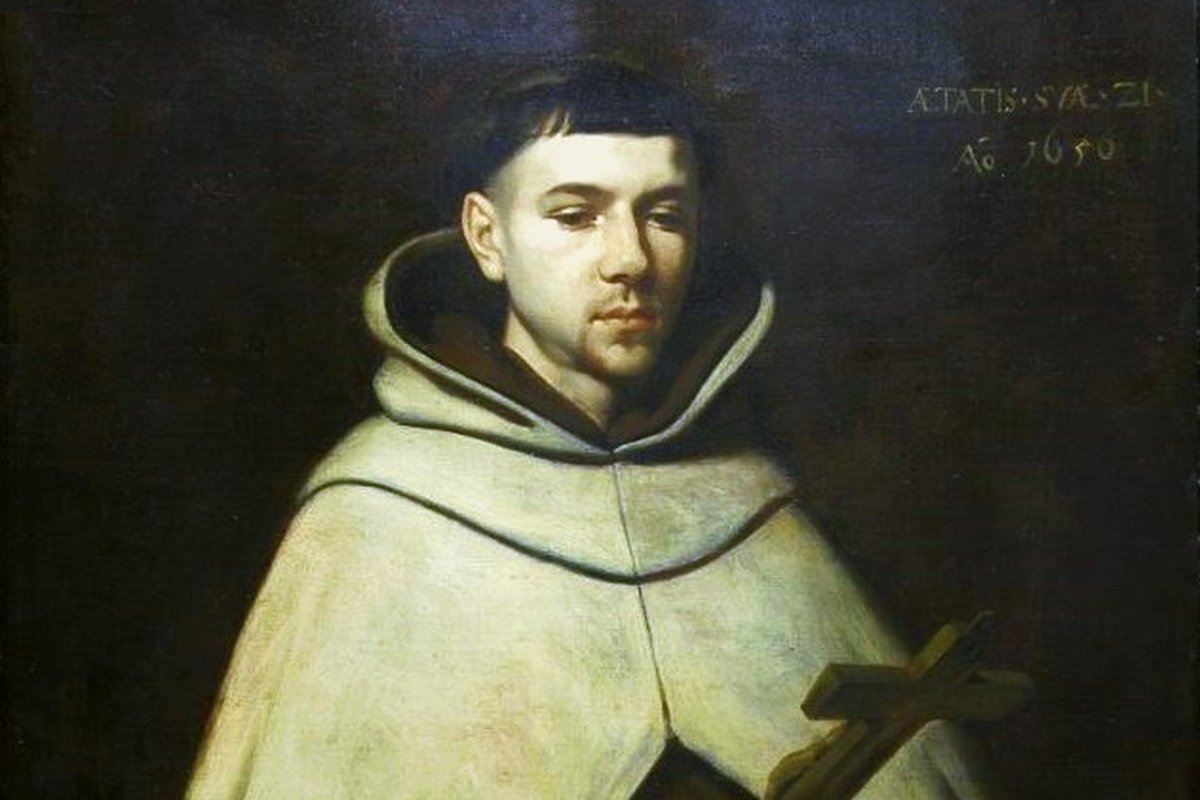
Attributed to Francisco de Zurbarán, Saint John of the Cross, 1656, Archdiocesan Museum, Katowice — public domain.
Meeting Teresa of Ávila
That meeting was with Teresa of Ávila, already deep into her own campaign to reform the Carmelite order back toward the poverty and contemplative silence of its origins. She persuaded the young priest to help her extend that reform to the friars, and on November 28, 1568, the first house of what became the Discalced Carmelites opened in a converted farmhouse at Duruelo, with John — now John of the Cross — serving as its first master of novices. It was a small, unglamorous beginning for a reform that would soon provoke serious resistance from the Carmelites who had no interest in being reformed.
Nine months in a Toledo cell
That resistance turned violent in December 1577, when Carmelites opposed to the reform had John abducted in Ávila and imprisoned at their monastery in Toledo. For roughly nine months he was held in a cell about six feet by ten, lit by a single small, high window, flogged before the assembled community once a week, and kept alive on bread, water, and scraps. He is thought to have composed much of his Spiritual Canticle, along with some shorter poems, during this captivity — carrying the words in memory, since he had no paper or ink. On the night of August 14–15, 1578, he worked his cell door's lock loose, slipped past a sleeping guard, and lowered himself from a window on a rope improvised from strips of torn blanket and his own tunic.
What "the dark night" actually means
John's later writings turned that experience of stripping-away into a structured account of the spiritual life. In Ascent of Mount Carmel, he lays out how a soul actively detaches from sensory and spiritual attachments; the line most often quoted from it captures the whole method in one breath: "In order to arrive at having pleasure in everything, desire to have pleasure in nothing. In order to arrive at possessing everything, desire to possess nothing." His companion work, Dark Night of the Soul, describes what happens next — not something the soul does, but something God does to it, withdrawing felt consolations so the soul can be purified at a level effort alone can't reach. That is what "the dark night" actually names in John's own theology: a passive, purifying darkness on the way toward union with God, not the general unhappiness the phrase gets stretched to cover in casual use today. His last two major works, The Spiritual Canticle and The Living Flame of Love, describe the far side of that darkness — the soul in search of, and then transformed by, union with God.
A saying that isn't quite his
A line often attributed to John of the Cross — "in the evening of life, we will be judged on love alone" — has become one of the most repeated quotations in Catholic spirituality. It doesn't appear in those exact words anywhere in his writing. What he did write, in the collection known as the Sayings of Light and Love, is blunter and less comforting: "When evening comes, you will be examined in love." The Catechism of the Catholic Church later draws on the same idea in its teaching on the particular judgment (§1022) — a reminder that the popular version and the authentic one carry the same weight, even though only one of them is actually his.
A five-foot friar who left a body of writing far bigger than he was
Contemporaries consistently described John as a small man, reportedly not much over five feet tall, and Teresa of Ávila herself is said to have joked that she'd finally found a friar small enough in body to match how large he was in spirit. That physical smallness sits at odds with the scale of what he produced: four major treatises — Ascent of Mount Carmel, Dark Night of the Soul, Spiritual Canticle, and Living Flame of Love — that together form one of the most systematic maps of the spiritual life in the Catholic tradition, built around a small handful of poems he composed first and then spent years explaining, stanza by stanza, in exhaustive prose commentary. That structure — poetry first, theology second, as an attempt to unpack in ordinary language what the verse had captured in a flash of image — is part of what makes his writing distinctive among the Doctors of the Church: he wasn't primarily a systematic theologian working outward from doctrine, but a poet-mystic working backward from experience, trying to explain in prose what he'd already said more truly in verse. It's a body of work that has shaped later Carmelite spirituality directly, including the writings of Saint Thérèse of Lisieux, who read him as a novice and drew on his teaching about spiritual poverty and total trust in God for her own "Little Way."
Recognized centuries later
John died at Úbeda on December 14, 1591, worn down by illness and, by some accounts, continued mistreatment from within his own order. He was canonized in 1726 by Pope Benedict XIII, and in 1926 Pope Pius XI declared him a Doctor of the Church under the title Doctor Mysticus — the Mystical Doctor — recognition of a body of writing that turned nine months in a locked room into a permanent fixture of Christian spiritual literature.
Trivia
Who was Saint John of the Cross?
Why was he imprisoned?
What does "dark night of the soul" actually mean in his writing?
Did Saint John of the Cross really say "we will be judged on love alone"?
When is his feast day, and why?
Related Reading