Saints Cyril and Methodius

Two brothers from a Greek port city
Cyril and Methodius were born in Thessalonica, a major Byzantine port city where Greek and Slavic populations lived side by side — Methodius around 815, Cyril (originally named Constantine) roughly a decade later, around 826 or 827. That mixed environment mattered enormously: growing up bilingual in Greek and the local Slavic dialect gave both brothers a working fluency that would define their entire life's work. Cyril, the younger and more scholarly of the two, studied in Constantinople and eventually taught philosophy there, while Methodius spent time administering a Slavic-populated province of the Byzantine Empire before entering monastic life. Neither brother started out as a missionary. Circumstance — and a request from far outside the empire — made them one.
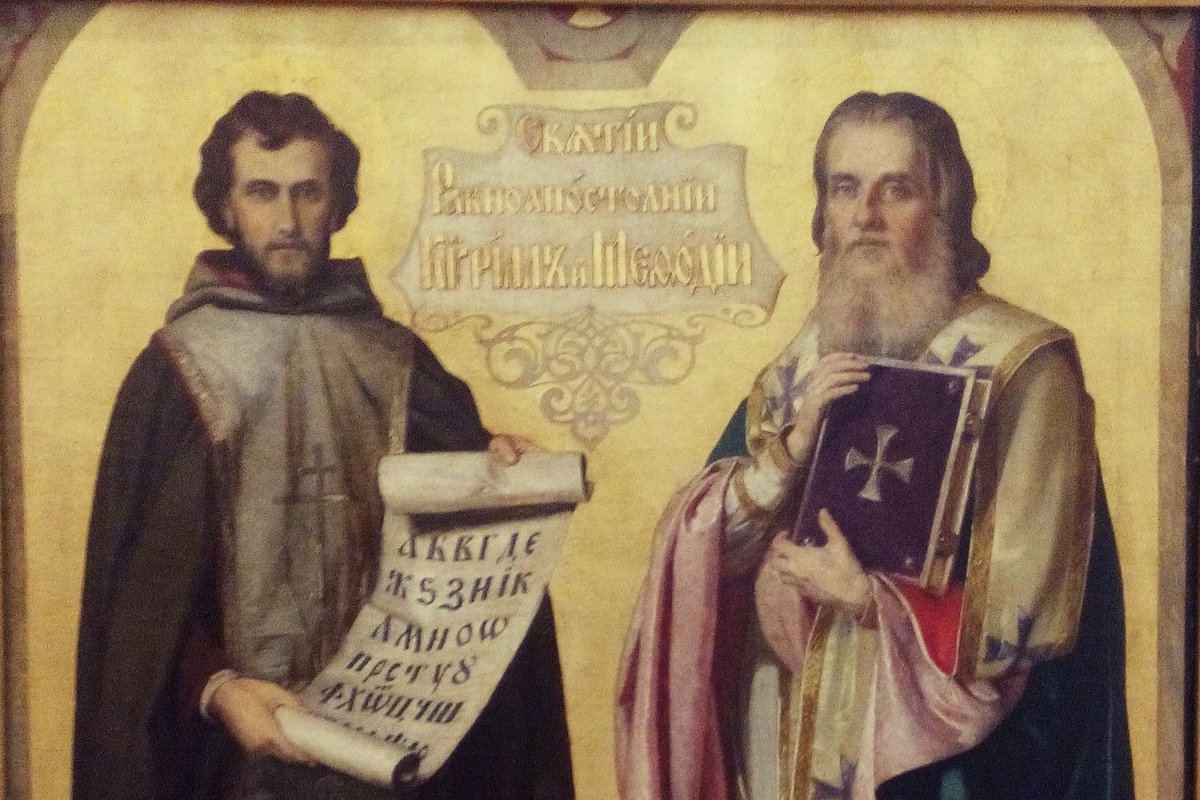
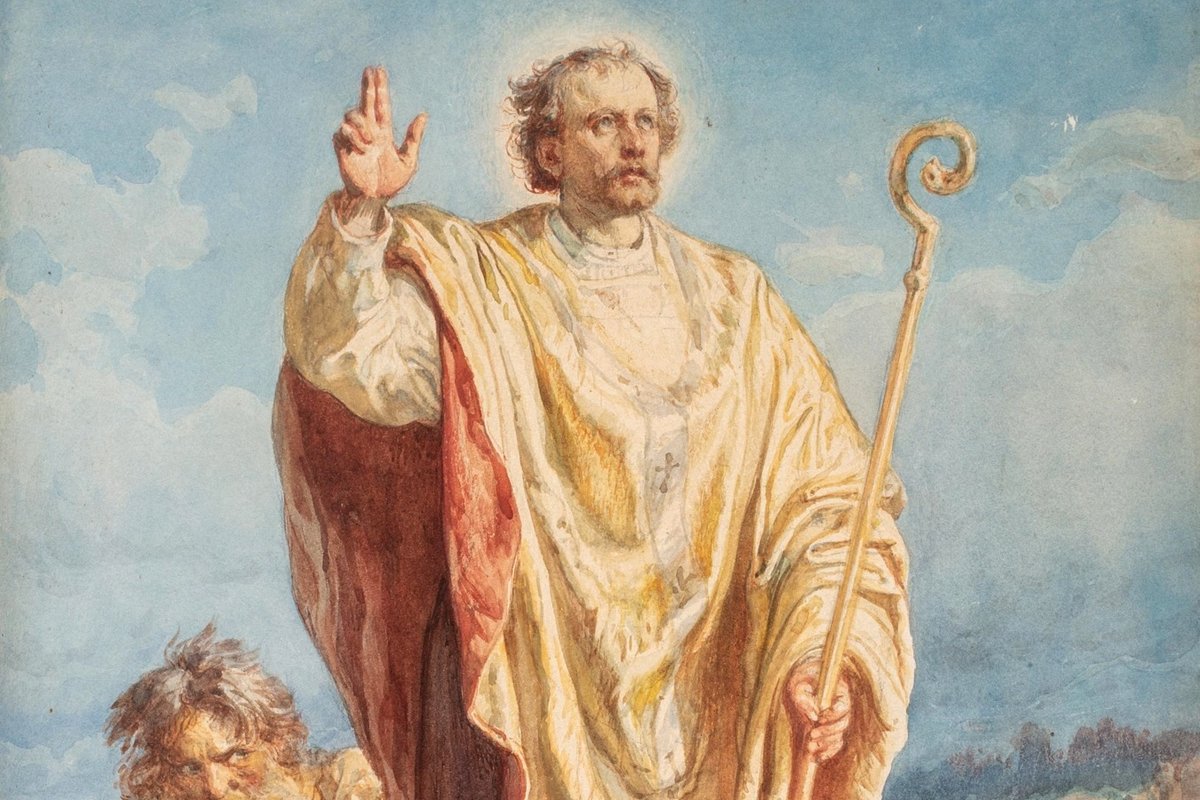
Uroš Predić, Saints Cyril and Methodius, 1912 — public domain.
Before Great Moravia ever entered the picture, Cyril had already built a reputation as a formidable scholar and diplomat. Constantinople sent him on a mission to the Khazars, a Turkic people north of the Black Sea, to debate Jewish and Muslim scholars over matters of faith — a task reserved for someone the Byzantine court trusted to represent Christianity credibly under pressure. Methodius, for his part, had already governed a Slavic-speaking Byzantine province before withdrawing to a monastery, giving him firsthand administrative experience with exactly the kind of people the Moravian mission would eventually require him to organize into a functioning church. Between them, they arrived at Great Moravia already carrying rare, complementary experience — one a linguist and debater, the other a governor and monk.
An alphabet built for a purpose
In 862, the ruler of Great Moravia — a Slavic realm covering parts of what's now the Czech Republic, Slovakia, and neighboring regions — asked Constantinople to send missionaries who could teach Christianity in the local Slavic language rather than Latin or Greek, languages his people didn't speak. Cyril and Methodius were the answer, and they approached the problem with unusual thoroughness: rather than trying to awkwardly transliterate Slavic sounds into an existing script, Cyril devised an entirely new alphabet, known today as Glagolitic, built specifically to capture the sounds of Old Church Slavonic. Using it, the brothers translated the Gospels, the Psalms, and the texts needed for the liturgy into a language the Moravians could actually understand — arguably the single most consequential act of translation in the early medieval Slavic world. Glagolitic itself would later give way to a related script named in Cyril's honor: Cyrillic, still the foundation of how Russian, Bulgarian, Serbian, Ukrainian, and other languages are written today.
Glagolitic's odd, looping letterforms — nothing like Greek or Latin script — reflect just how completely Cyril started from first principles rather than adapting an existing alphabet. Some scholars have noted resemblances between individual Glagolitic characters and Greek minuscule handwriting or even Hebrew and Coptic letters, but the overall system was a genuinely original invention, engineered sound by sound to match Old Church Slavonic's particular phonetics — including sounds that Greek and Latin script had no letters for at all. That precision is part of why the translation work built on top of it held up so well: the brothers weren't forcing Slavic speech into a foreign alphabet's limitations, they were building the alphabet around the speech itself.
A missionary defending vernacular worship in Rome
The brothers' work in Great Moravia didn't go unopposed. German-speaking clergy already active in the region, operating under the tradition that only Latin, Greek, or Hebrew were fit languages for the liturgy, pushed back hard against Slavonic-language worship. The dispute escalated enough that Cyril and Methodius traveled to Rome to make their case directly — a Byzantine monk defending vernacular liturgy inside the seat of the Western Church, a genuinely striking role reversal for the period. The gamble paid off: the papacy approved the Slavonic liturgical books, a decision that let the brothers' work in Moravia continue and set an early, significant precedent for worship in local languages rather than a single fixed liturgical tongue. Cyril died in Rome in 869, not long after this vindication; Methodius returned to Great Moravia as archbishop and continued the mission until his own death in 885, still defending the Slavonic liturgy against the same opposition until the end of his life.
Methodius's final years were harder than the Rome victory might suggest. After Cyril's death, the Frankish clergy who had opposed Slavonic worship all along didn't simply concede — Methodius was at one point imprisoned by Bavarian bishops for roughly two years, released only after papal intervention, and spent much of his remaining life defending the same ground he and his brother had already won once. It's a reminder that the papal approval secured in Rome didn't end the conflict so much as give Methodius the standing to keep fighting it, on the ground, for the rest of his life.
Patrons of a continent
The brothers' legacy reaches far beyond Great Moravia's medieval borders. Nearly every Slavic Christian tradition — Catholic and Orthodox alike — claims Cyril and Methodius as founding figures, and Eastern churches honor them with the title "Equal to the Apostles," a distinction reserved for a small number of especially significant missionary saints. In 1980, recognizing the sheer scale of what two brothers from Thessalonica had built for Slavic Europe, Pope John Paul II — himself Polish and keenly aware of the brothers' significance to his own region — declared Cyril and Methodius co-patrons of Europe alongside Saint Benedict of Nursia. Their joint feast falls on February 14 in the Roman Catholic calendar and May 11 in the Eastern calendar, two separate ways of marking the same extraordinary partnership: a scholar and an administrator, working as brothers, who gave an entire linguistic family its first alphabet and its first Bible.
Trivia
Who were Saints Cyril and Methodius?
What alphabet did Cyril and Methodius create?
Why did Cyril have to defend himself before the Pope?
What are Cyril and Methodius the patron saints of?
When is the feast of Cyril and Methodius?
Related Reading