The Angel at the Empty Tomb

Spices for a grave, not a miracle
Matthew places the scene "toward the dawn of the first day of the week," when "After the sabbath, as the first day of the week was dawning, Mary Magdalene and the other Mary came to see the tomb." (Matthew 28:1, RSV-CE). Nothing about their errand suggests they expect anything but a sealed grave — they are coming to mourn, not to witness a resurrection. Mark and Luke both add a detail Matthew leaves out: the women had bought spices to anoint the body properly, a burial custom that ordinary haste on the eve of the Sabbath had left unfinished. Anointing a body with oils and aromatic spices was standard Jewish burial practice at the time, meant both as an act of honor for the dead and as a practical measure against decay; nothing about bringing spices along suggests these women expected to find anything but a sealed grave and a task still waiting to be done. What they encounter instead upends the entire purpose of the visit before they've even reached the stone.
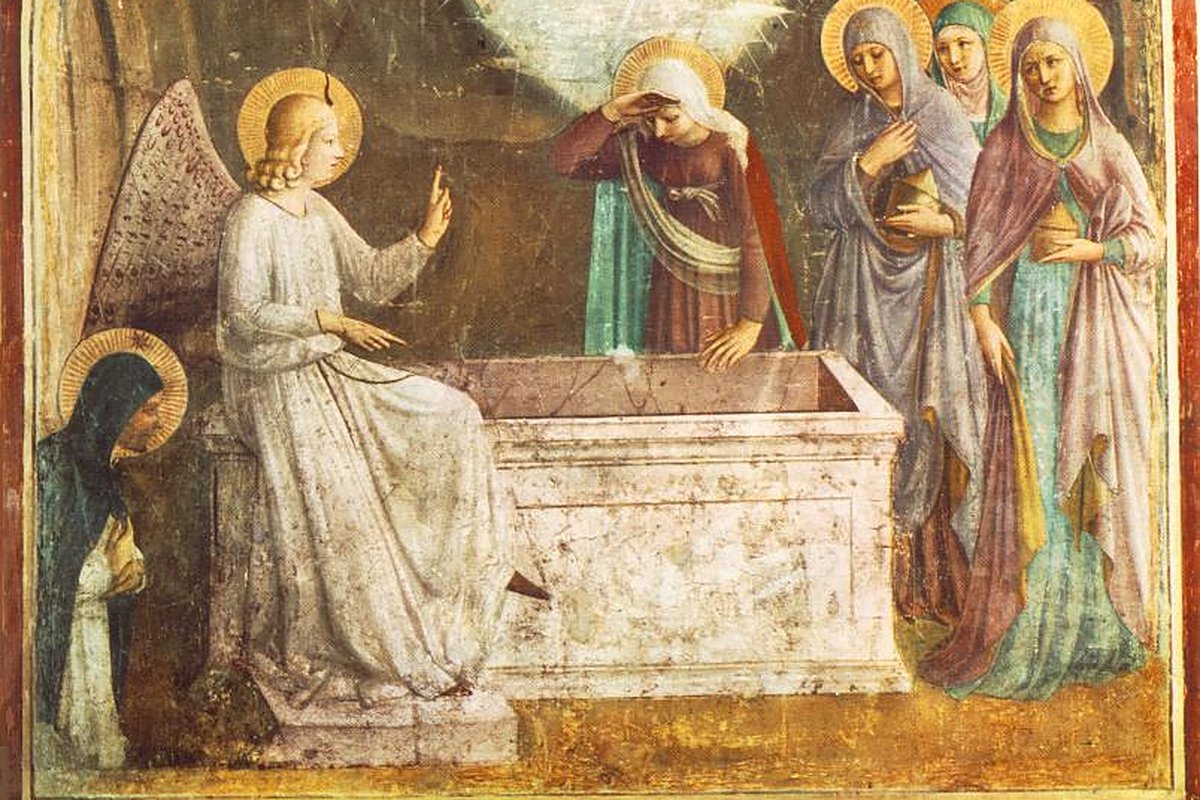
Fra Angelico, "Resurrection of Christ and the Women at the Tomb," 1439-1443, Convent of San Marco, Florence — public domain.
A worry that turns out to be pointless
Mark's Gospel adds a small, very human detail that Matthew doesn't include: on the way, the women are worrying aloud about a practical problem, asking each other "Who will roll back the stone for us from the entrance to the tomb?" (Mark 16:3, RSV-CE), since the sealing stones used for rock-cut tombs of the period were heavy enough to need several men to move. It's the kind of ordinary, logistical concern anyone planning a task might have, and it makes what they find next land even harder — the stone is already moved, and the problem they'd spent the walk fretting over turns out not to exist at all.
An angel like lightning, and guards struck down
Matthew describes the moment directly: "And behold, there was a great earthquake; for an angel of the Lord descended from heaven, approached, rolled back the stone, and sat upon it." (Matthew 28:2, RSV-CE). The description that follows is deliberately overwhelming: "His appearance was like lightning and his clothing was white as snow." (Matthew 28:3, RSV-CE) — and the effect on the Roman guards stationed there is immediate: "The guards were shaken with fear of him and became like dead men." (Matthew 28:4, RSV-CE). The women, by contrast, are met with reassurance rather than terror.
"He is not here; he has risen"
The angel speaks directly to the women: "Then the angel said to the women in reply, “Do not be afraid! I know that you are seeking Jesus the crucified. He is not here, for he has been raised just as he said. Come and see the place where he lay." (Matthew 28:5-6, RSV-CE). Then comes the commission: "Then go quickly and tell his disciples, ‘He has been raised from the dead, and he is going before you to Galilee; there you will see him.’ Behold, I have told you." (Matthew 28:7, RSV-CE). The women are the first people entrusted with the resurrection news — asked not merely to witness it, but to go announce it to others.
Four Gospels, four descriptions — and that's worth saying plainly
Here's a detail a careful retelling shouldn't smooth over: the four Gospels do not describe this scene identically, and pretending otherwise does a disservice to the text. Matthew describes a single angel, "like lightning," who rolls back the stone and sits on it outside the tomb. Mark describes the women entering the tomb itself and seeing "On entering the tomb they saw a young man sitting on the right side, clothed in a white robe, and they were utterly amazed." (Mark 16:5, RSV-CE) — the text doesn't explicitly call him an angel, though Christian tradition has long read him as one. Luke describes "two men... in dazzling apparel" standing beside the women (Luke 24:4, RSV-CE). John, in his account of Mary Magdalene's visit, describes her looking into the tomb and seeing "and saw two angels in white sitting there, one at the head and one at the feet where the body of Jesus had been." (John 20:12, RSV-CE).
That's a real spread — one figure or two, inside the tomb or outside it, explicitly called an angel or simply described in dazzling terms. Biblical scholarship has long noted these differences openly; they don't touch the substance every account agrees on, which is that the tomb was found open and empty, and that Christ had risen. But a text that quietly merged all four Gospels into a single harmonized angel-and-tomb scene would be smoothing over something the Gospels themselves simply don't agree on in the details, and an honest telling shouldn't do that.
The women who carried the news
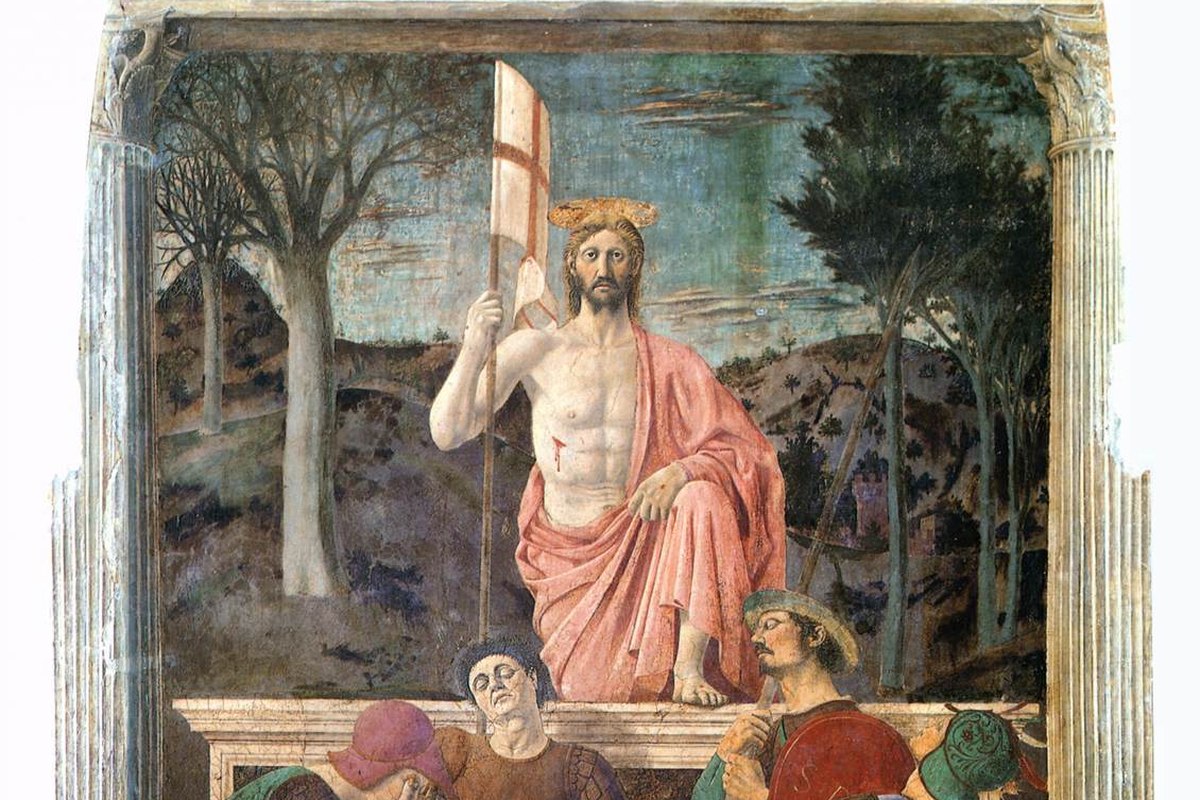
Eastern Christian tradition has a name for the women who went to the tomb that morning: the Myrrh-Bearers, after the myrrh and spices they carried. Eastern churches keep a Sunday of the Myrrh-Bearing Women a few weeks into the Easter season specifically to honor them, and Byzantine icons of the scene follow a recognizable pattern of their own — the women approaching from one side with covered jars in hand, an angel seated on the displaced stone, and Roman soldiers sprawled beneath it, echoing Matthew's detail that the guards "became like dead men." Western art, including the fresco pictured with this article, tends to soften that last detail or leave the guards out entirely and focus instead on the angel's gesture toward the open tomb, but the core visual grammar — stone rolled away, angel seated or standing beside it, women arriving with their jars — is shared across both traditions and has remained remarkably stable for well over a thousand years.
What all four accounts share
Despite the differences in how many figures appear and how they're described, every Gospel account agrees on the essentials: the stone had been moved, the tomb was empty, and the message delivered — whether by one figure or two — was the same proclamation of the resurrection. That core agreement, running underneath four otherwise distinct retellings, is arguably more striking than if all four had matched exactly. It suggests four separate traditions converging on the same central claim rather than one account copied uniformly into four versions.
Trivia
What does the angel say to the women at the tomb?
What did the angel at the tomb look like, according to Matthew's Gospel?
Do all four Gospels describe the same angel scene at the tomb?
Why do the Gospel accounts of the tomb differ?
What was the earthquake mentioned at the tomb?
Related Reading