The Angel Appearing to the Shepherds

A night shift, not a pilgrimage
Luke sets the scene with almost no ceremony: "Now there were shepherds in that region living in the fields and keeping the night watch over their flock." (Luke 2:8, RSV-CE). They aren't traveling toward anything, aren't expecting anything, aren't even awake for a religious purpose — they're working, doing the ordinary, faintly tedious job of making sure the flock survives until dawn. Whatever happens next happens to men in the middle of an unremarkable night, not in the middle of a search.
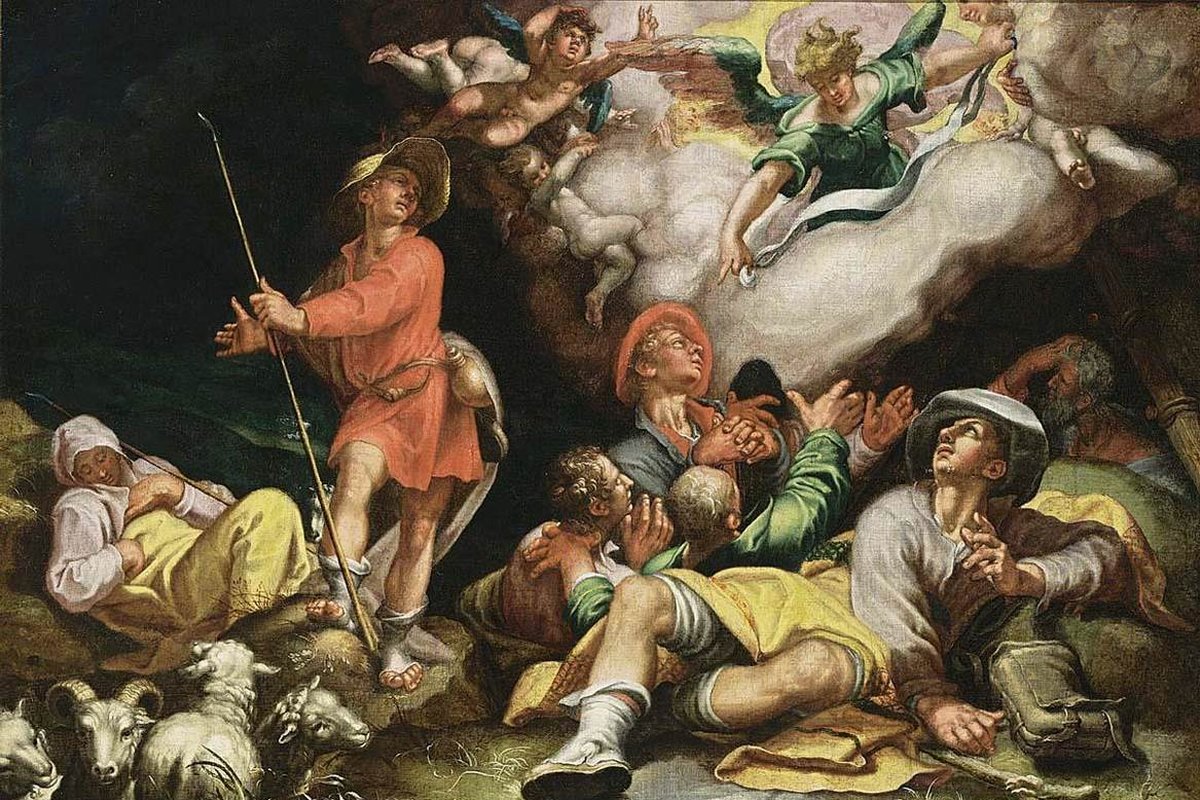
Abraham Bloemaert, "The Annunciation to the Shepherds," c. 1600 — public domain.
Glory breaking into the dark
What breaks in on them is described in almost physical terms: "The angel of the Lord appeared to them and the glory of the Lord shone around them, and they were struck with great fear." (Luke 2:9, RSV-CE). Luke doesn't dwell on what the angel looked like — no wings described, no elaborate vision — the emphasis falls entirely on the light and the fear it causes. Before a single word is spoken, the scene has already overwhelmed the men experiencing it.
"Good news of great joy for all the people"
The angel's first words are reassurance, then the announcement itself: "Do not be afraid; for behold, I proclaim to you good news of great joy that will be for all the people. For today in the city of David a savior has been born for you who is Messiah and Lord" (Luke 2:10-11, NABRE). Three titles arrive stacked on top of one another in a single sentence — savior, Messiah, Lord — a density of claim that nothing earlier in the story has prepared the shepherds for. The angel then gives them something concrete to go find: "this will be a sign for you: you will find an infant wrapped in swaddling clothes and lying in a manger" (Luke 2:12, NABRE), deliberately unglamorous directions for locating the newborn king.
A multitude joins the announcement
The scene doesn't end with one angel speaking. "And suddenly there was a multitude of the heavenly host with the angel, praising God and saying:" (Luke 2:13, RSV-CE), and together they say: "Glory to God in the highest and on earth peace to those on whom his favor rests." (Luke 2:14, RSV-CE). That single line has outlived nearly everything else about the scene, sung and spoken in churches for centuries under its Latin opening, Gloria in excelsis Deo. Then, as suddenly as they came, "the angels went away from them to heaven" (Luke 2:15, NABRE), and the shepherds are alone again in the dark, deciding to go and see for themselves.
Not Gabriel — and not the same scene as the Annunciation to Mary
It's worth being precise about a detail popular memory often blurs together. Luke never names the angel who speaks to the shepherds; the text calls him only "the angel of the Lord" (Luke 2:9, NABRE). The archangel Gabriel is named specifically in an earlier, separate scene — his appearance to Mary months before, announcing that she would conceive (Luke 1:26). These are two distinct angelic-announcement scenes serving two distinct people, and while Christian tradition has occasionally assumed the same angel delivered both messages, Luke's Gospel simply doesn't say that. It's a small distinction, but a real one.
Why shepherds, of all people
Scripture never explains outright why shepherds were the first to hear the news, but the choice has never stopped feeling pointed. Shepherding in first-century Judea was hard, low-status, unglamorous labor — not the audience anyone would expect for the most consequential birth announcement in the Gospels. Some biblical scholars have also noted that the area immediately around Bethlehem was known for pasturing sheep destined for Temple sacrifice, which would make it plausible, though Luke doesn't say this outright, that these particular shepherds were tending flocks meant for the altar in Jerusalem — a detail that later Christian writers found hard to resist reading as its own quiet foreshadowing, since the child they were sent to find would himself be called the Lamb of God. Christian reflection on the scene has returned to that detail again and again: before kings, before priests, before anyone with standing to lose or protect, the news reached men whose job was simply to stay outside all night and keep animals alive until morning.
From the hillside to the manger
The shepherds don't just marvel and go back to work. Luke reports that after the angels leave, they say to each other, "Let us go, then, to Bethlehem to see this thing that has taken place, which the Lord has made known to us." (Luke 2:15, RSV-CE), and they go "with haste" (Luke 2:16, RSV-CE) — the same word Luke uses earlier to describe Mary's own hurried journey to visit Elizabeth, as if the whole Gospel is full of people breaking into a run once they understand what's happening. When they find Mary, Joseph, and the child, they don't stay quiet about it: "When they saw this, they made known the message that had been told them about this child." (Luke 2:17, RSV-CE), making the shepherds the first missionaries of the Nativity, spreading news they'd only just received themselves before returning, Luke says, "glorifying and praising God" (Luke 2:20, RSV-CE).
A fixture of Nativity art
The shepherds and their angel have been part of Nativity imagery for as long as Christian art has depicted the birth of Christ at all, appearing alongside the manger scene in catacomb paintings, medieval altarpieces, and the elaborate Baroque canvas pictured with this article. Painters have typically split the episode into two linked moments within a single scene or a matched pair of panels: the annunciation on the hillside, all light and startled figures looking upward, and the quieter arrival at the stable afterward, where the same men kneel beside the Magi who arrive later in the story. That pairing has done real theological work over the centuries, visually uniting two very different groups — poor local laborers and foreign, wealthy travelers — as equally welcome witnesses to the same birth.
Trivia
What exactly does the angel say to the shepherds in the Bible?
Was the angel who appeared to the shepherds named Gabriel?
How many angels appeared to the shepherds?
Why were shepherds chosen to receive this news first?
What do the angels say together after the announcement?
Related Reading