The Risen Christ

An announcement before any explanation
The women who arrive at the tomb on the third day come prepared to find a body, not an empty space. Instead, an angel meets them there first, addressing their fear and their assumption in the same breath: "Then the angel said to the women in reply, “Do not be afraid! I know that you are seeking Jesus the crucified. He is not here, for he has been raised just as he said. Come and see the place where he lay." (Matthew 28:5-6, RSV-CE). Notice what the angel doesn't do: he doesn't simply assert the claim and move on. He invites direct verification — come and see for yourselves.
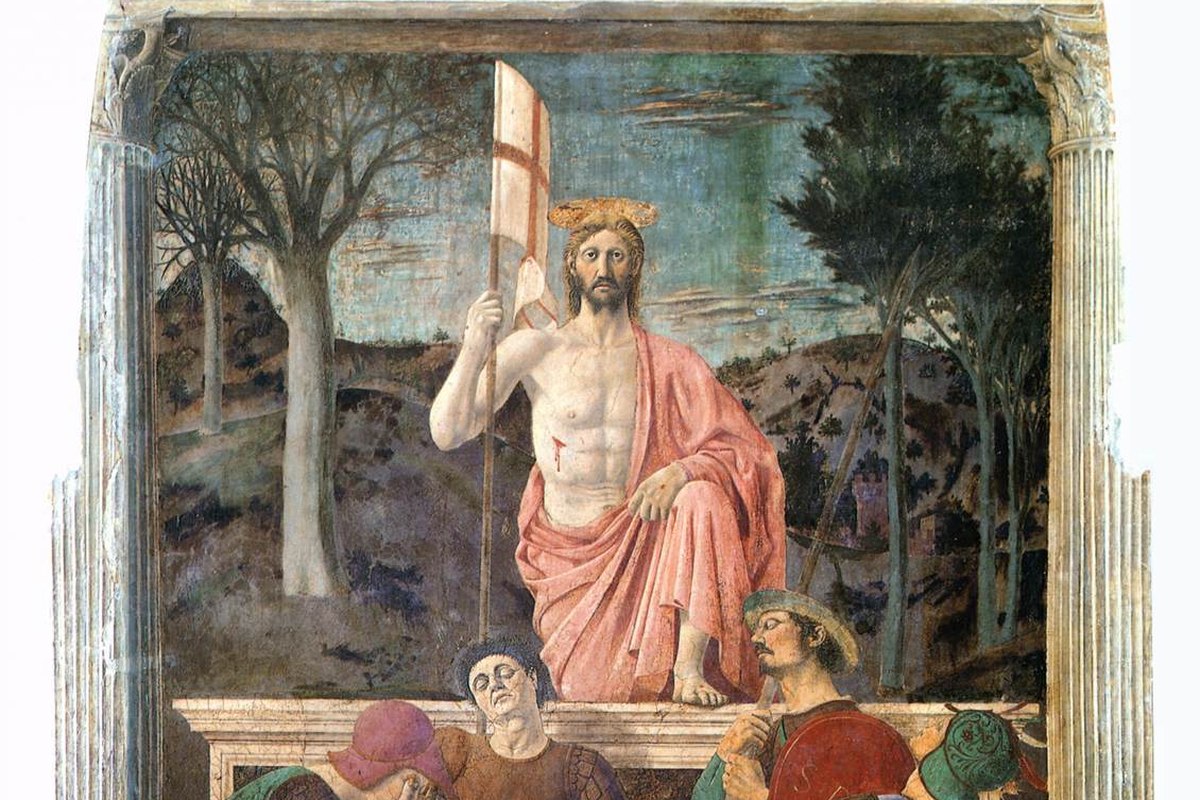
Piero della Francesca, "The Resurrection," c. 1463-1465 — public domain.
Confirmation within minutes, not days
The women don't have to wait long to test that invitation against something more than an empty room. Leaving the tomb, "And behold, Jesus met them on their way and greeted them. They approached, embraced his feet, and did him homage." (Matthew 28:9, RSV-CE). It's a strikingly quick confirmation — no extended gap between the angel's announcement and its verification, no lingering doubt built into the narrative's own pacing.
Two different kinds of evidence, working together
Scholars examining the resurrection accounts generally treat the empty tomb and the reported appearances as two related but distinct threads. The empty tomb establishes that something happened to the body; the appearances — independently attested across Matthew, Mark, Luke, John, and Paul's own writings — attempt to explain what that something was. Neither piece stands entirely alone in the Gospel accounts; they're presented as reinforcing each other, an empty space paired with a person who was subsequently, repeatedly seen.
A witness list too wide to easily dismiss
What stands out about the appearances specifically is their range: Mary Magdalene and the other women at the tomb, Peter individually, the assembled apostles as a group, a gathering reported at five hundred people, and James. That's a notably broad and varied set of reported encounters, spanning different times, places, and group sizes, recorded across independent sources rather than concentrated in a single account — which is precisely why the resurrection has remained, for two thousand years, the claim the rest of Christian belief has been built to stand or fall on.
A counter-story invented the same day
Matthew's Gospel is unusual among the four in also recording the alternative explanation that was circulating almost immediately: some of the guards posted at the tomb went to the chief priests and reported what had happened, and the priests, after consulting with the elders, paid the soldiers a substantial bribe to say instead that the disciples had come by night and stolen the body while they slept (Matthew 28:11-15). Matthew adds, pointedly, that this account "has circulated ... to the present day" — meaning the rival story was still being told at the time he was writing his Gospel, decades later. Its inclusion is telling: the Gospel writer isn't hiding the fact that an alternative explanation existed early on: he's naming it directly, in order to rebut it.
Doubt inside the Great Commission itself
Matthew's account ends with the eleven remaining disciples meeting the risen Jesus on a mountain in Galilee, where he commissions them to make disciples of all nations. What's easy to miss is a small, honest detail tucked into that climactic scene: "When they saw him, they worshiped, but they doubted." (Matthew 28:17, RSV-CE). Even among the inner circle, standing in front of the risen Christ himself, the Gospel doesn't claim universal, uncomplicated certainty. That admission of lingering doubt, preserved rather than edited out, is one of several details scholars point to as working against the idea that the resurrection accounts were simply invented to look persuasive.
Four Gospels, four different emphases
It's worth being honest about how the four Gospel accounts differ from one another, since harmonizing them too smoothly can obscure something important about how the tradition was transmitted. Mark's earliest manuscripts end abruptly at the empty tomb with the women fleeing in fear, before any resurrection appearance is narrated. Luke adds the walk to Emmaus and a more extended set of appearances in and around Jerusalem. John includes the intimate scene of Thomas being invited to touch Jesus's wounds. These aren't contradictions so much as four separate communities preserving different strands of a shared oral tradition, each emphasizing what mattered most to its own audience — which is itself a mark of authentic, independent transmission rather than a single coordinated narrative.
How the Resurrection has been painted
Resurrection scenes in Christian art follow a fairly consistent visual grammar: Christ stepping out of, or already standing above, an open tomb, usually holding a red-and-white banner (a symbol of victory over death borrowed from military triumph imagery), with Roman soldiers shown asleep or recoiling at his feet. Piero della Francesca's fresco used as this article's hero image is one of the most celebrated versions of this formula — Christ's direct, almost confrontational gaze out at the viewer was, art historians have noted, unusually bold for its time. Earlier Byzantine tradition favored a related but different image, the Anastasis, showing Christ pulling Adam and Eve bodily out of their tombs — a reminder that "resurrection" in the earliest Christian imagination was tied as much to the redemption of all humanity as to the single historical event at Jesus's own tomb.
From a Jewish feast to the center of the Christian year
The dating of Easter itself became one of the early Church's longest- running disputes: the Quartodeciman controversy of the second and third centuries pitted churches that fixed the celebration to the Jewish Passover date against those that insisted it always fall on a Sunday, in honor of the day of the week the resurrection itself was reported. The Council of Nicaea in 325 settled on the Sunday principle still used today, tying Easter's date each year to the first Sunday after the first full moon following the spring equinox — which is why the feast still moves within a roughly month-wide window rather than falling on a fixed calendar date, unlike Christmas.
Trivia
What did the women find when they reached the tomb?
Did Jesus appear to anyone that same day?
Is the empty tomb alone considered proof of the resurrection?
Who reported seeing the risen Jesus?
Related Reading