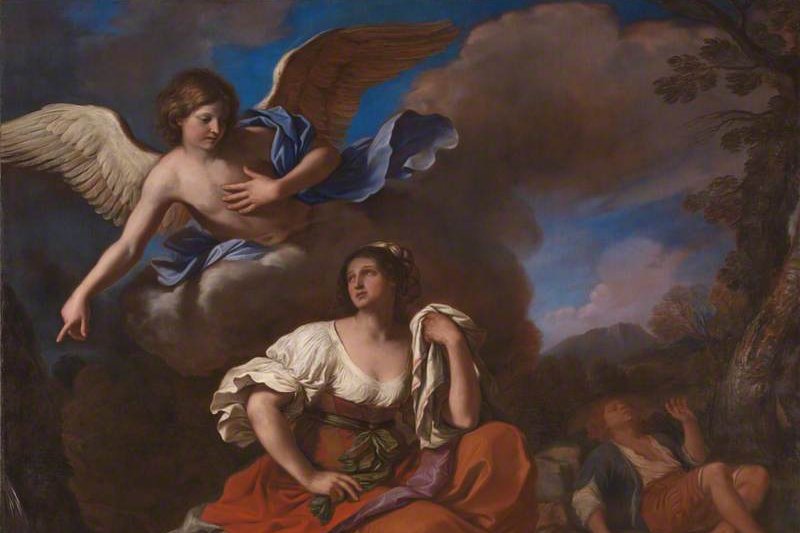
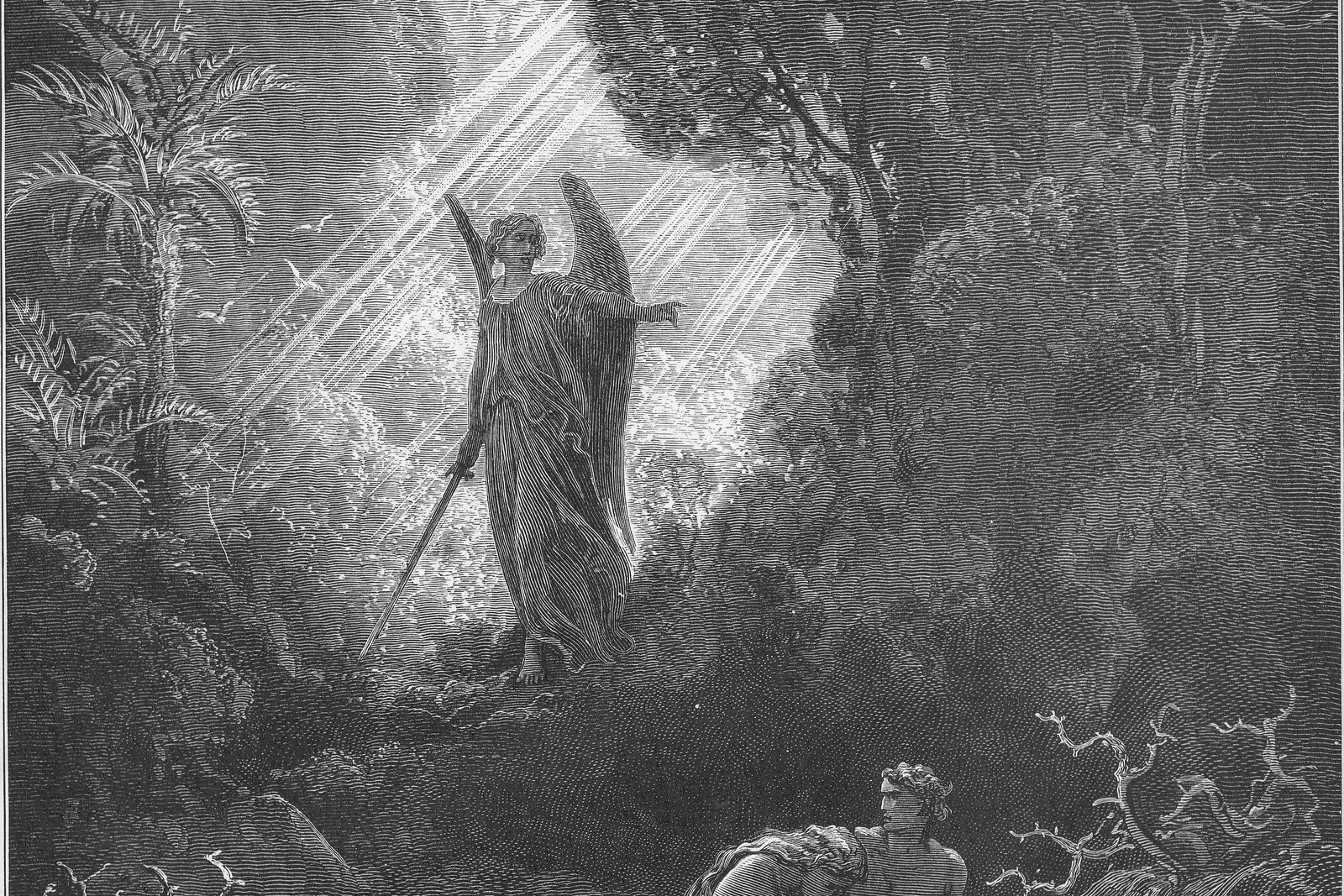
The Angel Strengthening Elijah

From triumph to despair in a single day
The chapter before this one is Elijah at his most triumphant: a public contest against four hundred and fifty prophets of Baal on Mount Carmel, decisively won, followed by the execution of the losing prophets. It's the high point of his career. Then Queen Jezebel, enraged at the deaths of her prophets, sends Elijah a message: "So may the gods do to me and more also, if I do not make your life as the life of one of them by this time tomorrow" (1 Kings 19:2, RSV-CE). The text gives no transition, no gradual decline — Elijah simply becomes "afraid, and... arose and went for his life" (1 Kings 19:3, RSV-CE), from the height of victory to open flight within a single scene.
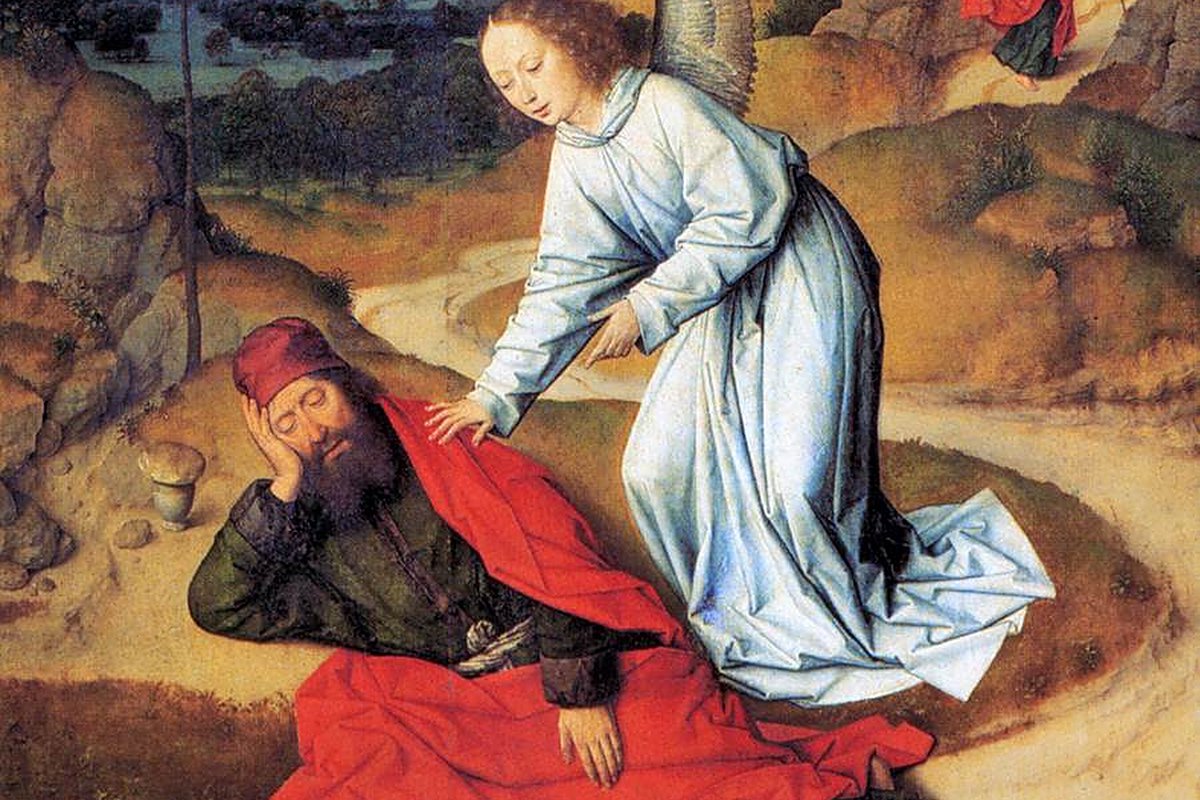
Dieric Bouts, "The Prophet Elijah in the Desert," 1464-1468, Sint-Pieterskerk, Leuven — public domain.
"Take my life"
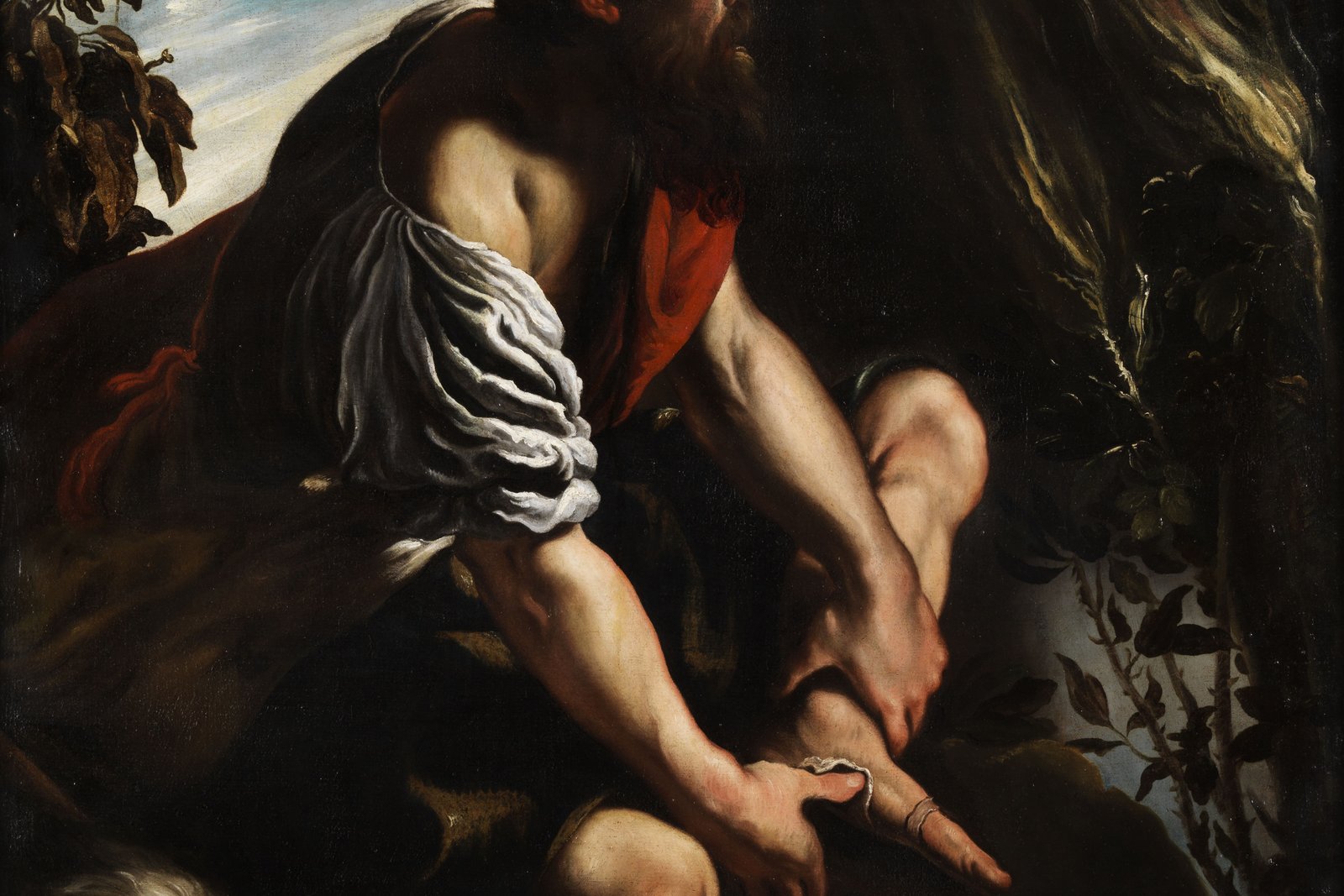
He leaves his servant in Beersheba and walks a full day alone into the wilderness, where he sits down under a broom tree and prays — not for protection, not for victory over Jezebel, but for his own death: "It is enough; now, O Lord, take away my life; for I am no better than my fathers" (1 Kings 19:4, RSV-CE). There's no self-pity dressed up as anything else here; it's the plain, exhausted request of a man who has nothing left. He lies down under the tree and falls asleep.
Fed, not lectured
What happens next is strikingly undramatic. "Behold, an angel touched him, and said to him, 'Arise and eat'" (1 Kings 19:5, RSV-CE). Elijah looks around and finds, at his head, "a cake baked on hot stones and a jar of water" (1 Kings 19:6, RSV-CE) — no explanation, no rebuke for wanting to die, no argument about his despair. He eats, drinks, and lies back down. The angel doesn't try to talk him out of anything.
The second visit, and the reason given
The angel returns a second time with the same instruction — "Arise and eat" — but this time adds why: "else the journey will be too great for you" (1 Kings 19:7, RSV-CE). Only on this second occasion does the angel acknowledge that more is coming, that Elijah will need strength for what lies ahead rather than simply for survival where he is. "He arose, and ate and drank, and went in the strength of that food forty days and forty nights to Horeb the mount of God" (1 Kings 19:8, RSV-CE) — a journey that would have been impossible for the man who collapsed under the broom tree a page earlier.
Care aimed at exhaustion, not danger
What sets this scene apart from other angelic interventions in Scripture is what the angel is actually responding to. Elijah isn't under attack in the wilderness — Jezebel's soldiers never appear, no immediate physical threat closes in. The danger here is entirely internal: burnout, grief, and a sincere wish to die after doing everything asked of him. The angel's response is correspondingly ordinary and physical — food, water, rest, repeated as many times as needed — rather than a dramatic rescue or a vision. It's one of the Bible's most direct pictures of care extended to someone in emotional collapse, met not with argument but with something to eat.
The same mountain where Moses stood
Elijah's forty-day walk ends at Horeb, and Scripture's writers clearly want readers to notice that this is the same mountain — also called Sinai in other passages — where Moses received the Law centuries earlier. Elijah even takes shelter in "a cave" (1 Kings 19:9, RSV-CE), echoing the cleft of rock where Moses had once stood while God's glory passed by (Exodus 33:22). The parallel isn't accidental: both men fast for forty days, both encounter God at the same holy place, and both are commissioned afterward for further work rather than allowed to simply retire from it. Later Jewish and Christian readers took Elijah as the representative prophet in the way Moses represented the Law — which is part of why, centuries later, both men appear together at the Transfiguration of Jesus, standing on either side of Christ in glory (Matthew 17:3), a scene explored in The Transfiguration on Mount Tabor.
A prophet running from his own success
Part of what makes Elijah's collapse so striking is the contrast with everything just before it. This was a man who had called down fire from heaven in front of the entire nation, who had just out-prayed and outlasted hundreds of rival prophets. Ancient readers would have expected a triumphant prophet to press his advantage, not flee a single queen's threat. The text offers no tidy explanation for the reversal — it simply presents a spiritual giant behaving like an exhausted human being, which is likely why the episode has remained one of the most quoted "burnout" narratives in the Old Testament, cited across centuries of Jewish and Christian spiritual writing as proof that even the most faithful can hit a wall.
Elijah in later tradition and art
Elijah's fiery, uncompromising reputation made him a favorite subject for painters and sculptors long after the biblical period, but this particular scene — the angel feeding a collapsed prophet under a solitary tree — became its own popular subject precisely because of its tenderness rather than its drama. Flemish and Italian painters of the fifteenth and sixteenth centuries, including Dieric Bouts in the panel that illustrates this article, favored a quiet, almost domestic treatment: no blaze of light, no army of angels, just one figure gently rousing another. Elijah himself became associated in later Christian devotion with contemplative life and desert spirituality — the Carmelite religious order traces its own roots symbolically to hermits living on Mount Carmel who took Elijah as their model, and the order's tradition of solitude and prayer draws directly on this image of a prophet withdrawing into the wilderness to be restored before returning to his work.
Trivia
Why did Elijah want to die after his victory on Mount Carmel?
What did the angel actually do for Elijah?
What happened after Elijah ate?
Is this angel's help about physical danger or something else?
What happens to Elijah once he reaches Mount Horeb?
Related Reading