The Angel with the Golden Censer

A pause before the trumpets sound
Revelation 8 opens with a curious hush: after the Lamb breaks the seventh seal, "there was silence in heaven for about half an hour" (Revelation 8:1, RSV-CE). Seven angels are given seven trumpets, but before any of them sound, the vision turns to something entirely different — not judgment, but prayer. It's an odd, deliberate pause placed directly before a sequence of disasters, and worth noticing on its own terms before the narrative moves on.
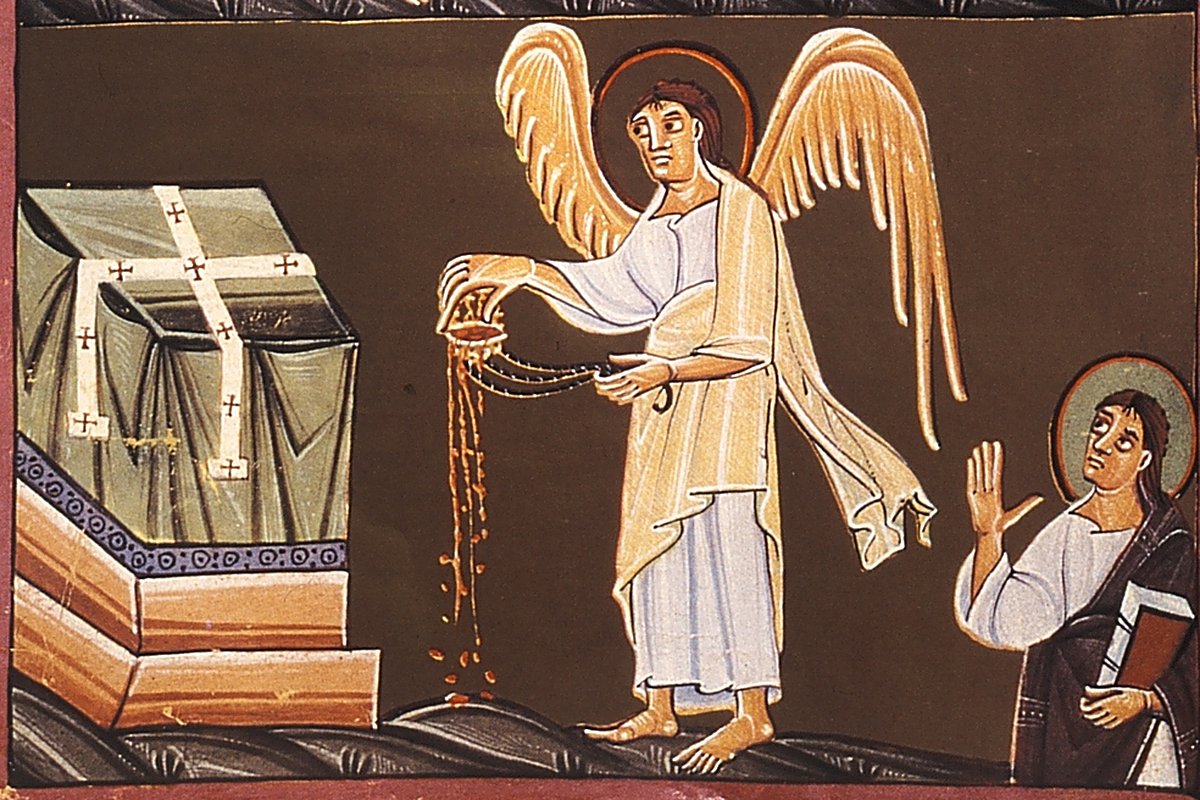
The Bamberg Apocalypse, folio 19v, "The Seven Trumpets and the Angel with a Censer," c. 1000-1020, Bamberg State Library — public domain.
Prayers carried upward as smoke
Into that pause comes "another angel," who "came and stood at the altar" before the throne, "holding a gold censer." He is "given a great quantity of incense to offer, along with the prayers of all the holy ones, on the gold altar that was before the throne," and "the smoke of the incense along with the prayers of the holy ones went up before God from the hand of the angel" (Revelation 8:3-4, NABRE). The image fuses two things into one rising column: the incense smoke and the prayers themselves, ascending together as if the smoke were simply making visible something that was already happening invisibly — prayer reaching God's presence.
An old symbol, not a new one
This isn't the first time Scripture links incense with prayer. Centuries earlier, the psalmist had already asked: "Let my prayer be counted as incense before thee, and the lifting up of my hands as an evening sacrifice!" (Psalm 141:2, RSV-CE) — a plea grounded in the daily Temple ritual of burning incense at fixed hours, a practice every worshiper in Jerusalem would have recognized. Revelation's angel with the censer draws on that same association, already centuries old by the time John wrote it down, rather than inventing a new image out of nothing.
Fire thrown back to earth
The scene doesn't end with the prayers ascending peacefully. "Then the angel took the censer, filled it with burning coals from the altar, and hurled it down to the earth. There were peals of thunder, rumblings, flashes of lightning, and an earthquake." (Revelation 8:5, RSV-CE). The same vessel that carried prayer upward is immediately repurposed to send judgment downward — a single angel, a single censer, moving in both directions within the space of two verses. Immediately afterward, the seven trumpet angels step forward and begin, one by one, to sound (Revelation 8:6 onward).
A liturgically resonant image
Of all the angel images in Revelation's often violent, strange visionary sequence, the censer angel stands out for how directly it connects to ordinary worship. Incense offered alongside prayer was a lived, physical part of Temple and later church practice, not an abstract symbol invented for apocalyptic literature — which is likely why this particular image has carried on so visibly into Christian liturgical tradition, where incense is still used in services today as a deliberate echo of exactly this picture: prayer, rising, reaching God's presence.
Who is this angel, according to tradition?
Revelation doesn't name the angel with the golden censer, and Scripture itself leaves the question open. Later Jewish and Christian tradition, drawing on other biblical passages that mention angels standing especially close to God's presence, has sometimes proposed identifying him with one of the archangels — most often Saint Michael or Saint Gabriel, both of whom Scripture places in unusually direct contact with God's throne room elsewhere. It's worth being careful here: this identification is speculative, built from inference across different books of the Bible rather than stated outright anywhere in the text, and the Church has never defined it as doctrine. Revelation itself seems content to leave the angel unnamed, letting the action — the offering, then the judgment — carry the meaning rather than the angel's individual identity.
Incense in the Temple that John's readers would have recognized
The ritual behind this image wasn't abstract to John's first readers. The Jerusalem Temple maintained a golden altar of incense, situated just outside the innermost sanctuary, where a priest burned incense twice daily as part of the fixed pattern of Temple worship — a practice described at length in the book of Exodus and still very much in living memory (or, for Jewish Christians reading Revelation shortly after the Temple's destruction in AD 70, in recent living memory) when John wrote. The golden altar "before the throne" in Revelation 8 deliberately echoes that earthly furniture, relocating it into a heavenly setting — the vision assumes its readers already know what a censer looks like, what incense smoke does in an enclosed room, and what it means for a priest to stand at that altar on behalf of a whole worshiping community. That familiarity is part of why the image lands with such force: John isn't describing something exotic, he's describing something intensely familiar, transposed into heaven itself.
Why the same censer both lifts prayer and hurls fire
The pivot from verse 4 to verse 5 — the same vessel first carrying prayer upward, then carrying fire downward — has drawn centuries of comment because it refuses to separate two things modern readers often want to keep apart: prayer and judgment. Many interpreters read the fire cast to earth as, in part, an answer to the prayers just offered — the cries of the persecuted faithful mentioned earlier in Revelation (see the souls under the altar in Revelation 6:9-11) finally provoking a divine response. Read that way, the scene isn't two unrelated events stitched together but a single continuous action: prayer ascends, and consequence descends, joined by the same golden vessel and the same angelic hand.
Trivia
What exactly does the angel with the golden censer do in Revelation?
What happens after the angel offers the incense and prayers?
Why is incense connected to prayer in this vision?
Whose prayers does the angel offer at the altar?
Is this the same angel who sounds one of the seven trumpets?
Related Reading