The Four Living Creatures

A vision by a river in Babylon
Ezekiel's account opens with a prophet in exile, watching "a great stormwind came from the North, a large cloud with flashing fire, a bright glow all around it" (Ezekiel 1:4, NABRE). Out of that storm come four creatures, "they were in human form" (Ezekiel 1:6, NABRE), but each one carries four faces and four wings (Ezekiel 1:6, NABRE). Their feet, Ezekiel writes, "gleaming like polished brass" (Ezekiel 1:7, NABRE), and beneath their wings were human hands (Ezekiel 1:8, NABRE) — a description built from familiar parts assembled into something that resists easy visualization.
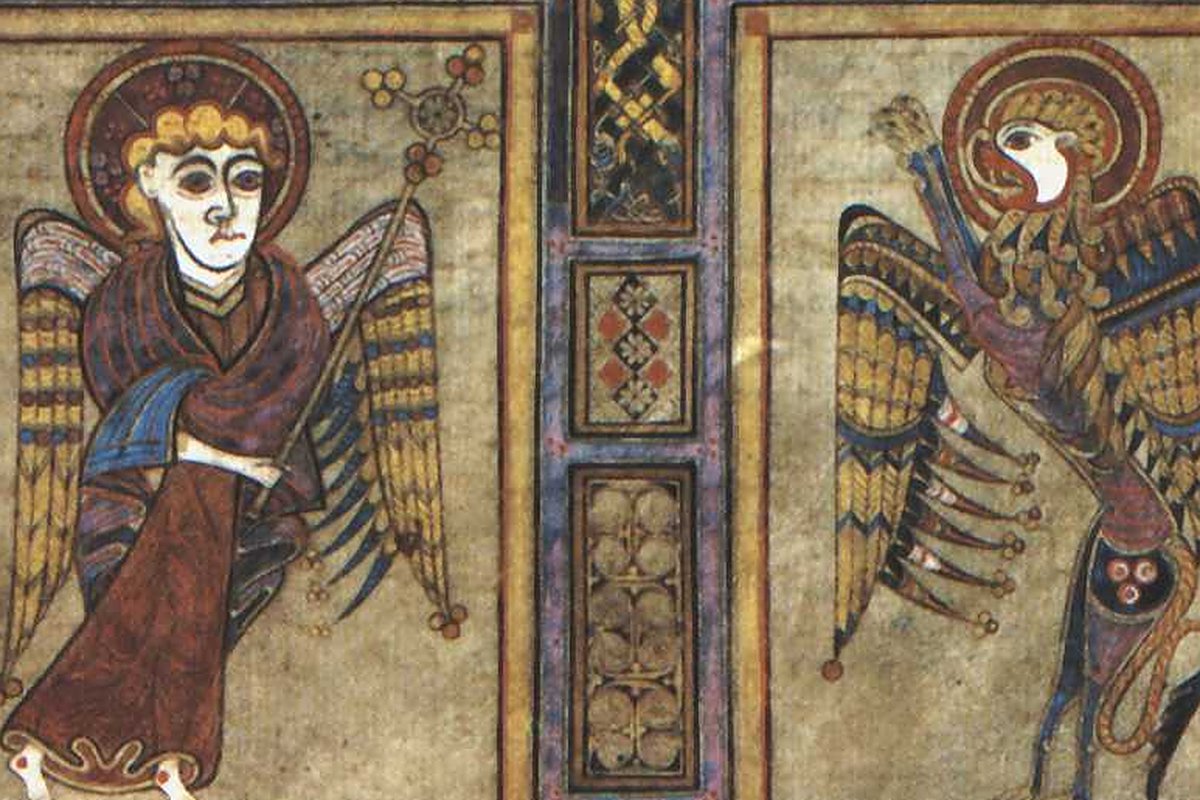
The Book of Kells, folio 27v (detail), c. 800, Trinity College Dublin — public domain.
One creature, four faces
The specific detail worth pausing on is how the faces are distributed: "Their faces were like this: each of the four had a human face, and on the right the face of a lion, and on the left, the face of an ox, and each had the face of an eagle." (Ezekiel 1:10, RSV-CE). This is one creature wearing four faces simultaneously — man, lion, ox, and eagle all belonging to the same being, not four separate creatures each with a single face. The whole scene is described as almost impossibly bright: "Something indeed like torches moved back and forth among the living creatures. The fire gleamed intensely, and from it lightning flashed." (Ezekiel 1:13, RSV-CE).
The same four forms, arranged differently in Revelation
Roughly six centuries later, John's vision in Revelation describes four living creatures surrounding God's throne, "covered with eyes in front and in back" (Revelation 4:6, NABRE) — but arranged differently from Ezekiel's vision. Here, each creature carries only one form: "The first creature resembled a lion, the second was like a calf, the third had a face like that of a human being, and the fourth looked like an eagle in flight." (Revelation 4:7, RSV-CE). It's a real difference worth naming rather than smoothing over — Ezekiel's single creature with four faces has become, in Revelation, four separate creatures with one face each. Both visions draw on the same four forms, but structure them differently. In Revelation, the creatures also have six wings each, "full of eyes all round and within," and cry out without rest: "Holy, holy, holy is the Lord God almighty, who was, and who is, and who is to come." (Revelation 4:8, RSV-CE).
What the Bible itself does not say
Neither Ezekiel nor Revelation offers an explanation of what the four faces mean or why these specific forms were chosen. Whatever symbolic weight later readers found in the man, lion, ox, and eagle came from interpretation applied after the fact — the biblical text describes the vision and moves on, without commentary on its own imagery.
A tradition that took shape over centuries
The idea that the four creatures secretly represent the four Gospel writers is a piece of later Christian tradition, not a claim within Scripture itself, and it didn't arrive fully formed. The 2nd-century bishop Irenaeus of Lyon was among the earliest to connect the four living creatures to the four evangelists, though the specific pairing he proposed differed from what eventually became standard. Other early writers, including Victorinus, proposed their own arrangements. It was Jerome, writing later, whose assignment eventually won out in the Western Church: the winged man for Matthew, the lion for Mark, the ox for Luke, and the eagle for John.
Jerome's reasoning followed how each Gospel opens. Matthew begins with Christ's human genealogy, hence the man. Mark opens abruptly with John the Baptist's voice "crying in the wilderness," a beginning long compared to a lion's roar. Luke's Gospel gives particular weight to Christ's priestly and sacrificial role, and the ox, a standard sacrificial animal, fit that emphasis. John's Gospel opens with soaring, cosmic language about the divine Word — and the eagle, believed in ancient tradition to be the one creature capable of gazing directly into the sun, fit a Gospel that opens by gazing directly at the divine.
Are the living creatures a kind of angel?
The text of Ezekiel itself never uses the word "angel" for these beings, but later chapters of the same book identify them with the cherubim, one of the ranks of heavenly beings surrounding God's throne — Ezekiel 10 describes essentially the same vision and explicitly names the creatures as cherubim (Ezekiel 10:20, RSV-CE). That identification matters for how Christian tradition eventually sorted the heavenly hierarchy: cherubim and seraphim are consistently placed among the very highest choirs of angelic beings, closest to the divine presence rather than functioning as messengers sent out into the world the way, for instance, Gabriel is in Daniel and Luke. The four living creatures, in other words, aren't wandering angels on assignment; in both Ezekiel and Revelation they stay fixed in place, permanently stationed around God's throne, their whole function bound up with worship rather than errand-running.
Eastern Christian iconography developed its own visual grammar for this, somewhat distinct from the Western tetramorph tradition. Byzantine icons of Christ in Majesty frequently surround him with the four creatures rendered as a unified mandorla-like frame rather than as four separate figures in the corners of a composition, a style that emphasizes the vision's original unity — one throne, one glory, encircled rather than illustrated as four independent characters. Western medieval art, by contrast, tended to split the four symbols apart entirely, assigning each one to its own evangelist and placing them in the four corners of a manuscript page or the four corners of a church's crossing vault, a layout that made the Gospel association visually unmistakable even to someone who couldn't read the Latin captions beside them.
From manuscript margins to cathedral stone
However it developed, the tetramorph — this four-part image of man, lion, ox, and eagle — became one of the most widely repeated symbols in Christian art. It appears in illuminated Gospel manuscripts across the early medieval world, carved into cathedral portals, worked into stained glass, painted around depictions of Christ in Majesty. A vision built from four impossible, composite faces in a sixth-century-BC prophet's account ended up, a thousand years later, as one of the most recognizable visual shorthand systems in Western Christian art — four creatures standing in, symbolically, for the four written accounts of Christ's life.
Trivia
What do the four living creatures look like in Ezekiel's vision?
How does Revelation's description of the four living creatures differ from Ezekiel's?
Does the Bible itself say the four creatures represent the four Gospel writers?
Who first linked the four creatures to the four evangelists, and did the pairing stay the same?
Why did Jerome's tradition assign each symbol to a particular Gospel?
Related Reading