Blessed Alexandrina of Balazar

A jump from a window
Alexandrina Maria da Costa was born March 30, 1904, in the parish of Balazar, near Póvoa de Varzim in northern Portugal, the second of three daughters in a poor farming family. Her father died when she was still a small child, leaving her mother to raise the girls largely alone, and Alexandrina herself began working at a young age, first in domestic service and later at a local textile factory, the kind of unremarkable rural upbringing shared by countless girls in early twentieth-century Portugal.

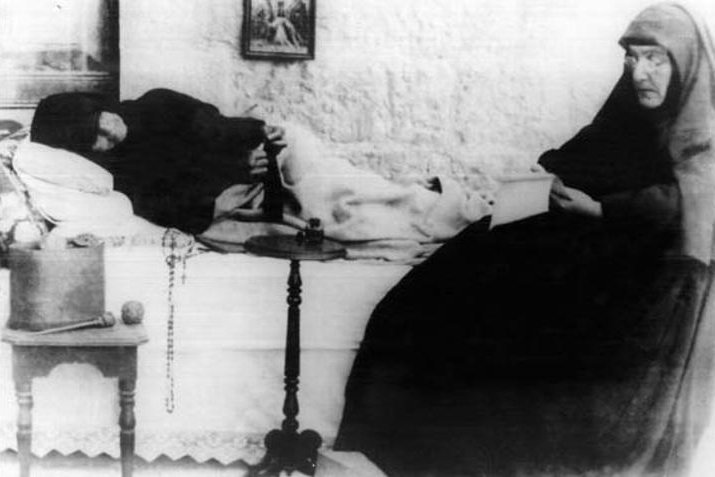
Photograph of the parish church in Balazar, Portugal, associated with Blessed Alexandrina Maria da Costa — used here as an honest substitute for a period photograph of Alexandrina herself, whose copyright status could not be confirmed as public domain.
Her early life took its defining turn at fourteen years old, in 1918, when three men broke into the room where she was sewing alongside her sister and another young apprentice and tried to assault her. Rather than submit, she jumped from an upper-story window. The fall itself wasn't fatal, but it set off a progressive paralysis that, over time, confined her to bed for roughly the next three decades of her life — the rest of her life, as it turned out, though no one could have known that at the time. She underwent several unsuccessful medical treatments in the years immediately following the fall, none of which restored any use of her limbs.
It's the kind of origin story that would already be remarkable on its own: a teenage girl's split-second decision to escape violence costing her the use of her body for the remainder of a long life. The paralysis didn't arrive all at once — accounts describe it worsening over the following years, moving from difficulty walking to full immobility by her early twenties, a slow decline that gave Alexandrina time to fully register what her life was becoming even as it was still unfolding. Doctors of the period could offer no cure and little explanation beyond the physical trauma of the fall itself, leaving her family to care for a bedridden daughter with no prospect of improvement.
What followed it is where Alexandrina's story becomes genuinely unusual, even by the standards of Catholic devotional history. Rather than becoming embittered by decades of confinement, she is remembered as having gradually reframed her suffering as something she could offer up in union with Christ's own suffering on the cross — a devotional practice with deep roots in Catholic spirituality, sometimes called "victim soul" spirituality, in which physical or emotional suffering is consciously united to Christ's redemptive suffering rather than simply endured. It's a theological framework, not a claim that suffering is good in itself, and it shaped everything that came after in her life.
Reliving the Passion, every Friday
Before the Friday experiences began, Alexandrina underwent what she described as a mystical exchange with Christ in 1936, after which her sense of spiritual purpose sharpened considerably; she came to see her paralysis not simply as a misfortune to be endured but as a form of victim-soul suffering deliberately united to Christ's own Passion, offered for the conversion of sinners. That theological framework — suffering understood as something that can be spiritually united to Christ's redemptive suffering rather than wasted — sits within an established strand of Catholic devotional tradition, though it is a matter of piety and personal spiritual vocation rather than defined Church dogma.
Beginning October 3, 1938, and continuing until March 24, 1942, Alexandrina reportedly relived Christ's Passion physically every Friday — a phenomenon that, unlike many private mystical claims, was documented as a repeated, witnessed occurrence rather than something reported only by Alexandrina herself after the fact. Priests, doctors, and other witnesses were present for many of these episodes over the years, describing her as passing through visible stages that mirrored the successive events of the Passion — agony, scourging, crowning with thorns, crucifixion — over the course of several hours each Friday, before returning to her ordinary bedridden state. Alongside this, she's said to have received invisible stigmata: the wounds of the Passion experienced without any visible marks appearing on her skin. That detail matters and shouldn't be glossed over, because it distinguishes her case from the more commonly told stigmata stories involving visible wounds, such as those recorded for her contemporary Padre Pio — the Church's own records on Alexandrina are specific that no such visible marks were present in her case.
Thirteen years, and a hospital's own records
Starting March 27, 1942, and continuing until her death, Alexandrina reportedly consumed nothing at all except the Eucharist she received daily. Claims of this kind — saints said to have survived for extended periods without ordinary food — appear elsewhere in Catholic history, and many of them rest on far thinner evidence than what exists for Alexandrina. Church authorities didn't simply accept the claim; they arranged a supervised, 40-day clinical observation at the Foce do Douro Hospital in Porto, running from June 10 to July 20, 1943, during which doctors monitored her directly and reported no intake of food or water beyond Communion.
That's an unusually well-attested investigation compared to many similar "fasting saint" traditions, and it's worth stating clearly why it matters: this isn't a story that only survives through pious retelling generations later, but a documented, contemporary clinical inquiry conducted by an institution with every reason to be skeptical. Even so, it should be described precisely — according to the clinical observation records from that 1943 study, not as a scientifically settled fact or a formally defined miracle. The Church's own beatification process treats it as a remarkable, closely documented phenomenon, not as proof requiring anyone's assent.
Beatification
Alexandrina died on October 13, 1955, in Balazar, the town where she'd spent nearly her entire life, still bedridden, still relying on nothing but daily Communion, thirty-seven years after the fall that changed the course of her life. She was declared Venerable on January 12, 1996, and beatified by Pope John Paul II on April 25, 2004, in a ceremony at Fátima rather than in Rome — a deliberate choice connecting her beatification to Portugal's own most famous site of Marian devotion. A widely repeated line describing her "secret of holiness" as love of Christ is often attributed to John Paul II's beatification homily, but the exact wording couldn't be confirmed against a precise citation here, so it's worth treating that particular phrase as a paraphrase of the general sentiment rather than a verified direct quotation.
Her cause for canonization remains open, meaning the formal process that could eventually lead to sainthood — requiring, under current Church procedure, a miracle attributed to her intercession and confirmed by the Vatican — has not yet concluded.
Feast day and devotion
Her feast is kept on October 13, the date of her death. Alexandrina doesn't carry a formally assigned Vatican patronage, but she's popularly invoked by the sick, by paralyzed and disabled people, and in connection with youth purity — devotional, grassroots associations rather than an official title, and worth naming as such. Her story sits at an unusual intersection for a modern saint: a documented act of self-preservation as a teenager, followed by decades of suffering that the Church itself chose to study rather than simply accept, and a life that ended in the same small Portuguese parish where it began.
Trivia
Who was Blessed Alexandrina of Balazar?
How was Alexandrina of Balazar paralyzed?
What happened during Alexandrina's Friday experiences of the Passion?
Did Alexandrina really live without food for years, and how do we know?
When was Alexandrina of Balazar beatified?
You May Also Like

Related Reading