Dietrich Bonhoeffer

A note on why this article belongs here, carefully framed
Most of the figures covered on this blog are canonized saints or formally beatified members of the Catholic Church. Dietrich Bonhoeffer is neither. He was a German Lutheran pastor and theologian, and the Catholic Church has never opened, let alone completed, a canonical process to declare him "Blessed" — there is no such title as "Blessed Dietrich Bonhoeffer" in Church law, whatever a casual search might turn up. What does exist is real and worth understanding on its own terms: Bonhoeffer is honored ecumenically, across an unusually wide range of Christian traditions, as one of the clearest examples of Christian resistance to totalitarian evil the twentieth century produced. He stands among the ten twentieth-century martyrs whose statues were unveiled above the Great West Door of Westminster Abbey in 1998 — an Anglican honor — and the United Methodist Church formally recognized him as a modern-day martyr in 2008. Catholic writers, popes, and theologians have spoken admiringly of his witness for decades. Admiration and formal canonization, though, are two different things, and this article keeps that distinction clear throughout.
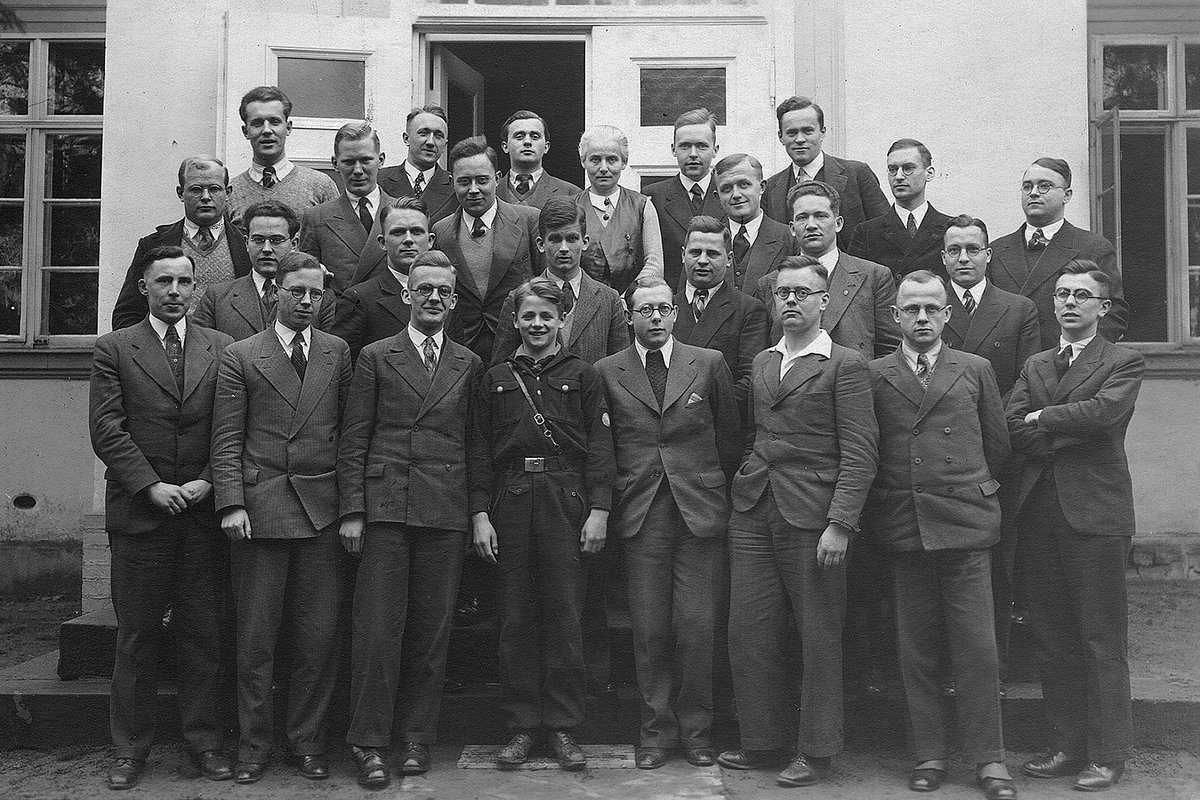
Photograph of the Confessing Church seminary at Sigurdshof, c. 1939–1940, Staatsbibliothek zu Berlin – Preußischer Kulturbesitz, photographer unknown — public domain. Used as an honest substitute for a solo portrait: no clean public-domain or CC0 individual photograph of Bonhoeffer could be confirmed for this article, as most surviving portraits remain under German copyright (Bundesarchiv CC BY-SA terms).
From Berlin theology student to church resister
Dietrich Bonhoeffer was born on February 4, 1906, in Breslau (now Wrocław, Poland), into a large, intellectually accomplished family, and studied theology in Tübingen and Berlin, completing his doctorate at just twenty-one. He spent time abroad early in his career, including a formative year at Union Theological Seminary in New York, where his exposure to the Black churches of Harlem — he taught Sunday school and attended services at Abyssinian Baptist Church — left a lasting mark on his theology of solidarity and lived faith.
He returned to a Germany rapidly reorganizing itself under Nazi rule, and by 1933 — the same year Hitler became chancellor — Bonhoeffer was already speaking and writing publicly against the "German Christian" movement, a faction working to bring the German Protestant churches into ideological line with Nazism, including purging clergy of Jewish descent from ministry. When the Confessing Church formed in 1934 as an organized theological and pastoral resistance to that takeover, Bonhoeffer became one of its most prominent younger voices, helping draft its founding declaration and later directing an underground seminary for its ordinands at Finkenwalde until the Gestapo shut it down in 1937.
The book that made "costly grace" a household phrase
It was during these Confessing Church years that Bonhoeffer wrote The Cost of Discipleship (1937), the book most responsible for his lasting influence among Christian readers of every denomination. Its central argument — that authentic Christian faith demands total, costly commitment rather than comfortable, undemanding belief — produced one of the most frequently quoted lines in twentieth-century Christian writing: "When Christ calls a man, he bids him come and die." Bonhoeffer meant the line seriously, not rhetorically, and his own life would go on to prove it in the most literal way possible.
From pastor to resistance conspirator
By the early 1940s, Bonhoeffer had moved from church resistance into wider anti-Nazi political resistance, formally working for German military intelligence (the Abwehr) in a position that in reality gave him cover to travel abroad and make contact with Allied officials on behalf of resistance circles opposed to Hitler. He was not among the small group who planned the July 20, 1944 assassination attempt on Hitler itself, but his contacts and family connections placed him firmly inside its wider conspiracy network. He was arrested on April 5, 1943, initially on narrower suspicions connected to helping Jews escape Germany and to currency violations tied to that rescue work, and held first at Tegel military prison in Berlin — the setting for the letters later published as Letters and Papers from Prison, a collection that has shaped Christian theology and ethics for generations of readers well beyond his own Lutheran tradition.
After the July 1944 plot failed and the Gestapo uncovered documents directly tying Bonhoeffer to the wider conspiracy, he was moved through a series of camps — Buchenwald among them — before arriving at Flossenbürg. A hastily convened court-martial tried and sentenced him overnight. He was executed by hanging at dawn on April 9, 1945, alongside several other resistance figures, only days before the camp was liberated by advancing American forces and just weeks before Germany's unconditional surrender.
An ecumenical martyr, not a Catholic one
Bonhoeffer's death produced no Catholic canonization process, because none was ever applicable — he lived and died a Lutheran pastor, and beatification is a specifically Catholic mechanism for a specifically Catholic communion. What his death did produce was a body of writing and a model of costly discipleship that Christians of practically every tradition, including many Catholics, have drawn on ever since as a touchstone for what genuine resistance to evil, grounded in faith, can look like. Various Christian traditions keep his memory on April 9, the anniversary of his execution — not as a feast day in the technical liturgical sense in most cases, but as a day of remembrance for a pastor whose theology and whose death remain difficult to separate from one another.
Trivia
Who was Dietrich Bonhoeffer?
Is Dietrich Bonhoeffer a Catholic saint or 'Blessed'?
What was the Confessing Church that Bonhoeffer belonged to?
Why was Dietrich Bonhoeffer executed?
What are Dietrich Bonhoeffer's most influential books?
You May Also Like
Related Reading