Blessed Fra Angelico

A painter who became a friar, or a friar who happened to paint
Fra Angelico was born Guido di Pietro around 1395 in Rupecanina, in the Tuscan countryside, and by his early twenties was already active as a painter in Florence before he entered the Dominican order at the priory of Fiesole, probably around 1420, taking the religious name Fra Giovanni. "Fra Angelico" — roughly, "the angelic friar" — was never his given religious name at all; it's a popular nickname that stuck after his death, a testament to how thoroughly contemporaries associated his painting with genuine devotion rather than mere technical skill. He is also sometimes referred to by the honorific "Il Beato Angelico," reflecting his eventual beatification.
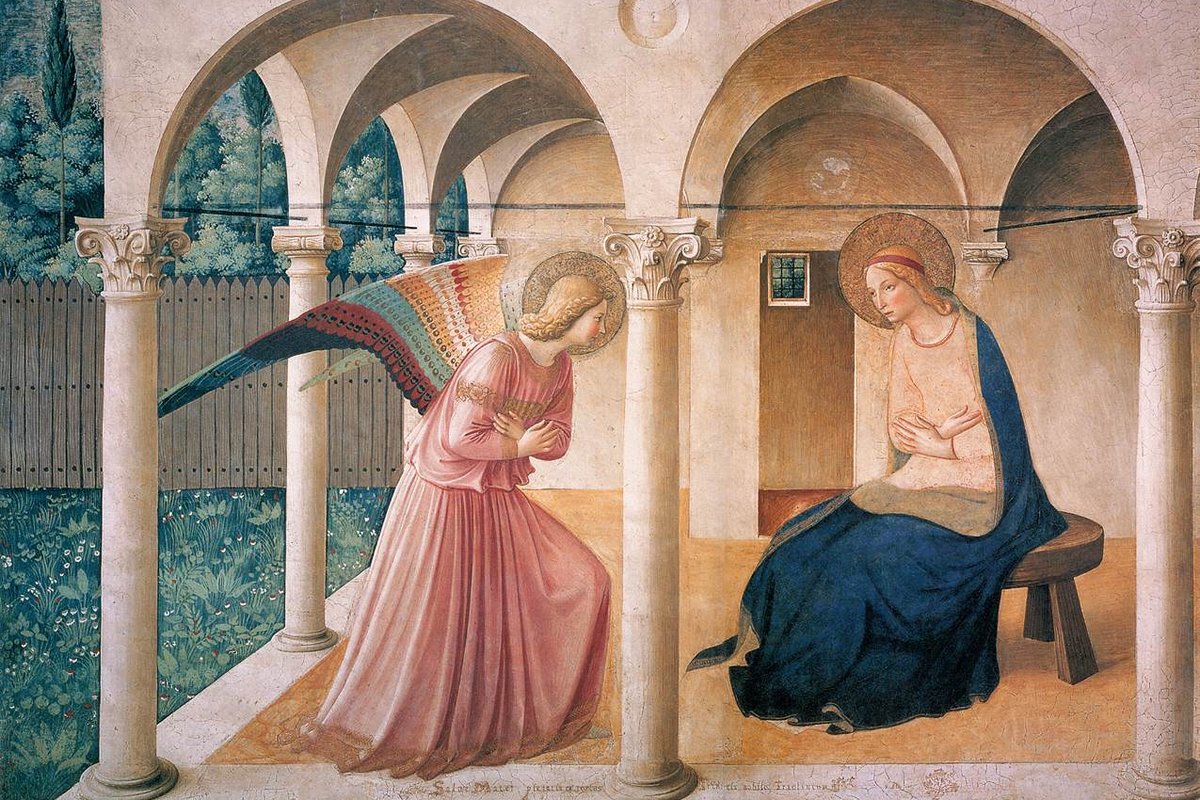
Fra Angelico, The Annunciation, fresco, c. 1440–1445, Convent of San Marco, Florence — public domain.
As a Dominican, Angelico's life followed the ordinary rhythms of the order — community prayer, study, obedience to superiors — and his painting developed alongside that religious formation rather than apart from it. He trained in the workshop traditions of Florence, absorbing the innovations of the Early Renaissance around him, particularly a growing interest in perspective and naturalistic space, while keeping the devotional clarity and gold-ground luminosity more associated with the earlier Gothic altarpiece tradition. The result was a distinctive style that could feel almost startlingly modern in its use of architectural space while remaining unmistakably aimed at prayer rather than display.
Frescoes meant for an audience of one
Angelico's defining achievement came in the 1440s, when the Dominican community relocated to a rebuilt convent, San Marco, in Florence, funded largely by Cosimo de' Medici. Angelico led the decoration of the entire complex, and the most remarkable part of that project is also the least visited by ordinary tourists even today: dozens of small frescoes, one to a room, painted directly onto the walls of the individual cells where the friars slept, studied, and prayed in solitude.
These were not commissioned showpieces meant to advertise the convent's wealth or Angelico's talent to outside visitors. Each cell fresco depicts a scene from the life of Christ — the Crucifixion, the Transfiguration, the Noli me tangere — rendered with a simplicity and quiet restraint that stands in deliberate contrast to the more elaborate, crowded compositions common in public commissions of the period. Art historians have long read this restraint as intentional: a fresco meant to be seen daily, alone, by a single friar attempting to enter into the scene through prayer, needs a different visual language than an altarpiece meant to impress a congregation. The most celebrated of all these images, the Annunciation at the top of the convent's main staircase, achieves its effect through almost bare simplicity — Gabriel kneeling before Mary in an unadorned loggia, with none of the ornamental crowding typical of the era's grander religious commissions.
Rome, and a Vatican chapel outlasting the man who painted it
Angelico's reputation eventually carried him to Rome, where Pope Eugene IV and later Pope Nicholas V employed him on major commissions, including frescoes for a private chapel in the Vatican — the Niccoline Chapel — depicting scenes from the lives of the early martyr-deacons Saint Stephen and Saint Lawrence. He also worked in Orvieto Cathedral on a fresco cycle later completed by Luca Signorelli. These papal commissions show a different register of Angelico's work — more public, more monumental — but the same combination of technical sophistication and unmistakable devotional seriousness that marked his cell frescoes in Florence.
He died in Rome on February 18, 1455, and was buried in the Dominican church of Santa Maria sopra Minerva, where his tomb still stands.
From respected painter to patron of artists
Fra Angelico's reputation as a genuinely holy man circulated for centuries alongside his reputation as a painter — early biographers, including Giorgio Vasari in the sixteenth century, described him as a man of exceptional humility who reportedly wept while painting scenes of the Crucifixion and refused to alter his work once begun, treating the act of painting itself as a form of prayer rather than simply a craft. Whether every detail of these early accounts is strictly documented or has picked up some legendary polish over the centuries, the consistent thread across five hundred years of testimony is the same: contemporaries and later generations alike saw no real separation between Angelico's artistic excellence and his personal holiness.
That reputation eventually became formal recognition. Pope John Paul II beatified him on October 3, 1982, and two years later, in 1984, declared him the patron of Catholic artists, explicitly citing, in his own words, the perfect integrity of Angelico's life together with the almost divine beauty of the images he painted. His feast is kept on February 18, the date of his death — and his San Marco cell frescoes remain, to this day, viewable largely by anyone willing to climb the same staircase the friars once did, a rare case of private devotional art from the fifteenth century surviving essentially in its original setting.
Trivia
Who was Blessed Fra Angelico?
Why are Fra Angelico's San Marco frescoes considered unusual?
Is Fra Angelico a canonized saint?
Why is Fra Angelico the patron saint of artists?
What is Fra Angelico's most famous work?
You May Also Like
Related Reading