Saint Albert the Great

The bellow that filled the world
The story, as it's been passed down for centuries, is simple enough to repeat and vivid enough to stick: Thomas Aquinas, as a young Dominican student, was large, slow to speak, and so quiet in class that his fellow friars started calling him the "Dumb Ox." Albert, who was teaching him, wasn't having it. He is said to have told the class that they had it backwards — that this Dumb Ox would one day "bellow so loud that his bellowings will fill the world." No surviving contemporary document pins the line down word for word, so it belongs to the category of famous attributed sayings rather than a verified quotation. What isn't in doubt is the relationship underneath it: Thomas Aquinas studied under Albert first in Paris and then again in Cologne, and went on to become the most influential theologian in the history of the Western Church. Whoever first wrote the line down, it turned out to be one of the more accurate predictions in medieval academic history.
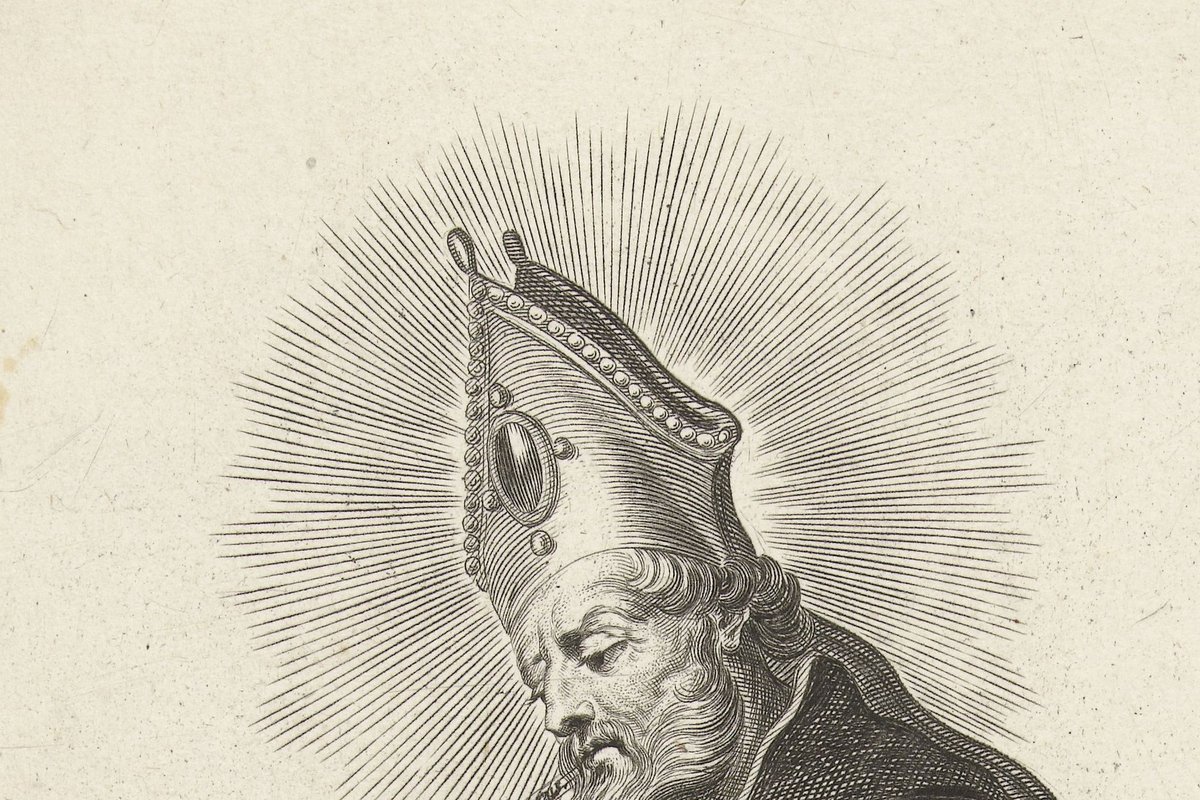
Petrus de Balliu, Saints Albertus Magnus and Thomas Aquinas, engraving, c. 1650, Rijksmuseum, Amsterdam — public domain.
From Lauingen to the lecture halls of Paris
Albert was born around 1200 (some sources push the date back as far as 1193, though the earlier year isn't firmly established) in Lauingen, in Bavaria, and joined the Dominican Order roughly in 1223 — a young, newly founded order of preachers still building its reputation for serious scholarship. Family tradition holds that he studied at the University of Padua before his entry into religious life, drawn into the Dominicans by the preaching of Blessed Jordan of Saxony, who had succeeded Saint Dominic himself as head of the order only a few years earlier. He rose through it quickly, teaching at Paris, where he earned the rank of Master of Theology in 1245, and later at Cologne. It was in these two cities that his path crossed permanently with Aquinas's, first as teacher and student, later as two of the most respected minds in the Dominican order working in the same intellectual tradition.
The Dominicans in Albert's day were barely a generation old, still proving to the wider Church that an order built around preaching and study — rather than the older monastic pattern of stability within a single cloister — could produce serious theologians and not just wandering friars. Albert's own career became one of the clearest arguments for that case: a friar who moved between cities as his teaching assignments required, publishing steadily the whole time, embodying exactly the mobile, intellectually engaged religious life the order's founders had envisioned.
An encyclopedic mind
What set Albert apart from most of his contemporaries wasn't a single breakthrough but the sheer range of what he tried to master. He wrote commentaries covering nearly the entire surviving body of Aristotle's work, and alongside that he wrote at length on botany, zoology, mineralogy, and astronomy — treating the natural world as something worth observing and describing carefully, not just theorizing about from a library chair. That project of integrating Aristotelian natural philosophy with Christian theology didn't stay contained to Albert's own writing; it laid much of the groundwork for the far more famous synthesis his student Aquinas would later build in the Summa Theologiae. For a few years in the middle of his career, Albert set the books aside for administration, serving as Bishop of Regensburg from 1260 to 1263 before resigning the post to return to teaching and writing, which is where he clearly wanted to be all along. He also served the wider Church in more public roles when needed — preaching a crusade at the pope's request and traveling to the Second Council of Lyon in 1274, evidence that his standing extended well beyond the Dominican schoolroom, even though administration never suited him the way study did.
A friar who dissected what he described
What made Albert's scientific writing unusual for his century wasn't just its breadth but its method. Where many medieval scholars were content to repeat what earlier authorities had written, Albert regularly noted his own direct observations of plants, animals, and minerals, sometimes correcting Aristotle outright when his own field observations contradicted the ancient text. He is credited with detailed, largely accurate descriptions of plant reproduction and mineral properties that historians of science still cite as genuinely original contributions rather than mere commentary, which is part of why later admirers sometimes called him, only half-jokingly, the medieval world's first real naturalist.
The magician who never was
Albert's genuine, careful engagement with the natural sciences left an opening that later writers happily exploited. After his death, a collection of alchemical and magical texts known as the "Secreta Alberti" — the Secrets of Albert — began circulating under his name, borrowing his reputation to lend themselves an air of authority they didn't earn on their own. It's worth being direct about the gap here: Albert's authentic writings treat proto-scientific subjects modestly and within a clearly theological framework; the "magician Albertus" of later folklore is a legend built on top of a real scholar's name, not a description of the man himself.
Doctor Universalis
Albert died in Cologne on November 15, 1280, and was beatified more than three centuries later, in 1622, by Pope Gregory XV. The fuller recognition took even longer: Pope Pius XI canonized him and declared him a Doctor of the Church — with the title Doctor Universalis, honoring the universal range of his learning — on the very same day, December 16, 1931. That's worth stating precisely, because the two milestones are sometimes garbled together with a very different pope from four centuries earlier; it was Pius XI, not Pius IX, who made both declarations at once. His feast is kept on November 15, and in 1941 Pope Pius XII named him patron of natural scientists, a title that fits a scholar who spent a lifetime insisting the created world was worth studying on its own terms.
Trivia
Who was Saint Albert the Great?
Did Albert the Great really predict Thomas Aquinas's future greatness?
Was Albert the Great a magician or alchemist?
When was Albert the Great canonized, and who declared him a Doctor of the Church?
What is Saint Albert the Great the patron saint of?
You May Also Like
Related Reading