Saint Margaret of Castello

Hidden from birth
Margaret was born in 1287 at Metola Castle, near Mercatello sul Metauro in Italy, to the noble parents Parisio and Emilia. She arrived blind, with a curved spine, legs of noticeably uneven length, and short stature — a combination of conditions that, to parents concerned above all with their family's standing, apparently registered as a shame to be managed rather than a child to be raised openly. Their solution was to wall off a room attached to the family chapel and keep her there, out of sight, for roughly a decade. It's a detail worth sitting with plainly: this wasn't neglect born of poverty or ignorance, but a deliberate, sustained decision by people with every resource to do otherwise.
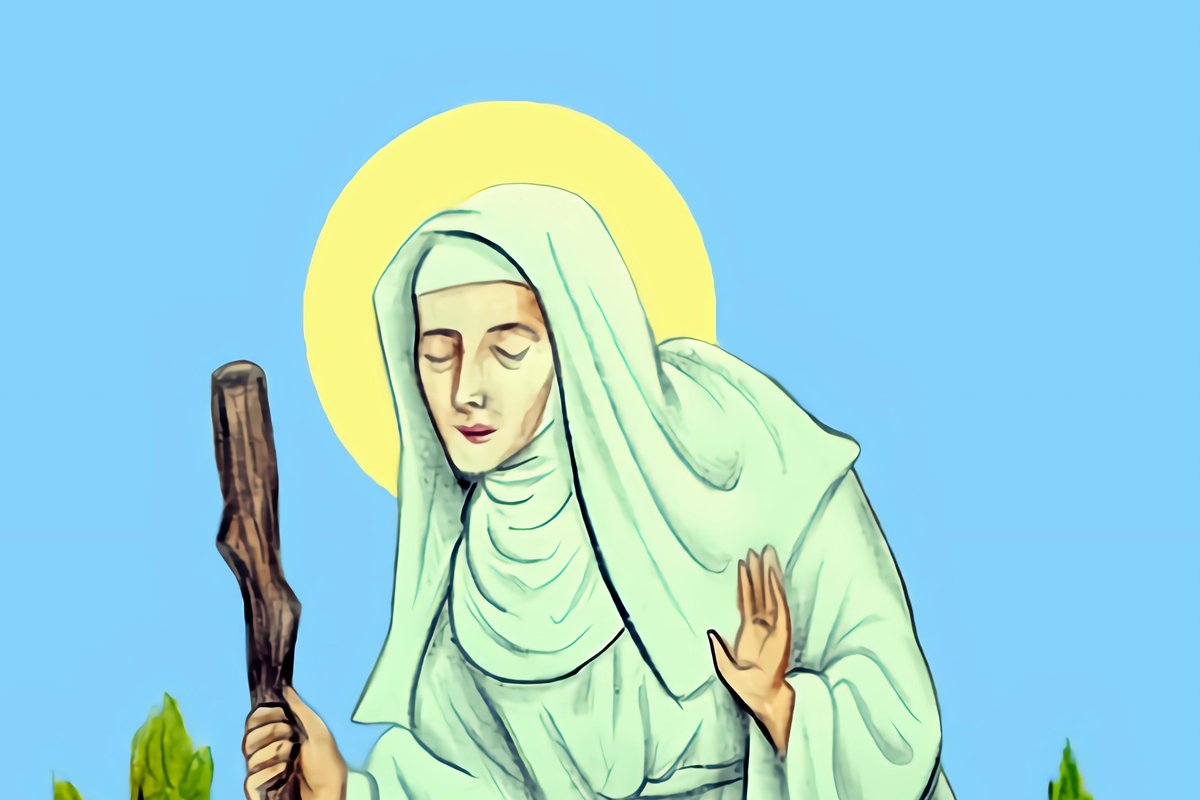
Saint Margaret of Castello aka 'Little Margaret,' digital devotional illustration by Philip K (Robert444444), 2023 — released CC0/public domain via Wikimedia Commons. Used here as no public-domain historical painting of her could be located; a period artwork will replace it if one is confirmed.
Abandoned at a shrine
In 1303, when Margaret was sixteen, her parents took her to a Franciscan shrine in Città di Castello that had a reputation for miraculous cures. Whatever combination of hope and desperation brought them there, it didn't work the way they wanted — no cure came. And rather than bring their daughter back home, Parisio and Emilia left her at the shrine and returned to Metola without her. The historical record doesn't soften this: it was, plainly, an abandonment, the final act in a relationship her parents had already spent a decade managing by concealment.
A new family among the poor
What happened next is the part of Margaret's story that turned a decade of concealment and a final abandonment into the beginning of a life that would eventually be recognized as sainthood. The poor of Città di Castello took her in. She came under the guidance of the Dominican friars established in the town and was admitted into the Third Order of St. Dominic, the lay branch that let men and women live according to Dominican spirituality without taking the full vows of friars or cloistered nuns.
Margaret put that new life to immediate, practical use. She ran an informal school for the town's children, teaching them the faith and the psalms she had learned, and she looked after other children while their parents were at work — a woman abandoned as a burden becoming, within a few years, someone an entire town of working families relied on. Contemporary accounts consistently emphasize one specific trait: she never spoke bitterly of the parents who had hidden and then deserted her. That absence of recorded resentment isn't a later embellishment added to smooth the story — it's one of the most repeated and attested features of her cult from early on.
She also became known during her lifetime for a quiet, practical ministry to the sick and imprisoned, visiting those the town itself had pushed to its margins — a natural extension, contemporaries noted, of a woman who understood from her own life exactly what it felt like to be shut away out of sight. Accounts from those who knew her describe a woman remembered less for any single dramatic miracle during her lifetime than for the sheer consistency of her charity, sustained year after year in a town that had, at first, offered her nothing but the shelter a stranger's home could provide.
What her body revealed after death
When Margaret died in 1320, the friars preparing her for burial reportedly discovered something unexpected: a small growth near her heart that, when opened, was said to contain three pearl-like formations arranged as if depicting the Holy Family — Mary, Joseph, and the Christ Child. This detail belongs squarely to pious tradition rather than verified medical fact, but it spread quickly through the town and became part of the immediate popular momentum behind her cult, with local devotion to her as a holy woman beginning almost the moment she died, long before any formal Church process examined her life.
From four centuries as "Blessed" to a 2021 canonization
Margaret died in Città di Castello on April 13, 1320. Her cause moved through the Church's processes slowly, in the way many medieval causes did: Pope Paul V granted her equipollent beatification — a recognition of already-existing, longstanding popular veneration, rather than a newly investigated case — on October 19, 1609. For more than four hundred years afterward, she was venerated across the Dominican world and well beyond it as "Blessed" Margaret of Castello.
That changed on April 24, 2021, when Pope Francis formally canonized her by equipollent canonization, the same mechanism used for Paul's original 1609 declaration: a recognition, grounded in centuries of continuous cultus, rather than a fresh miracle-driven cause. She is, today, a fully canonized saint of the Catholic Church — Saint Margaret of Castello — even though she's still sometimes referred to informally as "Blessed" out of centuries of habit. Her feast is kept on April 13, the date of her death.
A modern patronage rooted in an old story
Margaret's patronage has grown considerably in the century since her story was rediscovered by a wider audience, and it maps directly onto her own life rather than onto any invented symbolism: she's widely invoked today by and for people with disabilities, for the blind specifically, and — especially within pro-life advocacy — for unborn and unwanted children. None of this is an ancient, formally assigned title; it's a 20th- and 21st-century devotional development, driven by disability ministries and pro-life organizations recognizing in a 14th-century abandoned child a story that speaks directly to causes they represent today. Readers interested in other saints whose holiness took shape after being cast aside by their own families may also want to read about Saint Dymphna.
Trivia
Who was Saint Margaret of Castello?
Why did Margaret of Castello's parents abandon her?
Is Margaret of Castello a saint or a blessed?
What is Saint Margaret of Castello the patron saint of?
Did Margaret of Castello resent the parents who abandoned her?
You May Also Like
Related Reading