Blessed Jan van Ruusbroec

An eleven-year-old who vanished to study theology
Jan van Ruusbroec was born around 1293 in the village of Ruisbroek, near Brussels, in the Duchy of Brabant. By tradition — a detail told and retold in accounts of his life rather than independently documented in a contemporary record — he left home at eleven without telling his mother, walking to Brussels to live and study under his uncle Jan Hinckaert, a canon at the collegiate church of St. Gudula. His mother is said to have searched for him with real anxiety before eventually accepting, and even joining, the religious life her son had chosen so abruptly. Whatever the precise historical accuracy of the story's details, the underlying fact is solid: Ruusbroec spent his formative years under his uncle's guidance in Brussels and was ordained a priest there in 1317.
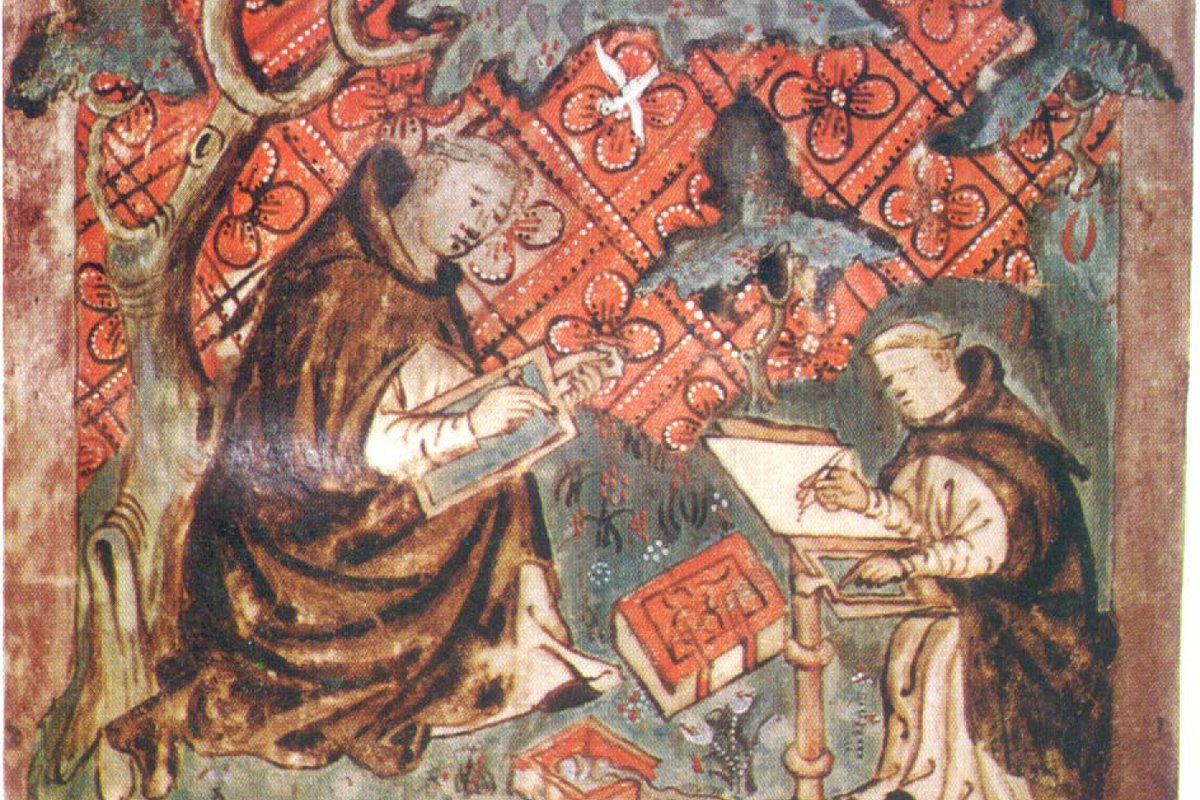
Anonymous illuminator, miniature from a 14th-century manuscript of Ruusbroec's collected works (Royal Library of Belgium, Brussels, KB 19.295-97, fol. 2v), c. 1380 — public domain.
Twenty-six years as an ordinary parish chaplain
For roughly the next twenty-six years, Ruusbroec served as a chaplain at St. Gudula's, living alongside his uncle Hinckaert and a companion named Vrank van Coudenberg in a kind of informal ascetic common life — not yet a religious order, but a household of priests deliberately choosing simplicity and shared prayer over the more comfortable clerical lifestyle available to them in a major city. It was during these Brussels years that Ruusbroec began writing the mystical treatises that would eventually make him one of the most significant spiritual authors of the medieval Low Countries, working in Middle Dutch rather than the Latin normally used for serious theology — a choice that widened his potential readership considerably beyond university-trained clergy.
Withdrawal to the forest, and a priory built around three friends
In 1343, the three men — Ruusbroec, his uncle, and Coudenberg — withdrew together from Brussels to a hermitage in the Sonian Forest at Groenendaal, seeking a quieter setting for the contemplative life they had already been cultivating within the city. What began as an informal retreat gradually formalized: in 1349, the community was officially erected as a priory of Augustinian Canons Regular, with Ruusbroec serving as its first prior, a position he held for the rest of his life.
Later Groenendaal tradition holds that Ruusbroec, deep in old age, would sometimes wander alone into the surrounding forest to pray, and that his brethren once found their elderly prior so completely absorbed in contemplation that he never noticed them approach. It's a vivid image, and worth flagging plainly for what it is — a piece of devotional legend passed down about him, not an independently documented event, though entirely consistent with the intensity of contemplative practice his own writings describe.
The book that made a Paris theologian nervous
Ruusbroec's most important work, The Spiritual Espousals (Die Chierheit der Gheestelike Brulocht), maps out the stages of spiritual growth toward union with God in extraordinary psychological and theological detail. It's in this book, and in the intensity of the language Ruusbroec uses to describe the soul's union with God, that the most serious controversy of his legacy took shape — not in his own lifetime primarily, but in the decades after his death, when his writing reached a wider European audience.
Jean Gerson, the influential chancellor of the University of Paris and one of the leading theologians of his generation, read passages of The Spiritual Espousals as teaching that the soul, in its highest mystical state, becomes identical with God's own essence — a position that would cross directly into pantheism, a serious theological error rather than a permissible mystical intensity of language. This wasn't a minor or private objection; Gerson was among the most authoritative theological voices in Europe at the time, and his criticism carried real weight. Ruusbroec's defenders, and the surviving tradition of how Ruusbroec himself explained his own writing, pushed back firmly: what he meant, they insisted, was unity in love between the soul and God, not a literal dissolution of the soul's own distinct nature into God's. The Catholic Encyclopedia's own summary of his defense preserves the distinction in his own terms: "There where I assert that we are one in God, I must be understood in this sense that we are one in love, not in essence and nature."
This is worth presenting plainly as a real, historically documented theological dispute rather than glossing over it — Gerson's concerns were substantive, Ruusbroec's mystical language genuinely does push close to the edge of orthodox expression in places, and the eventual settling of the question in Ruusbroec's favor within Catholic tradition reflects a real resolution of a real disagreement, not merely later hagiography smoothing over an inconvenient episode.
A cultus older than the paperwork behind it
Ruusbroec died at Groenendaal on December 2, 1381, and his reputation for holiness and his enduring influence as a mystical writer persisted for centuries afterward, including a documented influence on Gerard Groote, founder of the Devotio Moderna movement that reshaped late medieval spirituality across northern Europe — Groote is recorded as having visited Ruusbroec personally at Groenendaal. Ruusbroec's title of Blessed did not come from a modern beatification process built around an investigated miracle; instead, Pope Pius X confirmed, by papal decree in December 1908, the legitimacy of a local devotional cultus that had already existed continuously "from time immemorial" — a real but procedurally different route to the title than the beatifications more familiar from recent centuries. His feast is kept on December 2, the anniversary of his death, and no strong universal patronage has been formally attached to him.
Trivia
Who was Blessed Jan van Ruusbroec?
Was Jan van Ruusbroec formally beatified in a modern ceremony?
Was Jan van Ruusbroec accused of heresy?
What is The Spiritual Espousals about?
Did Jan van Ruusbroec influence later religious movements?
You May Also Like
Related Reading