Saint Lydwine of Schiedam

A fall on the ice that never healed
Lydwine was born on April 18, 1380, in the Dutch town of Schiedam, one of nine children born to a laborer father — an ordinary, unremarkable start for a life that would become anything but ordinary. At fifteen, out ice skating with friends the way any teenager in that part of Holland might have been, she fell and broke a rib. It should have been a routine injury, the kind that heals in weeks. It wasn't. Lydwine never recovered.
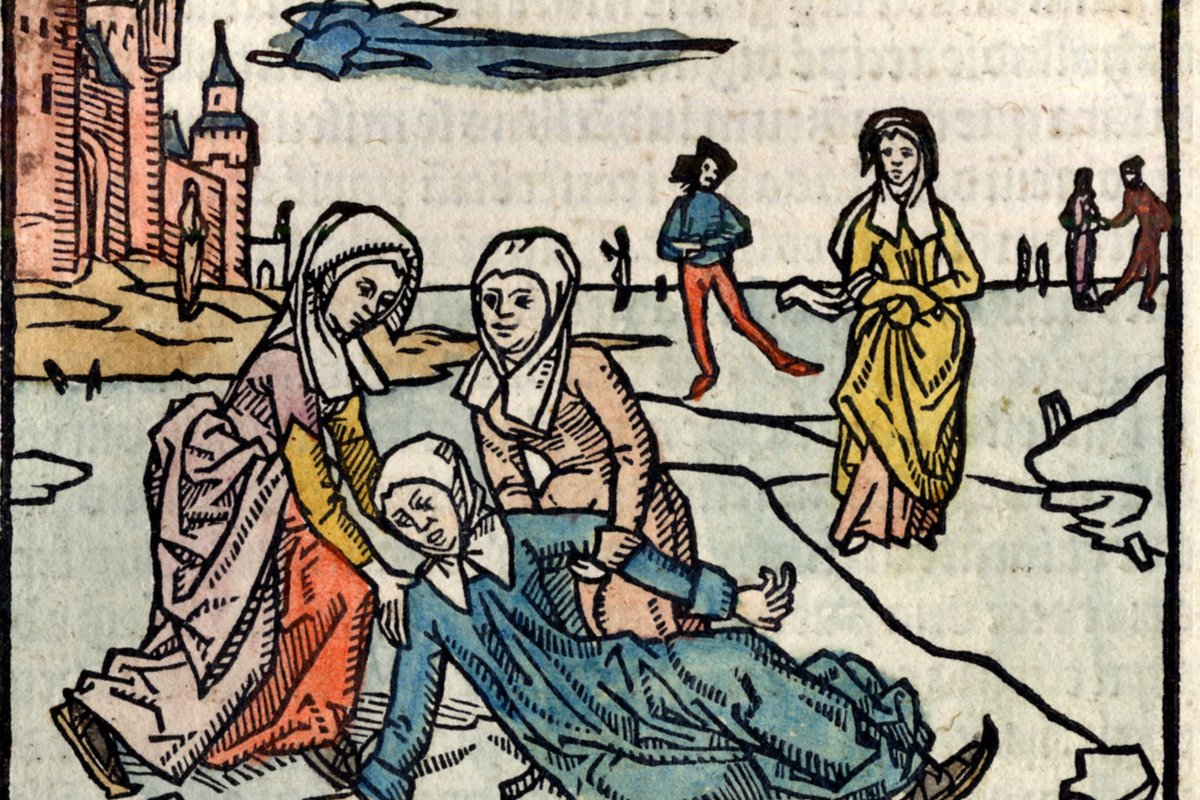
Hand-colored woodcut, The Fall of Lidwina on the Ice, from an early printed Life of Saint Lidwina of Schiedam, 1498 — public domain.
What followed instead was a slow, cascading decline that modern readers might reasonably find hard to picture happening to a single teenager. Walking became difficult, then painful, then close to impossible. Headaches set in, along with violent tooth pain. By the time she was nineteen, just four years after the accident, both of her legs were paralyzed and her vision had begun to fail. Her condition continued to deteriorate over the following decades, with what accounts describe as occasional periods of partial remission, until her death in 1433 at the age of 52 — thirty-seven years after the fall that started it all.
Schiedam in the late 1300s was a small trading town on the river Schie, a few miles from Rotterdam, built around fishing and brewing rather than anything grand. Lydwine's father worked as a night watchman, and the family had little money to spare for a sick daughter who could no longer help with housework or hope to marry. That ordinary, unglamorous poverty is part of what makes the rest of her story striking: there was no convent, no wealthy patron, no religious order behind her. Her fame grew entirely out of a small room in her parents' house, where she lay for decades while word of her spread by nothing more than travelers' accounts.
A modern medical guess, not a medieval diagnosis
Modern medical historians looking back at Lydwine's documented symptoms — the age at which her illness began, the sheer length of time it lasted, and the particular pattern of its progression, including periods of apparent remission followed by relapse — have noted real similarities to multiple sclerosis. It's worth being direct about what that observation is and isn't. It's retrospective speculation by researchers working centuries after Lydwine's death, applying a modern diagnostic category that simply didn't exist in the 15th century, to symptoms recorded by people who had no framework for understanding what was happening to her. It's an informed, interesting guess — not a contemporary diagnosis, and not something that should be presented as settled medical fact.
Fame as a suffering holy woman
As her condition worsened, Lydwine's reputation grew rather than faded. Tradition holds that after her accident she began an extended, continuous fast, and that she became known across the region as a healer and holy woman whose suffering itself seemed to carry spiritual weight — pilgrims reportedly traveled to see her, seeking her prayers and her presence at her own sickbed. Later accounts also credit her with mystical visions experienced during the depths of her long illness. None of this rests on independently verified contemporary documentation in the way a modern historian would want; it belongs to the category of pious tradition built up around a genuinely suffering woman, not confirmed biographical fact. That distinction doesn't erase the devotion that grew around her — it just means the specific claims of extended fasting and visionary experience should be read as tradition, not as established history.
How later artists remembered her
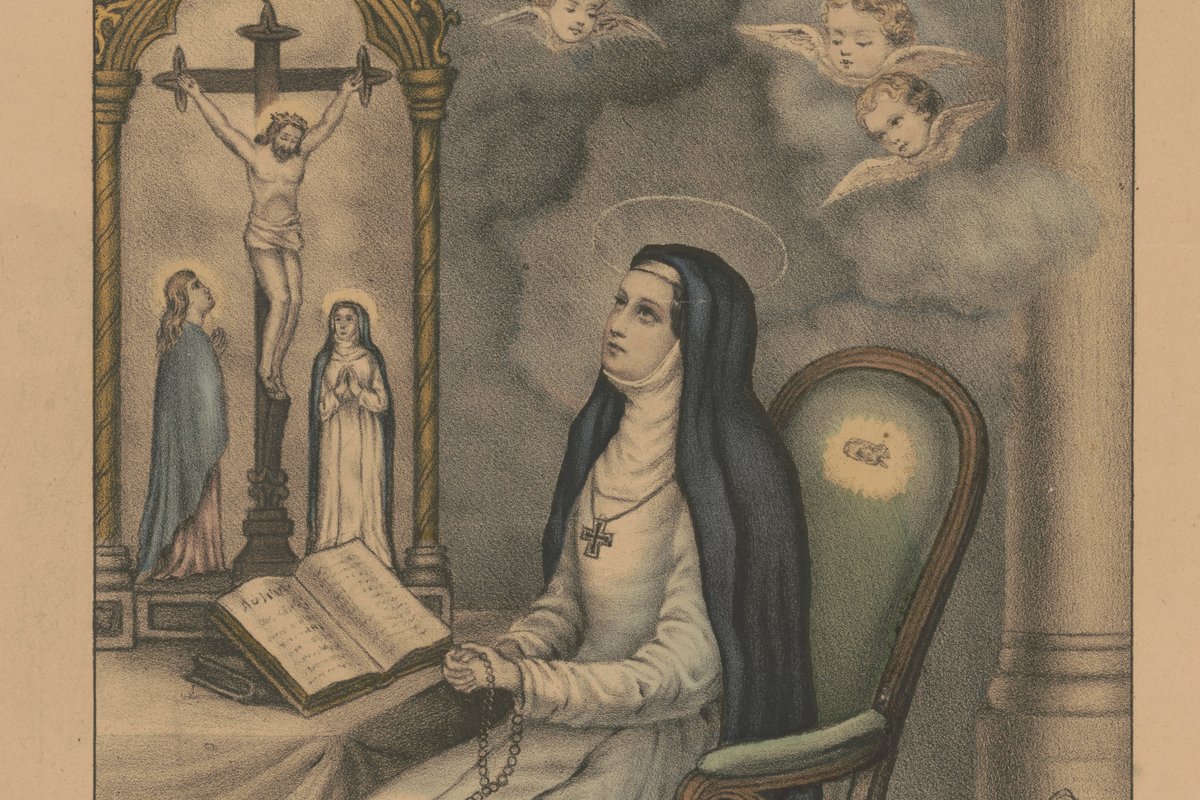
Because Lydwine's story is so tightly bound to a single accident, the art made about her keeps returning to that moment on the ice. The earliest printed life of her, published in 1498, includes woodcuts showing her fall in front of other skaters on a frozen Dutch canal — the same image used for this article's hero picture — and later paintings and prints followed the same pattern, contrasting the ordinary winter scene with the extraordinary suffering it set in motion. She's typically depicted as a bedridden woman, sometimes with a rosary, sometimes attended by an angel, rather than in the standing, triumphant poses given to warrior-saints or martyrs. It's a visual language that fits her: sanctity found lying still, not in dramatic action.
A pilgrimage site, and recognition centuries later
When Lydwine died in 1433, her grave in Schiedam quickly became a site of pilgrimage, carrying forward the same devotion that had drawn visitors to her sickbed while she was still alive. A chapel was eventually built over the site, and her cult persisted locally through the centuries even as the Reformation reshaped religious life across the Netherlands and made public Catholic devotion far more difficult in Dutch towns. Formal Church recognition came much later: Pope Leo XIII officially recognized her sanctity in 1890, confirming centuries of popular veneration with papal authority. The gap between local fame and papal recognition is common in this period — the medieval mystic Blessed Henry Suso, a near contemporary of Lydwine's on the other side of the German border, waited even longer for formal Church approval of a cult that had grown up around him during his own lifetime.
Patron of the sport that broke her
Lydwine's patronages read, more than most saints', like a direct response to her own biography. She's honored as patroness of her hometown, Schiedam, and — with obvious relevance — as patroness of people suffering chronic pain and long-term illness, a designation that needs no explanation given the thirty-seven years she spent living with exactly that. She sits alongside a small group of saints venerated specifically for chronic illness and healing, most of whom, unlike her, were not disabled themselves but ministered to the sick.
But it's her modern patronage as protector of ice skating and ice skaters that carries the sharpest, almost poetic irony: centuries after a single fall on the ice ended her health as she'd known it, the Church named her guardian of the very sport that caused it. Skating clubs in the Netherlands still mark her feast day, April 14, with quiet acknowledgment of the connection — a reminder that her patronage isn't an accident of bureaucracy but a direct line drawn from a fifteen-year-old's ordinary afternoon on the ice to the life, and the legend, that grew out of it.
Trivia
Who was Saint Lydwine of Schiedam?
What happened to Saint Lydwine of Schiedam after her skating accident?
Did Saint Lydwine of Schiedam have multiple sclerosis?
Are the stories of Saint Lydwine's fasting and visions historically verified?
What is Saint Lydwine of Schiedam the patron saint of?
You May Also Like
Related Reading