Saint Bernard of Clairvaux

Thirty recruits and a hard new order
Bernard was born in 1090 near Dijon, in Fontaine-lès-Dijon, Burgundy, into a noble family, and by 1113 had made an unusual decision for a young man of his background: he entered Cîteaux, the recently founded and still-struggling Cistercian monastery, known for a stricter, more austere reading of the Benedictine rule than most existing houses followed. He didn't go alone. Bernard had spent the preceding months personally persuading roughly thirty other men — including several of his own brothers and an uncle — to join him, a recruitment drive that on its own tells you something about how persuasive he already was at 22. Two years later, in 1115, the order sent him to found a new house of its own: Clairvaux Abbey, in Champagne, which he led as abbot for the remaining 38 years of his life.
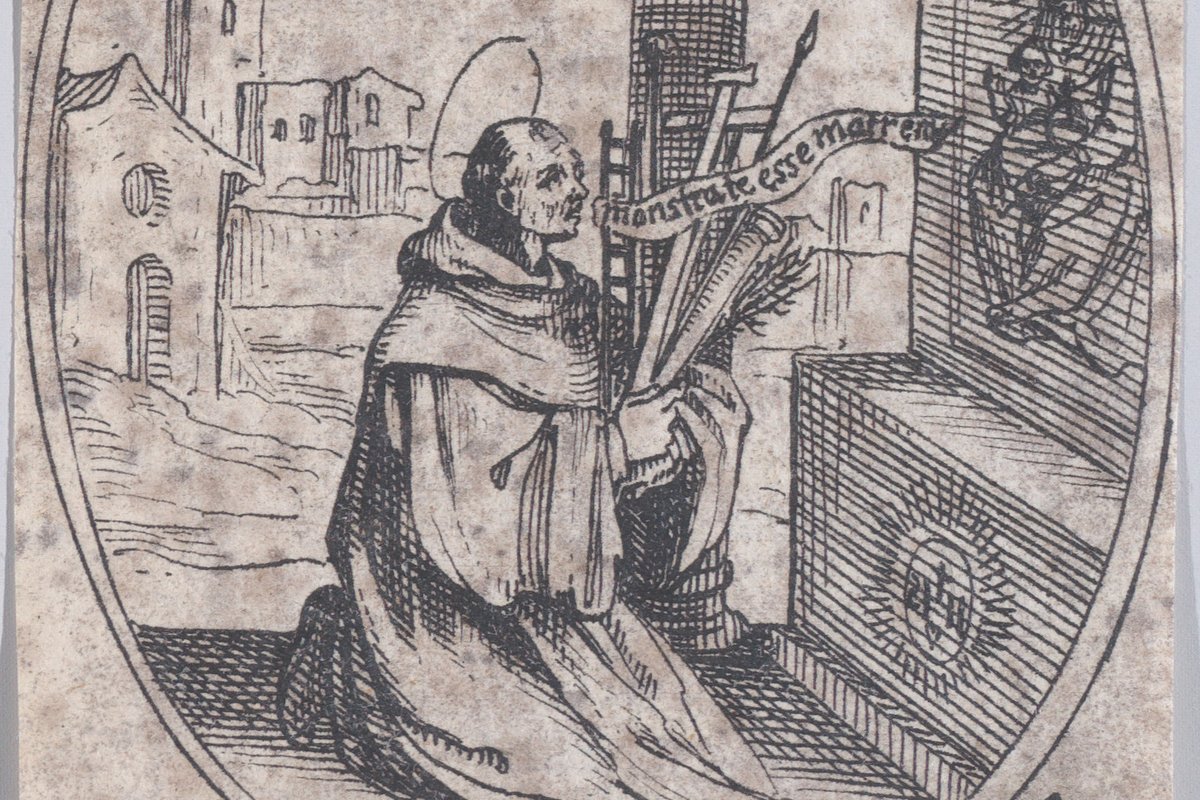
Jacques Callot, S. Bernard, abbé, from Les Images de Tous les Saincts et Saintes de l'Année, 1636, Metropolitan Museum of Art — public domain (CC0).
The abbey that built an order
Clairvaux grew quickly into the mother house of dozens of daughter monasteries across Europe, and Bernard, more than any other single figure, became the driving force behind the wider Cistercian reform movement — a push toward simpler liturgy, manual labor, and a stricter monastic discipline than much of contemporary Benedictine life had settled into. His influence reached well past the cloister. In the 1130s, when a disputed papal election split the Church between two claimants, Bernard threw his considerable authority behind Innocent II and helped resolve the schism in his favor, becoming, in the process, one of the most consulted churchmen in Europe on matters well beyond monastic reform.
De Diligendo Deo
Bernard was also a major theological and mystical writer, and one line from his treatise "On Loving God" (De Diligendo Deo) has outlasted most of his other work in popular memory: "The reason for loving God is God Himself; and the measure of love due to Him is immeasurable love" (Bernard of Clairvaux, De Diligendo Deo, Chapter I). It's a compact statement of a theme that runs through the whole treatise — that love of God doesn't need an external justification, because God himself is sufficient reason for it.
Vézelay, and a crusade that ended in disaster
In 1146, Pope Eugenius III commissioned Bernard to preach a new crusade after the Crusader stronghold of Edessa fell to Muslim forces the year before. Bernard took up the assignment with the same persuasive energy that had once talked thirty men into Cîteaux, and his preaching campaign for the Second Crusade was an immediate popular sensation — most famously at the assembly at Vézelay, where tradition holds that the crowd's demand for the cloth crosses marking a crusader's vow was so overwhelming that Bernard tore his own habit into strips to keep the supply going. That detail comes down through period chroniclers rather than Bernard's own writing, so it's fairest described as tradition rather than settled fact, but it captures how effective his preaching genuinely was.
The campaign that followed did not go well. The Second Crusade collapsed at the disastrous Siege of Damascus in 1148, achieving essentially nothing and costing a great many lives. Because the crusade's popular momentum had so clearly been Bernard's doing, the bitter criticism that followed its failure landed heavily on him personally, and he spent his later years defending himself against it. It's worth stating this plainly rather than folding it into a triumphant footnote about his preaching skill: Bernard bears real, documented responsibility for popularizing a campaign that ended in catastrophe. At the same time, historians don't place the failure on him alone — blame at the time and since has been spread across the Byzantine Greeks, internal disputes among the Templars, the count of Flanders, the military leadership of King Louis VII of France, and decisions made by the papal legates traveling with the army. This isn't a chapter of Bernard's life to glorify, and it isn't one to erase either — it's a genuinely complicated episode that belongs in any honest account of who he was.
A voice for Mary, and against a rival theologian
Bernard's writing wasn't confined to treatises on divine love. He preached and wrote extensively on the Virgin Mary, and sermons attributed to his devotion helped popularize forms of Marian piety that spread widely across medieval Europe — though scholars caution that not every Marian text later attributed to him is reliably his own work, a common problem with medieval authorship before strict textual attribution became standard practice. He was also a fierce theological opponent of Peter Abelard, the brilliant and controversial philosopher-theologian whose rationalist approach to explaining doctrines like the Trinity struck Bernard as dangerously overconfident in reason's ability to penetrate mysteries meant to be received in faith. Their dispute came to a head at the Council of Sens in 1140, where Bernard's arguments contributed to Abelard's condemnation — a clash, still studied today, between two very different medieval visions of how theology should be done: through mystical contemplation, as Bernard practiced it, or through dialectical reasoning, as Abelard championed.
Doctor Mellifluus
Bernard died at Clairvaux on August 20, 1153. Recognition came fast by medieval standards: Pope Alexander III canonized him on January 18, 1174, just 21 years after his death. Centuries later, Pope Pius VIII named him a Doctor of the Church in 1830, and in 1953 Pope Pius XII gave him the title "Doctor Mellifluus" — the honey-sweet doctor — in an encyclical of the same name, honoring the eloquence that had once filled a monastery with recruits and a crusade with volunteers. His feast is kept on August 20, and he's remembered today as patron of the Cistercian order, of beekeepers, of candlemakers, and of Gibraltar.
Trivia
Who was Saint Bernard of Clairvaux?
What did Bernard of Clairvaux actually write?
Did Saint Bernard preach the Second Crusade, and how is that viewed today?
When was Bernard of Clairvaux canonized, and when was he named a Doctor of the Church?
What is Saint Bernard of Clairvaux the patron saint of?
Related Reading