Saint Anthony the Great

One verse, taken literally
Anthony was born around the year 251 in the village of Coma, near Herakleopolis Magna in Egypt — a date reconstructed by later scholarship rather than independently documented at the time, but a reasonable anchor for his life. He inherited substantial land as a young man, and by his early twenties was a wealthy landowner with every reason to expect a comfortable, conventional life. That changed on an ordinary visit to church, where he heard a line from the Gospel read aloud instructing the listener to sell everything and give it to the poor. Rather than treating the line as a general spiritual ideal, Anthony took it as spoken directly to him. He sold the land, distributed the proceeds, and walked out into the Egyptian desert to live alone — a single, literal-minded act of obedience that, almost by accident, founded an entire way of Christian life.
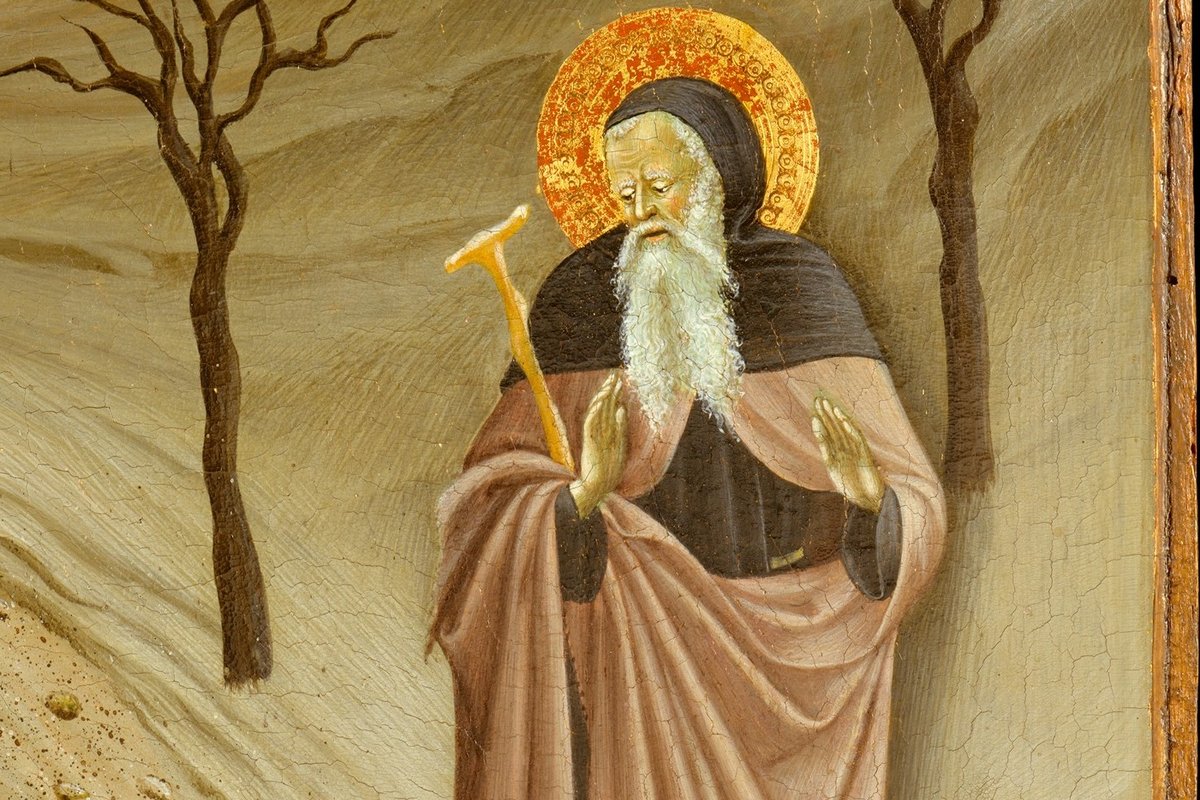
Master of the Osservanza Triptych, Saint Anthony the Abbot in the Wilderness, tempera on panel, c. 1435, Metropolitan Museum of Art — public domain (CC0).
The father of a movement he didn't set out to start
Anthony didn't organize a monastery or write a rule of life. He simply withdrew, progressively going deeper into solitude over the following years as his reputation for holiness spread. He first moved to tombs near his village, then further out to an abandoned Roman fort at Pispir on the edge of the desert, where Athanasius says he sealed himself in for roughly twenty years, receiving food passed through a gap in the wall and emerging only rarely to speak with the crowds gathering outside. Other men, drawn by his example, began settling near him and imitating his way of life, and out of that loose gathering of imitators grew the seedbed of organized Christian monasticism — the tradition that would later produce formal monastic rules, communities, and the entire vocabulary of "monks" and "hermits" the Church still uses. He's remembered as the "Father of Monks" not because he intended to found a movement, but because everyone who came after him in the desert traced their own vocation back to what he'd done first.
Later in life, Anthony withdrew even further, to a remote mountain near the Red Sea now called Mount Colzim, seeking greater solitude even from the disciples who had gathered around Pispir. He didn't cut himself off from the world entirely, though — he made at least two documented trips back to Alexandria, once to encourage Christians facing persecution under Emperor Maximinus, and once late in life to publicly support Athanasius against the Arian controversy, a major theological dispute over the nature of Christ that was convulsing the Church at the time. Those brief public appearances, contrasted against decades of near-total withdrawal, are part of what gave his life such lasting authority: he wasn't a recluse hiding from responsibility, but a man who left the world by choice and returned to it only when something greater than his own solitude was at stake.
A source historians actually trust
Much of what's known about Anthony comes from one text: the Life of Antony (Vita Antonii), written by Athanasius of Alexandria within a few decades of Anthony's death. That matters more than it might for other ancient saints. Athanasius was a contemporary Egyptian churchman with direct access to people who had known Anthony personally, and modern historians generally treat his account as substantially reliable for the broad contours of Anthony's life — a genuinely stronger historical foundation than the much thinner, later hagiography behind many early saints' stories. Anthony reportedly died at Mount Colzim, a hermitage near the Red Sea, on January 17, 356, at the extraordinary reported age of 105.
The demons that came a thousand years later
What's worth being direct about is where the popular image of Anthony actually comes from. Ask most people what they picture when they hear his name, and they'll describe grotesque monsters, hybrid creatures, and surreal, tormenting landscapes — the "Temptation of Saint Anthony." That imagery is almost entirely a later invention: Martin Schongauer's engraving from the 1470s, Hieronymus Bosch's triptych around 1501, Matthias Grünewald's panel on the Isenheim Altarpiece from around 1512–1516, Gustave Flaubert's 1874 novel, and Salvador Dalí's 1946 painting all built freely on the theme, adding centuries of imaginative embellishment that Athanasius's comparatively restrained text never contains. Anthony's near-contemporary written record describes real spiritual struggle and temptation in the desert, but the demon menagerie familiar from museum walls is the product of more than a thousand years of later art, not of the saint's own lifetime.
Patron of monks — and, unexpectedly, of pigs
Anthony's feast is kept on January 17 in the Western Church and on the 22nd of Tobi in the Coptic calendar; as a saint from Christianity's earliest centuries, he was never put through a formal papal canonization process, but has been venerated continuously since antiquity by both East and West. Beyond his obvious patronage of monks and monasticism, he picked up an unlikely secondary association in the Middle Ages: the Hospitallers of St. Anthony, a religious order founded in the eleventh century that treated sufferers of ergotism — a disease that came to be known as "St. Anthony's Fire" — kept pigs as part of their hospital work, which is the root of his folk patronage over domestic animals, swineherds, and basket-weavers. Ergotism itself was a poisoning caused by a fungus that grows on rye grain, producing burning sensations in the limbs severe enough that sufferers sought out the saint whose own body, tradition held, had proven immune to the fires of demonic temptation in the desert.
Anthony's relics were reportedly moved from Egypt to Constantinople and eventually to France in the eleventh century, where a shrine dedicated to him at Saint-Antoine-l'Abbaye in the Dauphiné region became a major pilgrimage destination for people suffering from the disease that bore his name — a striking example of how a hermit who spent his whole life fleeing crowds became, centuries after his death, the center of one of medieval Europe's busiest pilgrimage cults. His enduring popularity in art, from Byzantine icons to Renaissance altarpieces, also helped keep alive the desert spirituality he pioneered, a tradition carried forward by later figures like Saint Pachomius, who took Anthony's solitary example and organized it into the first communal monastic rule. It's a fitting legacy for a rich young man who took one verse of Scripture at its word, and by doing so gave the Church its first monk.
Trivia
Who was Saint Anthony the Great?
How reliable is the historical record for Anthony's life?
Did Saint Anthony really see monstrous demons in the desert?
Why is Anthony the Great associated with animals and 'St. Anthony's Fire'?
When is the feast of Saint Anthony the Great, and was he formally canonized?
You May Also Like
Related Reading