Saint Pachomius the Great

A conscript fed by strangers
Pachomius was born around 292 in the Thebaid, the stretch of Upper Egypt along the Nile, into a pagan family with no connection to Christianity. Like many young men of his region, he had no say in the matter when Roman authorities swept him up for military service in his early twenties. He and the other new recruits were held under guard in a barracks in Thebes, cold and hungry, waiting to be shipped off to serve an empire they'd had no hand in choosing.
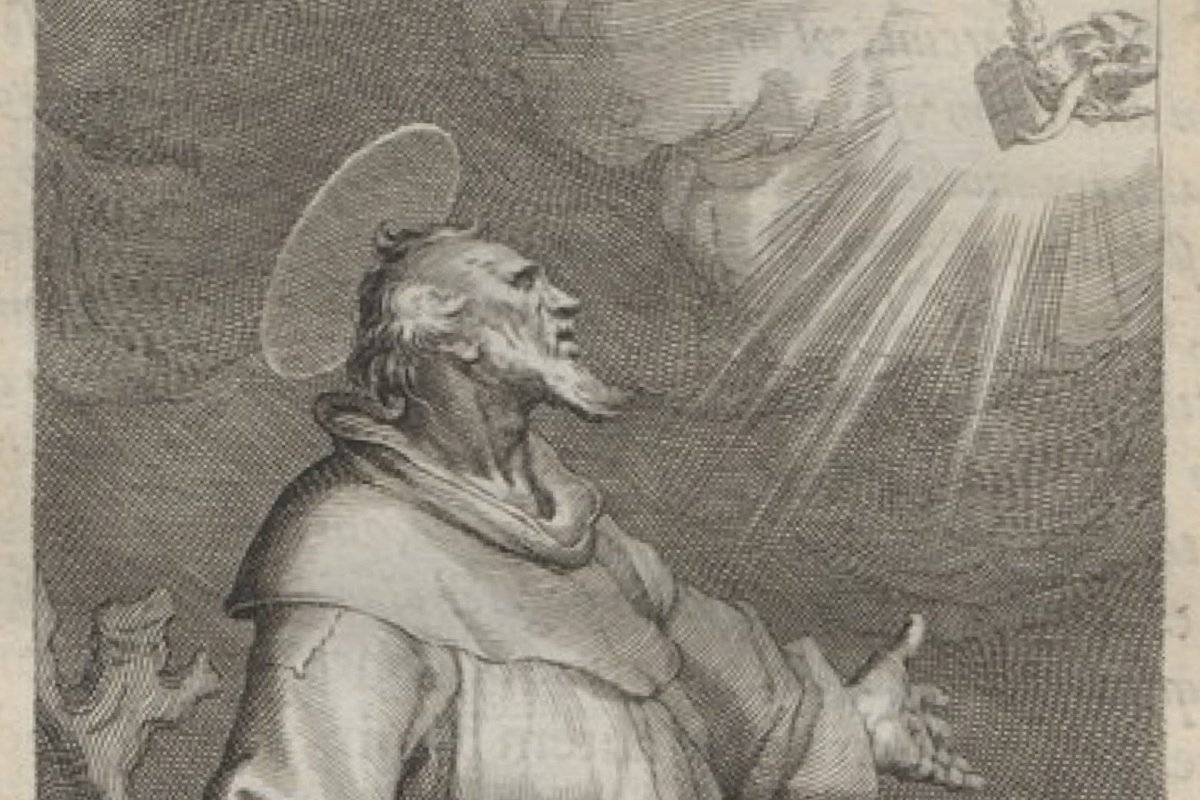
Design by Abraham Bloemaert, engraving by Boetius à Bolswert, "Sanctus Pachomius," plate from Sylva anachoretica Aegypti et Palaestinae, 1619, Radboud University Library — public domain.
What happened next is the detail that made Pachomius's later life possible. Local Christians from the town came to the barracks and brought food and comfort to the prisoners — people they'd never met, soldiers of an occupying power, with nothing to gain from the kindness. Pachomius was struck hard enough by it that he prayed that night to "the God of the Christians," asking for his release and promising that if it came, he would spend the rest of his life serving others. He was eventually discharged, and he didn't forget the promise. He sought out instruction in the Christian faith, was baptized, and began the search for how, exactly, to live out what he'd vowed.
Learning solitude before building community
The monastic model available to Pachomius in the early fourth century was almost entirely eremitic — hermits living alone in the desert, following the pattern associated with Anthony the Great, seeking God through solitude and personal ascetic discipline. Pachomius apprenticed himself to one of these hermits, a man named Palaemon, and spent years living under his guidance, learning the rhythms of prayer, fasting, and manual labor that defined the anchorite life.
It was solid training, but it wasn't where Pachomius's own vocation ultimately settled. Somewhere in that solitude, he began to think differently about the promise he'd made in the barracks — not just to serve God alone in the wilderness, but to build something where people served each other.
Tabennisi and the birth of communal monasticism
Around 323 to 325, Pachomius founded a monastery at Tabennisi, on the east bank of the Nile. What made it different from anything before it wasn't the location or the rule of prayer — it was the structure. Instead of scattered hermits living apart and meeting only occasionally, Pachomius gathered monks to live, eat, work, and pray together under one roof, organized into "houses" grouped by trade, wearing common dress, eating common meals, and reporting through superiors who in turn answered to Pachomius himself.
This was the first documented instance of what's now called cenobitic monasticism — from the Greek for "common life" — a genuinely new structural model for Christian religious life, distinct from the solitary anchorite tradition that had come before it. Pachomius went on to write what survives as the earliest known monastic rule in Christian history, though it comes down to later generations mainly through Jerome's Latin translation and fragmentary Coptic and Greek texts rather than in Pachomius's own original wording — worth noting plainly, since no verified direct quotation from his own hand can be pinned down with confidence.
An angel's tablet — legend, not history
One story attached to Pachomius deserves to be named clearly as legend: the later hagiographic Life traditions describe an angel appearing to him dressed as a monk, handing him an inscribed tablet containing the rule for cenobitic life. It's a vivid image, and it circulated widely in devotional literature about him — but it belongs to pious storytelling built up after the fact, not to the historical record. What actually happened, as far as scholars can reconstruct it, is more remarkable in its own way: an ordinary man worked out, through trial and error and real administrative effort, an entirely new way for Christians to live together.
A movement that outgrew one monastery
By the time Pachomius died — likely of a plague sweeping through his monasteries around May 9, 348, at Pbow near Tabennisi — his communities had grown into a network of roughly nine to eleven monasteries, both men's and women's houses, home to several thousand monks and nuns. That's a striking scale for something built from nothing within a single lifetime, and it didn't stop growing in influence after his death. Basil the Great drew on the cenobitic model when shaping monastic life in Cappadocia, and through Jerome's Latin translation of Pachomius's rule, the tradition reached the West, feeding into the monastic thinking that Benedict of Nursia would later formalize in his own famous Rule.
Feast day and legacy
Pachomius is venerated as a saint from before the Church had any formal canonization process — his cult dates to ancient veneration shared by East and West alike. His feast is kept on May 9 in the Catholic and Coptic traditions, and on May 15 in the Eastern Orthodox calendar. He's honored broadly as the patron of monks and coenobites, a patronage that doesn't rest on any single miracle story but on the plain historical fact of what he built: a structure for shared religious life that monasteries, in one form or another, still follow seventeen centuries later.
Trivia
Who was Saint Pachomius the Great?
How did Pachomius become a Christian?
What's the difference between Pachomius's monasticism and the earlier hermit tradition?
Did an angel really give Pachomius his monastic rule?
What is Saint Pachomius the patron saint of?
You May Also Like
Related Reading