Saint Bruno of Cologne

A teacher who quit over corruption
Bruno was born around 1030 in Cologne, Germany, and built a genuinely distinguished career as a scholar: he taught theology and eventually served as chancellor of the Diocese of Reims, a senior administrative post in one of the most important dioceses in France. Students traveled considerable distances to study under him, and by his middle years he was one of the more recognized theological teachers in northern France — a man with a clear, comfortable path ahead of him. That career came to an end over a matter of principle. Reims's archbishop at the time, Manasses, became embroiled in a corruption dispute serious enough that Bruno chose to leave rather than remain associated with the diocese under his leadership — walking away from an established, respected position rather than compromise on the issue. He wasn't alone in that decision either; a handful of former students and colleagues left with him, drawn more by his example than by any plan he'd yet worked out.
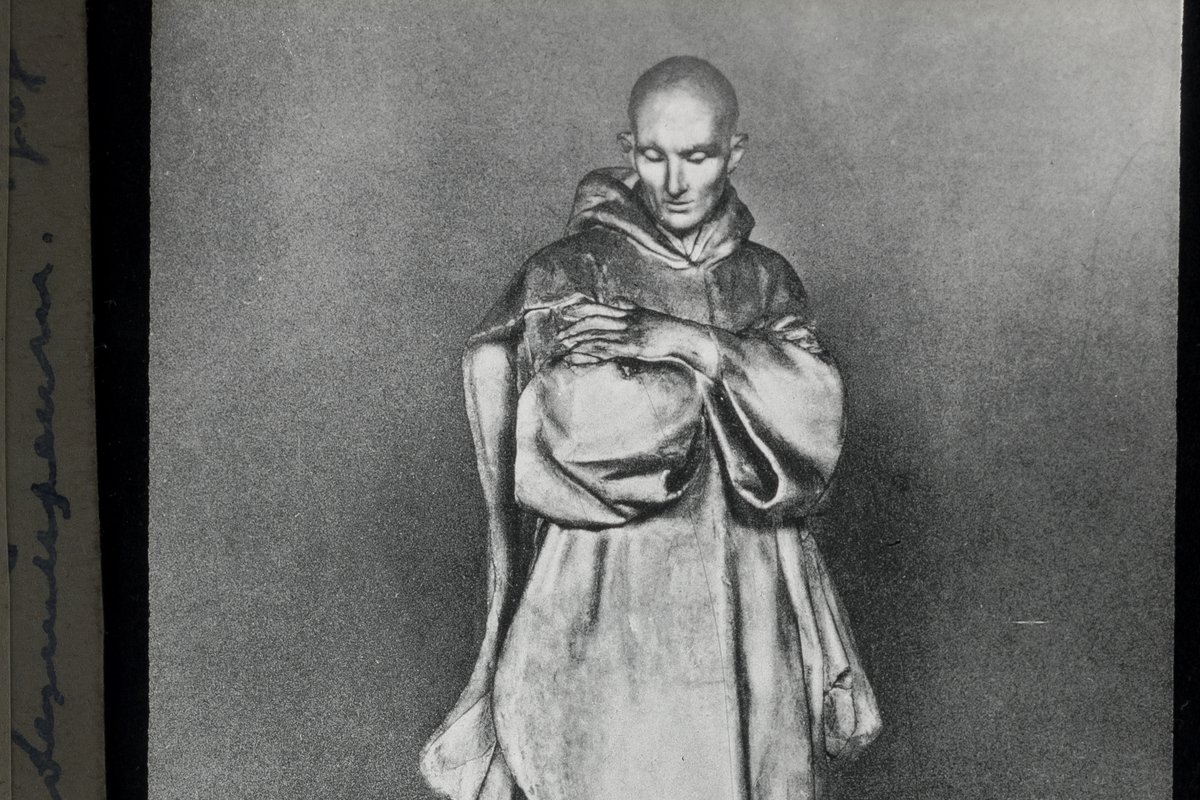
Jean-Antoine Houdon, Saint Bruno (preparatory model), 1767, Landesmuseum Gotha; glass-slide photograph, KU Leuven Libraries — public domain.
Six men and an Alpine valley
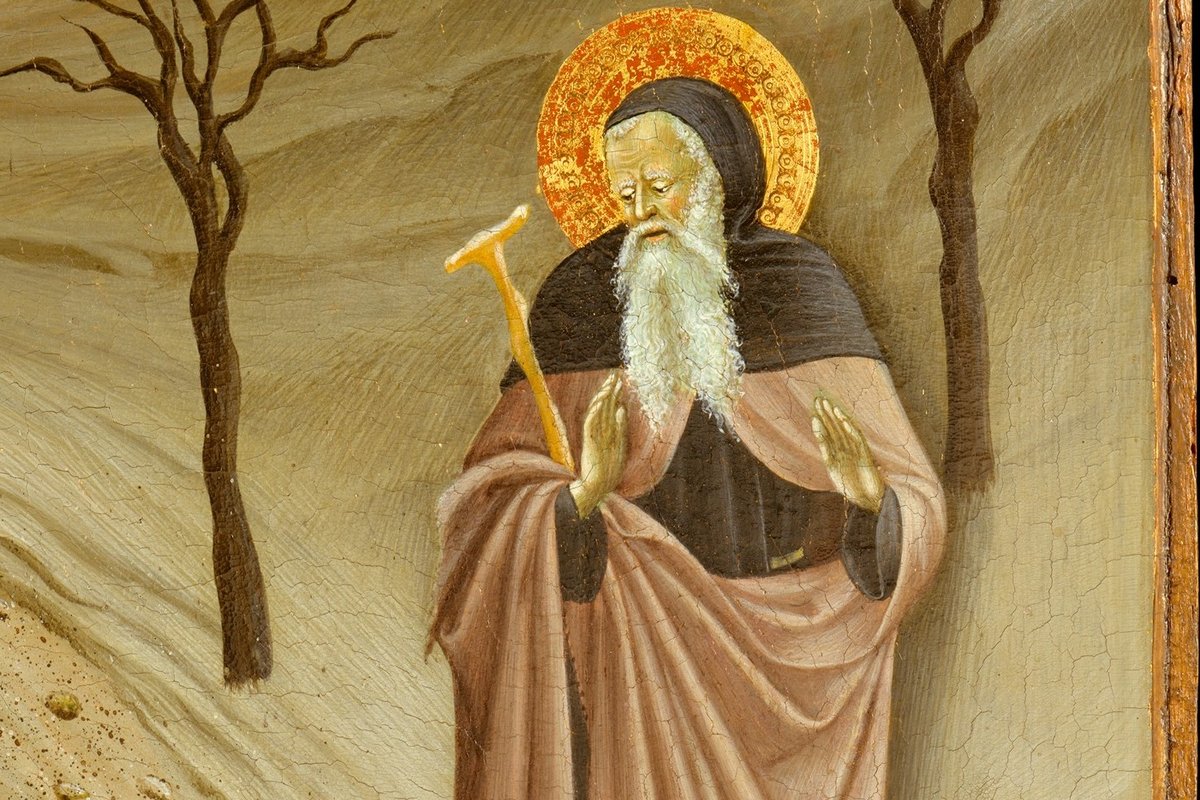
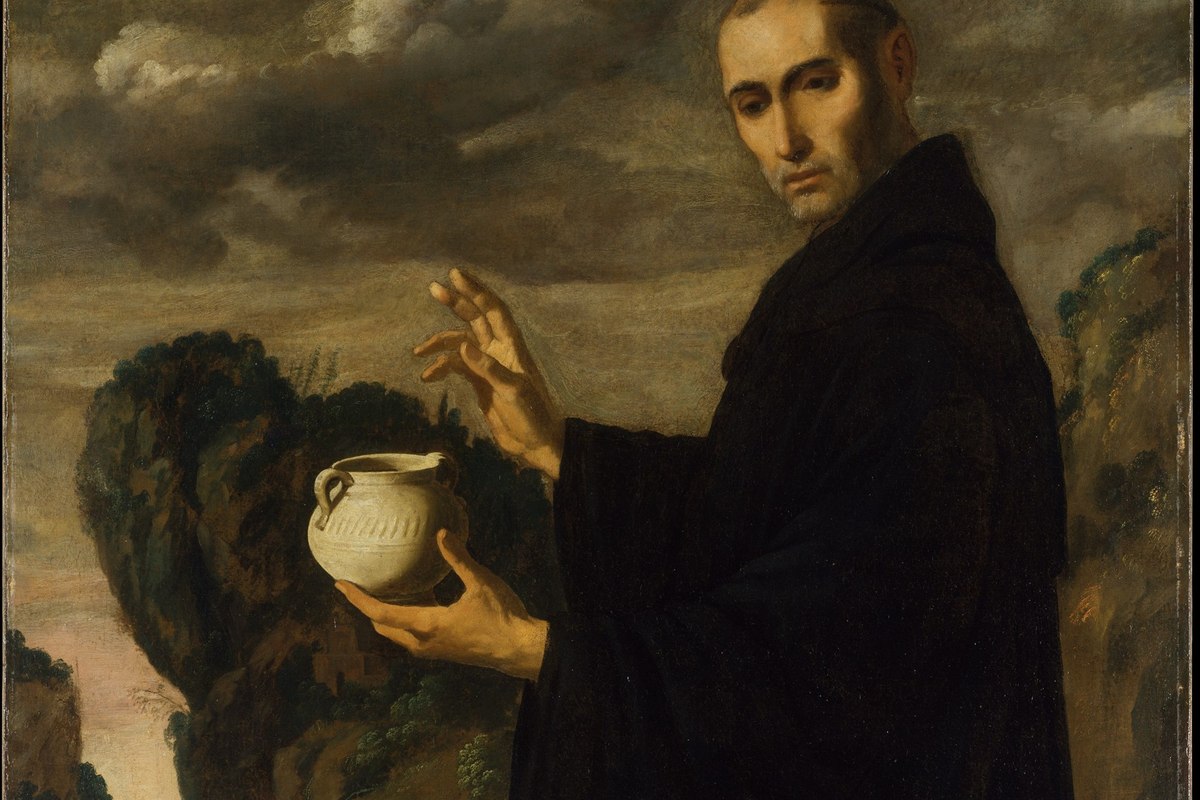
What followed wasn't a quiet retirement. Bruno first tried monastic life at Molesme, under the future Saint Robert of Molesme, but it didn't hold him — he was looking for something starker, closer to the solitary life of early desert monks like Saint Anthony the Great than to the busy communal routines of a conventional Benedictine house. In 1084, he withdrew with six companions into a remote, difficult valley high in the French Alps, guided there by Hugh of Grenoble, the local bishop, who had reportedly seen the site in a dream years before Bruno ever arrived. There they founded the Grande Chartreuse — not as a conventional monastery with monks living a fully shared communal life, but as a cluster of individual stone hermitages loosely bound together, an arrangement that let each monk live largely in solitude while still belonging to a genuine community. Each monk kept his own small cell with a garden plot, meeting the others only for a handful of communal offices and one shared meal on Sundays and feast days; for the rest of the week, meals were passed through a hatch in the cell door so that even that small contact wouldn't interrupt the silence. That eremitic-communal structure became the defining feature of the Carthusian order that grew out of it, an order still summarized by its enduring motto, "Stat crux dum volvitur orbis" — the cross stands still while the world turns. Unlike many medieval religious orders, the Carthusians never underwent the kind of internal reform crisis that forced other communities to rewrite their rule from scratch; their way of life at the Grande Chartreuse today is still recognizably the one Bruno set down.
Summoned to Rome, and a second foundation
Bruno's reputation eventually reached Rome. Pope Urban II, who had studied under Bruno years earlier, summoned his former teacher to serve as an advisor at the papal court. Bruno went, but declined the bishopric he was offered there, choosing instead to return to the kind of life he'd built in the Alps. Rather than going back to the Grande Chartreuse itself, he founded a second charterhouse, La Torre, in Calabria, in southern Italy, where he lived out the rest of his life and died on October 6, 1101.
A legend about a rising corpse
A vivid story has long circulated about what supposedly pushed Bruno toward founding the Carthusians in the first place: that he witnessed a Paris canon, traditionally named Raymond Diocrès, sit up three times in his own coffin during his funeral Mass, each time announcing his own condemnation by God. It's a dramatic scene, and it isn't in the earliest reliable accounts of Bruno's life — a later pious addition rather than documented biography, and it should be read as legend rather than as an explanation for his actual decision to leave Reims.
Two canonizations, a century apart
Bruno left almost nothing behind in his own words — just two short surviving letters, one to a friend named Raoul Le Verd and one to the Carthusians of Chartreuse — so any quotation circulating under his name beyond those letters should be treated with caution. His path to sainthood was similarly understated. The Carthusian order's own culture of humility meant no one pushed for a formal papal canonization on his behalf for centuries. On July 19, 1514, Pope Leo X authorized liturgical veneration of Bruno through equivalent canonization — but that recognition applied only within the Carthusian Order itself, not the wider Church. It took until February 17, 1623 for Pope Gregory XV to extend his feast to the entire Latin Church, later raised in rank by Pope Clement X in 1674. Those are two distinct milestones separated by more than a hundred years, not one event — worth keeping straight, since accounts of his sainthood sometimes blur them together. His feast is kept on October 6, and while no major individual patronage is attached to his name, his real legacy is harder to overstate: an order of hermit-monks, founded in a snowbound valley by seven men, that has continued in unbroken practice for over 900 years.
Trivia
Who was Saint Bruno of Cologne?
What made the monastery Bruno founded different from other monasteries?
Was Bruno of Cologne ever formally canonized?
Is the story about a corpse rising up at its own funeral connected to Bruno's founding of the Carthusians?
What is Saint Bruno of Cologne the patron saint of, and when is his feast?
You May Also Like
Related Reading