Saint Syncletica of Alexandria

A fortune given away, a life deliberately hidden
Syncletica's traditional dates — born sometime in the 270s, died in the 350s at around age 80 — are reconstructions rather than firm historical record, and it's worth saying so plainly before anything else. Her family was of Macedonian origin and had relocated to Alexandria, in Roman Egypt, where she was born into considerable wealth. She had two brothers who died in childhood, and one sister, blind from an early age, with whom she remained closely connected for the rest of her life. After their parents died, Syncletica made a decision that upended everything her social position was supposed to lead toward: she gave away the family fortune, cut off her hair, and withdrew with her blind sister into a converted tomb or crypt outside the city, deliberately choosing the kind of obscurity that a wealthy, reportedly beautiful young woman of her era was never expected to want.
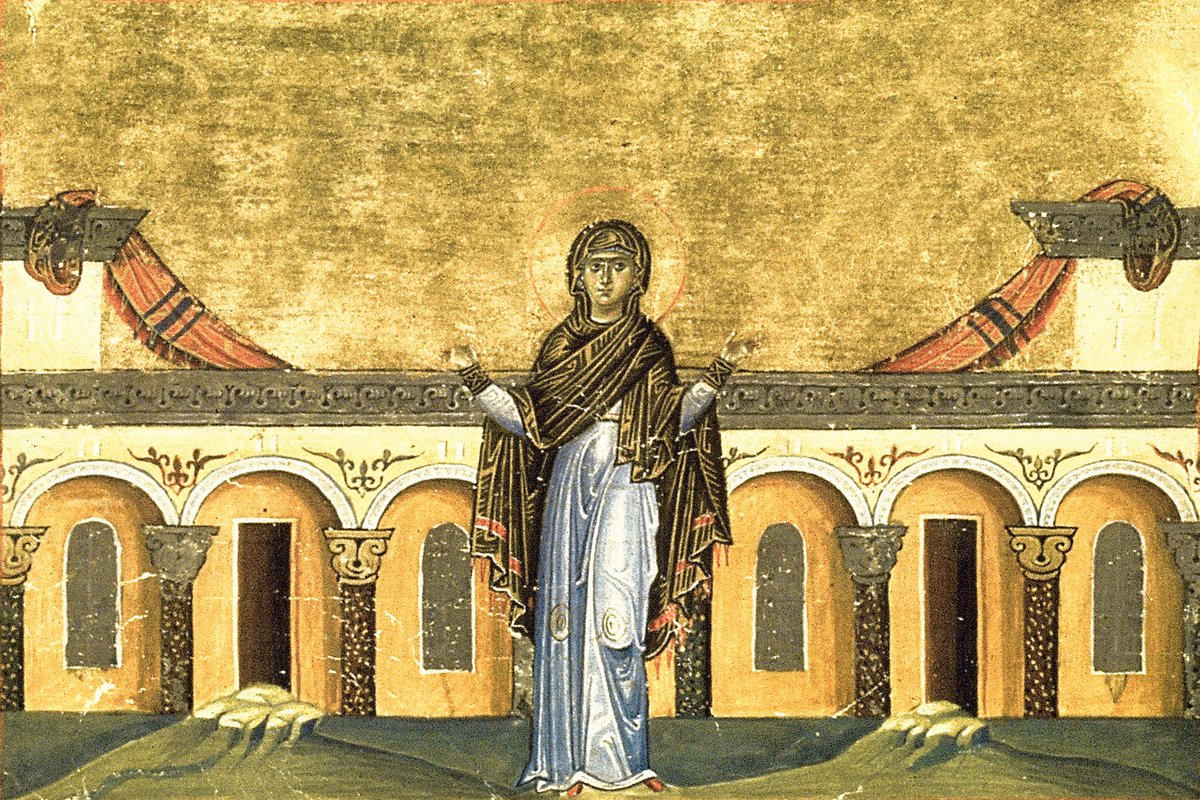
Menologion of Basil II, Righteous Syncletica of Alexandria, c. 985 AD, Vatican Library (Vat. gr. 1613) — public domain.
A teacher who tried not to be one
That attempt at disappearing didn't work, at least not permanently. Despite Syncletica's efforts to live in genuine seclusion, word of her spread, and women began seeking her out for spiritual guidance. In time she became known as an "Amma" — the female counterpart to the "Abba" title given to the male spiritual teachers of the desert monastic movement that was reshaping Christian religious life across Egypt and the wider Mediterranean world in this period. That she held this kind of recognized teaching authority, on comparable footing with the desert fathers whose names are far better remembered today, is one of the more distinctive and important details of her story.
Twenty-eight of her sayings are preserved in the Apophthegmata Patrum, the "Sayings of the Desert Fathers," a 6th-century compilation of the teachings attributed to the monastic movement's early leaders. Her sayings stand out within that collection for how heavily they draw on nautical and everyday domestic-labor imagery — the kind of concrete, working images that would have made sense to people who had never set foot in a classroom but understood ships, tools, and household work. One widely cited example, drawn from that tradition, compares humility to the nails that hold a ship's timbers together: without it, she taught, salvation isn't possible, any more than a ship can be built without nails.
Teaching that took suffering seriously
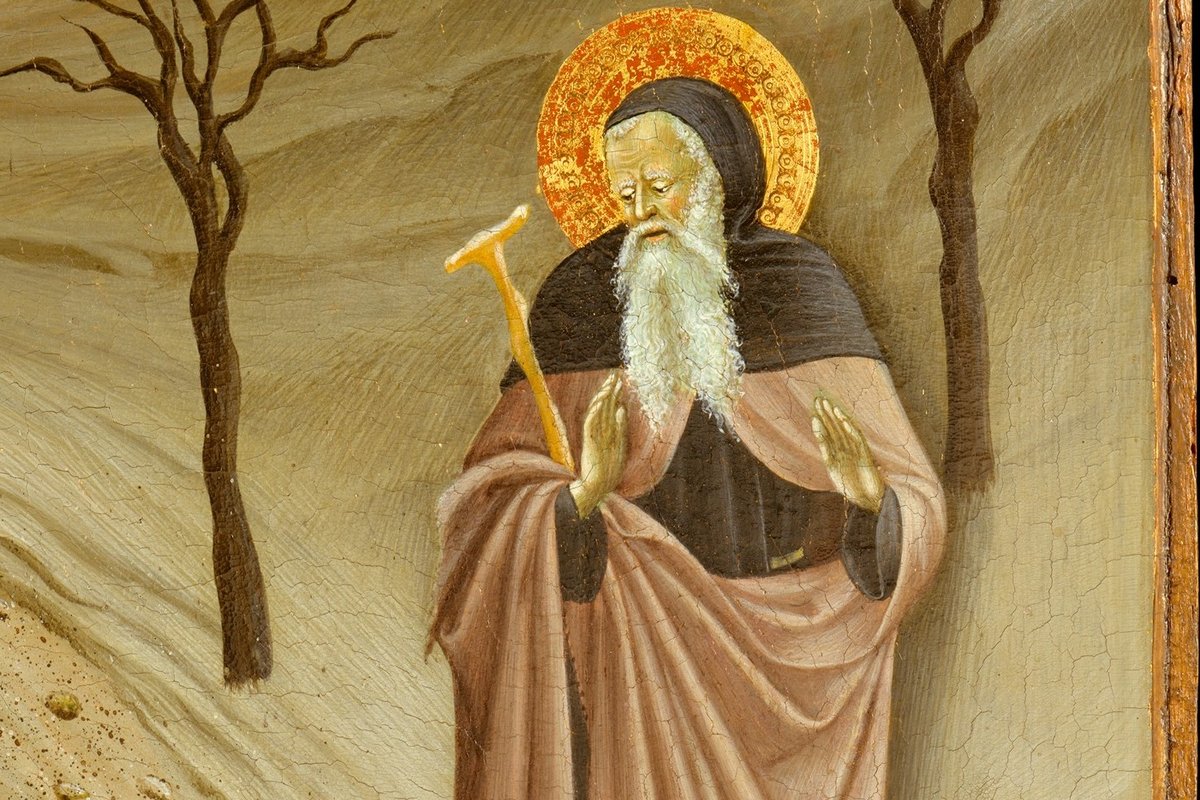
Beyond the nail-and-ship image, Syncletica's recorded sayings return again and again to a theme many of the desert fathers, including the movement's founding figure Saint Anthony the Great, also emphasized: that the spiritual life is a form of ongoing struggle, not a single dramatic renunciation followed by peace. She's remembered for describing the ascetic path in stages, comparing early efforts at self-discipline to lighting a fire with damp wood — difficult, smoky, and slow to catch, but eventually giving way to a steadier flame that requires far less struggling to maintain. She also taught, more bluntly, that withdrawing from the world doesn't end temptation so much as relocate it: a monastic in seclusion still has to fight the same interior battles anyone does, just without the usual distractions available to soften or delay the fight.
That teaching carries extra weight given how Syncletica herself died. Tradition holds she endured roughly three years of illness before her death, a painful condition affecting her mouth and throat that eventually left her unable to speak at all in her final months. Later generations of her admirers read this drawn-out suffering not as contradicting her teaching on discipline and perseverance, but as its final, most demanding lesson — a woman who had spent decades teaching others how to hold steady through difficulty facing an illness that gave her every reason to test that same teaching on herself.
What can, and can't, be said with confidence
The central biographical source for Syncletica's life, known simply as the "Life of Syncletica," has traditionally been attributed to Athanasius of Alexandria, the towering theologian who died in 373. That attribution runs into an immediate problem: the text wasn't actually published until around 450 AD, roughly eight decades after Athanasius's death, which makes his authorship almost certainly false. Some scholars have gone further still, suggesting that "Syncletica" may function in this literature more as a kind of composite or literary figure representing an ideal of ascetic wisdom than as a precisely documented historical individual whose biography can be trusted in its specifics. The honest position is a mixed one: her sayings are a reasonably well-attested part of the broader Apophthegmata tradition, cited and recopied for centuries, while the detailed narrative of her life — her exact family circumstances, the precise shape of her early years — deserves real caution rather than flat retelling as settled fact.
No recorded miracles, and veneration built on something else
One more detail sets Syncletica apart from most saints of her era, ancient or otherwise: no miracles, during her lifetime or after her death, are recorded for her anywhere in the tradition. She died after a three-year illness, traditionally described as a form of cancer affecting the mouth and throat, at around 80 years old. Her veneration — shared across Catholic, Eastern Orthodox, Oriental Orthodox, and Anglican traditions, and marked with a feast on January 5 in the Catholic calendar and January 6 in Orthodox tradition — rests entirely on her teaching and her example, not on any claim of miraculous intercession. In a monastic literature full of dramatic wonders, that absence is itself worth noticing: Syncletica's authority came from what she said and how she lived, not from anything more extraordinary than that.
Trivia
Who was Saint Syncletica of Alexandria?
How reliable is what we know about Syncletica's life?
What does 'Amma' mean, and why is it significant that Syncletica was one?
What is Syncletica's most famous saying?
Are any miracles recorded for Saint Syncletica?
You May Also Like
Related Reading