Saint Bernadette Soubirous

A miller's daughter sent to gather firewood
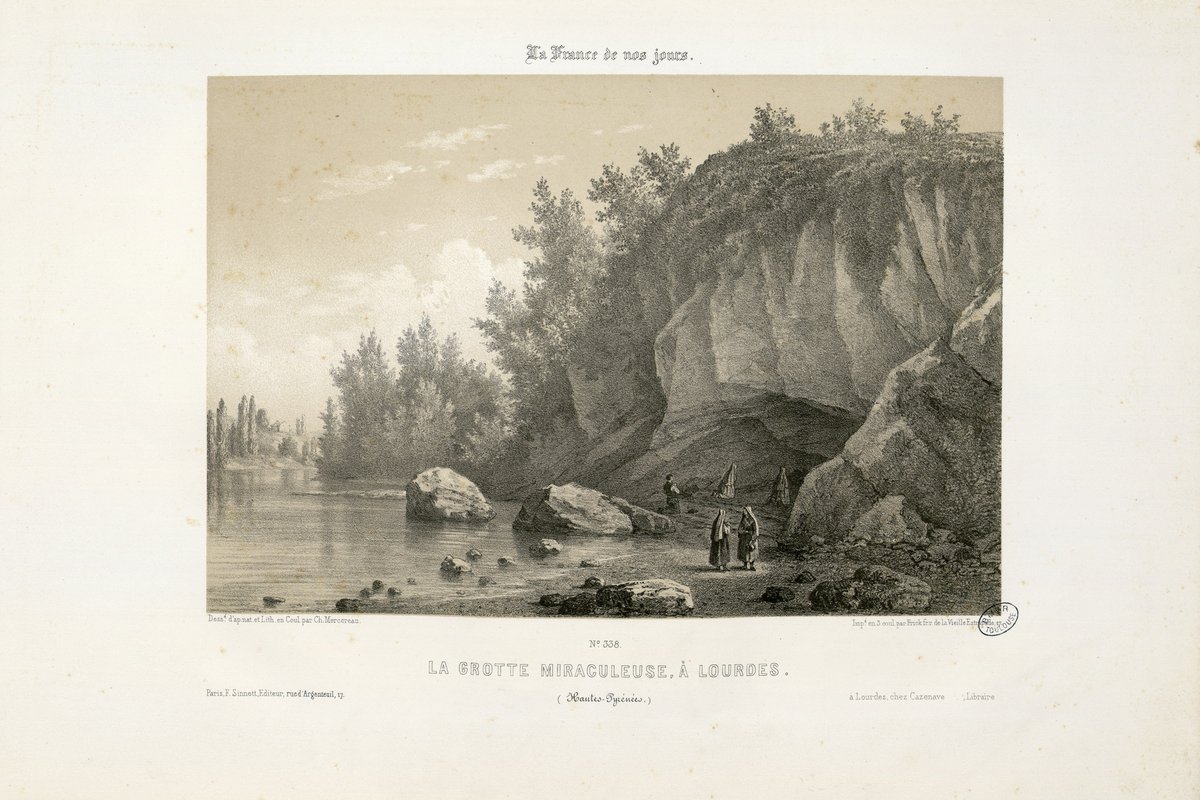
Marie-Bernarde Soubirous — known throughout her life as Bernadette — was born January 7, 1844, in Lourdes, France, into a family that had fallen from modest prosperity into real poverty; her father had once run a mill but lost it, and the family was living in cramped, difficult circumstances by the time she was a teenager. She was also chronically unwell, asthmatic for most of her life, in a period when childhood illness routinely went untreated. On February 11, 1858, fourteen years old, she was sent out with her sister and a friend to gather firewood near the Massabielle grotto — a rocky area on the edge of town, close enough to the local garbage dump that no one would have called it a place of particular beauty or significance.
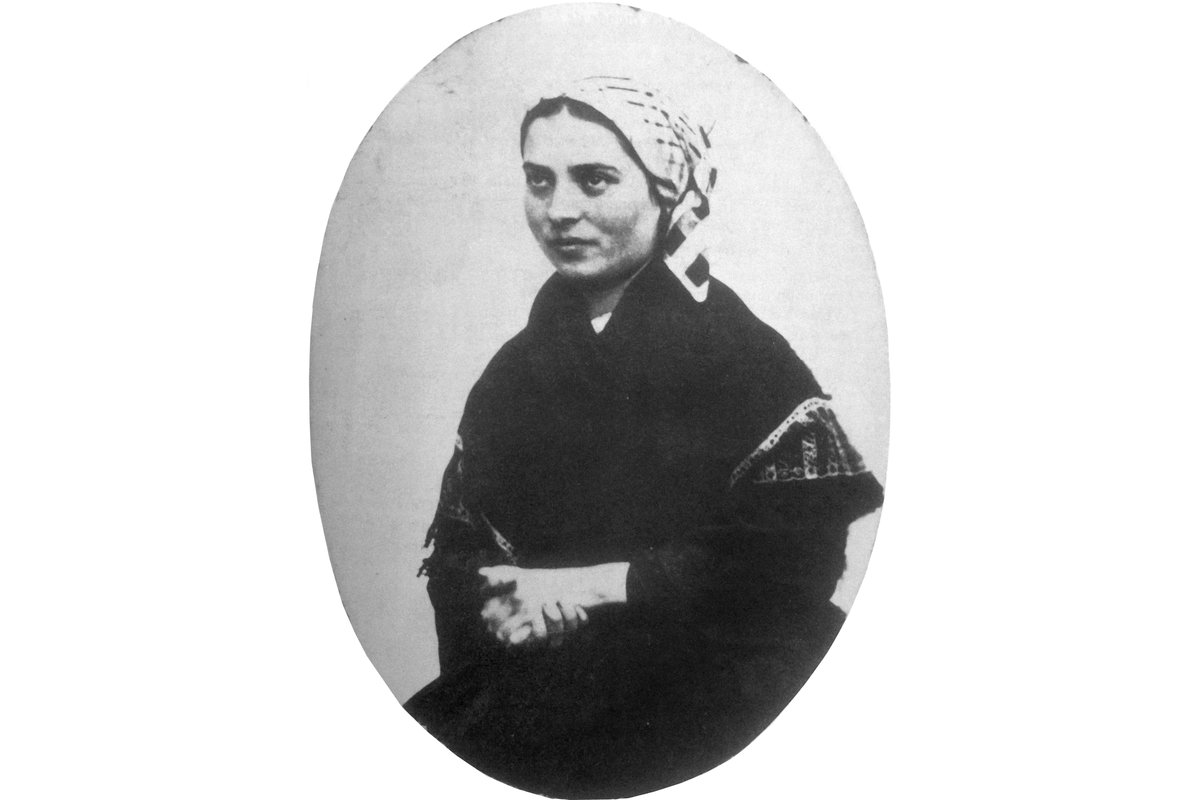
Photograph of Bernadette Soubirous, 1863, by Auguste Billard-Perrin — public domain.
Eighteen visits to a grotto
It was there that Bernadette reported seeing "something white in the shape of a woman" occupying a niche in the rock. She went back. Over the following months, through July 16, 1858, she reported eighteen separate apparitions of what she simply called "the Lady" at the same spot — and as word spread through Lourdes, the visits stopped being a private matter. Local civil authorities, uneasy about the crowds gathering and the disruption to public order, treated the whole situation as a problem to be managed and pressured Bernadette's family to make it stop. She kept going anyway, unmoved by explicit threats that she could be committed to an asylum for what she was claiming. Her own position, through all of it, stayed strikingly modest: she wasn't there to convince anyone of anything. She had been given a message to pass along, and passing it along — not securing belief — was the whole of what she understood her job to be.
Among what she reported hearing, one detail became central to how the apparitions were later understood theologically: Bernadette said the Lady identified herself, speaking in the local Occitan dialect, with words she rendered as meaning "I am the Immaculate Conception" — a title referring to Mary's own conception free from original sin, a doctrine Pope Pius IX had formally defined just four years earlier, in 1854. That timing is one of the details that gave the Lourdes apparitions particular theological weight in the Church's eventual assessment of them.
A four-year investigation, not an instant verdict
It's worth being clear about how slowly the Church actually moved here, because popular retellings sometimes flatten this into instant recognition. It wasn't. The bishop of Tarbes convened a formal commission to investigate the claims, interviewing witnesses and examining the physical and circumstantial evidence over an extended period, and it wasn't until 1862 — four years after the first apparition — that the Church declared the events at Massabielle worthy of belief. That gap represents a genuinely cautious, skeptical process, the opposite of an institution eager to rubber-stamp a visionary teenager's claims.
A short life spent mostly out of view
In 1866, Bernadette entered the Sisters of Charity of Nevers, and for the remaining thirteen years of her life she lived largely outside the public spotlight that Lourdes itself had become — a deliberate contrast, by most accounts, with the pilgrimage site growing around the grotto she'd once visited as an ordinary, sickly teenager. Her health, never strong, worsened steadily; she suffered from chronic asthma and later bone tuberculosis, and she died at Nevers on April 16, 1879, at just thirty-five years old.
She was beatified on June 14, 1925, and canonized on December 8, 1933, both under Pope Pius XI. As part of her canonization process, her body was exhumed three separate times — in 1909, 1919, and 1925 — and each exhumation is documented in the Church's own records as finding her remains in a remarkably preserved state. Today her body rests in a glass reliquary at the motherhouse chapel in Nevers, on public display; a wax mask covers her face and hands for that display, a detail worth naming plainly rather than letting the word "incorrupt" suggest something more absolute than what the exhumation records actually describe.
A saying she probably never said quite that way
One line associated with Bernadette circulates constantly in devotional writing: "I am not responsible for making people believe, I am only responsible for telling them." It captures her actual, well-documented posture throughout the apparitions and the scrutiny that followed remarkably well — but careful sources are clear that this exact phrasing isn't attested in any verified primary source. It's best treated as a fair paraphrase of a real, consistent attitude rather than a direct quotation.
Bernadette's feast is kept on April 16, the date of her death, with February 18 observed in some local and pre-1969 calendars — the date tradition holds the Lady promised her happiness "not in this life, but in the next." She's honored today as patroness of the sick, of shepherds and shepherdesses, and of Lourdes itself, the pilgrimage town her firewood-gathering trip in 1858 transformed permanently. Readers interested in the apparitions themselves, rather than Bernadette's own biography, may want to read this blog's article on Our Lady of Lourdes.
Trivia
Who was Saint Bernadette Soubirous?
What did Bernadette Soubirous actually see at Lourdes?
Did the Church immediately believe Bernadette Soubirous?
Is Bernadette Soubirous's body really incorrupt?
Did Bernadette Soubirous really say 'I am not responsible for making people believe, I am only responsible for telling them'?
You May Also Like
Related Reading