Saint Marcellin Champagnat

Born the year the Revolution began
Marcellin Champagnat was born on May 20, 1789, in Marlhes, France — the same year the French Revolution began, a coincidence of timing that meant his entire childhood unfolded against the backdrop of a country tearing up and rebuilding its relationship with the Catholic Church. He was ordained a priest on July 22, 1816, entering ministry in a France still working out what parish life and Catholic education would look like in the Revolution's aftermath.
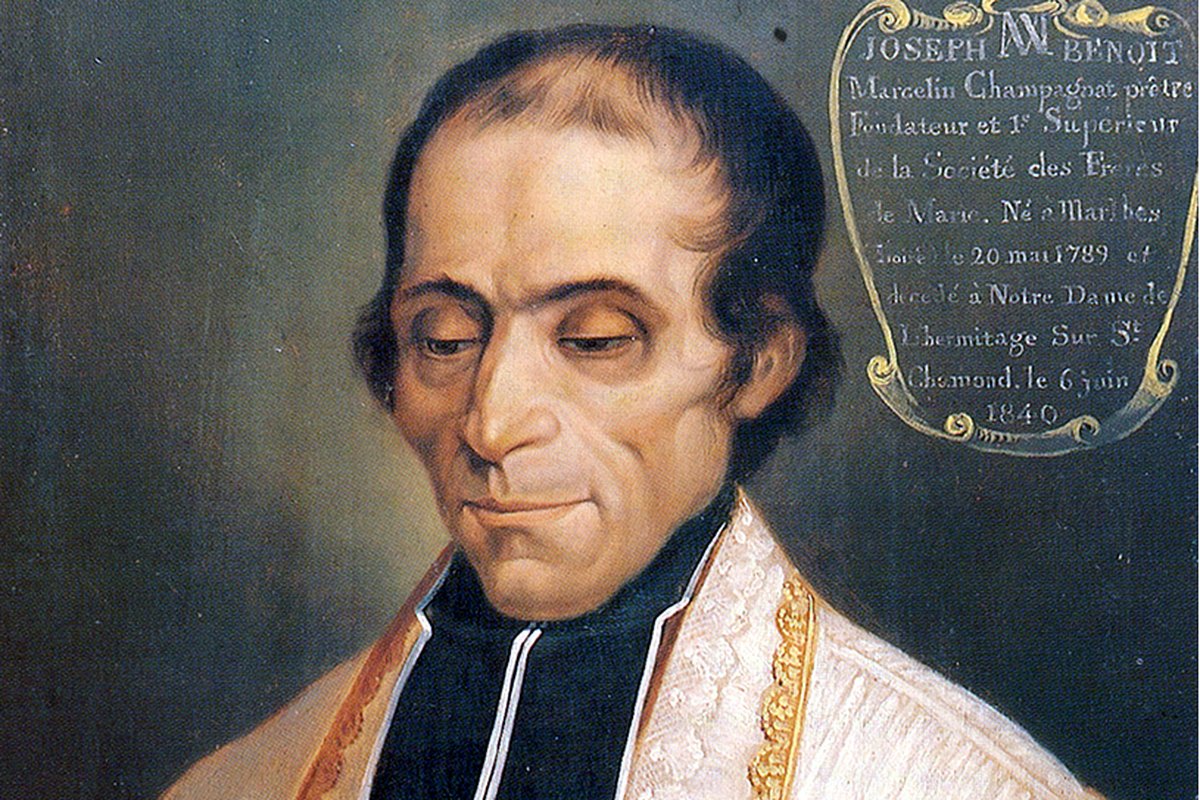
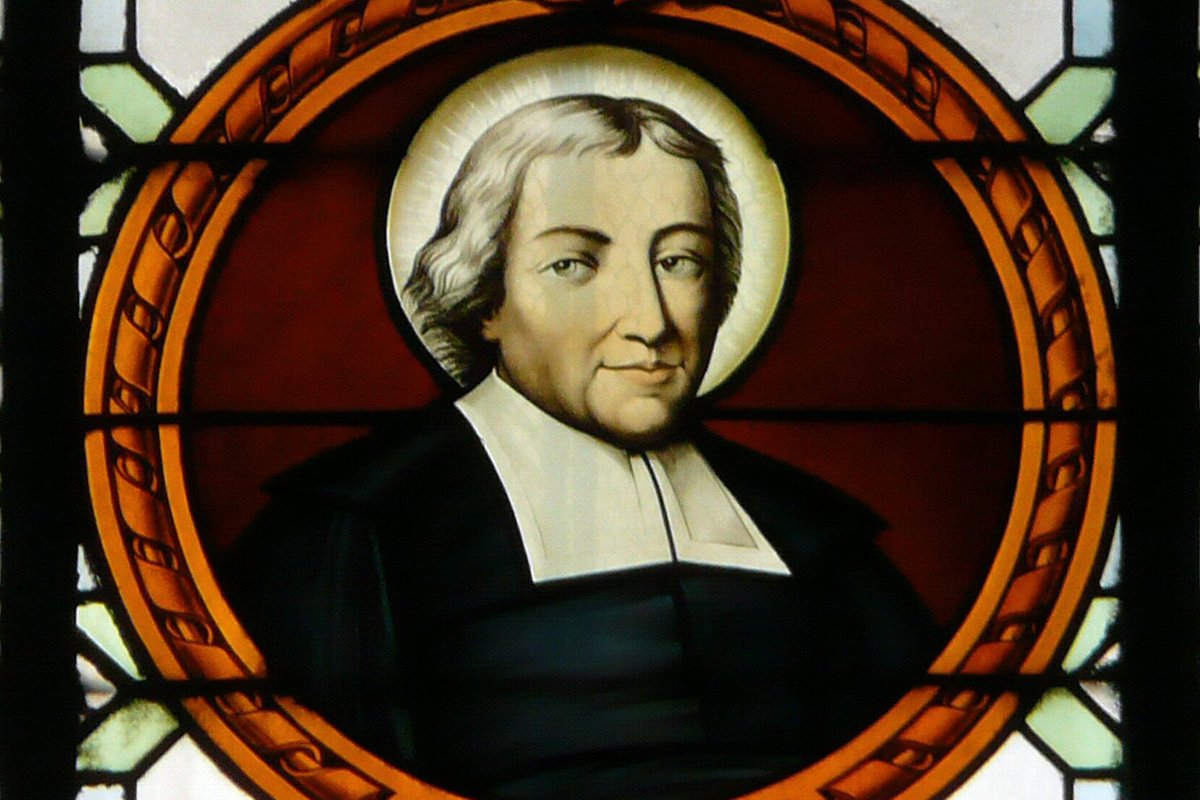
Ravery, Portrait of Marcellin Champagnat, founder of the Marist Brothers, 1840 — public domain.
A dying boy who knew nothing of the faith
The event that redirected Champagnat's priesthood happened early, and it happened at a single bedside. He was called to attend a dying sixteen-year-old boy — and found, to his genuine distress, that the boy was almost entirely ignorant of even the most basic elements of Catholic teaching, despite having nominally grown up within the faith. It wasn't an isolated failure of one family or one parish; it was a symptom of exactly the gap post-Revolutionary rural France had opened up in religious education, especially for children whose families had no access to formal Catholic schooling. Champagnat, already known for what he described as "great zeal for the poor," left that bedside convinced the Church needed something it didn't yet have: religious brothers whose entire vocation was teaching children like that boy, before it was too late.
Two disciples in a rented room
Champagnat didn't wait long to act on that conviction. On January 2, 1817 — mere months after his ordination — he brought together his first two disciples and founded the Little Brothers of Mary, the order that would become known as the Marist Brothers. It was about as unassuming a beginning as a religious order could have: two young men, a young priest, and a shared commitment to teaching children the Church was otherwise failing to reach.
The following year, 1818, Champagnat opened the first Marist school, and the way he designed it reveals exactly what problem he was trying to solve. He built the school's timetable around the rhythms of rural farm life, so that children whose families needed their labor at certain times of year could still attend. He set tuition at a level most local families could realistically afford, and for the families who couldn't afford anything at all, he provided the education free. It wasn't an abstract commitment to Catholic education in general — it was a practical response to the specific children who were being left out.
Part of a larger Marist project
Champagnat wasn't working entirely alone when he founded his teaching brothers. He was one of a small group of seminarians in Lyon, including Jean-Claude Colin, who had pledged together to build a broader Marist family of institutes — priests, brothers, sisters, and eventually a lay branch — all placed under Mary's patronage and modeled on the idea of working quietly and effectively rather than seeking recognition, an approach the group's members sometimes summed up as wanting to be present in the Church the way Mary herself was present at the early Church's beginnings: real, essential, but rarely at the center of attention. Champagnat's teaching brothers became the branch of that wider Marist family focused specifically on education, while Colin went on to found the Marist Fathers; the two projects grew up side by side, sharing a name and a spiritual vision even as they developed as formally distinct institutes.
Presence over punishment
What made Champagnat's approach to teaching distinctive, by the accounts of brothers who trained under him directly, wasn't a particular curriculum but a particular manner: he insisted that his brothers know their students individually, treat discipline as formation rather than punishment, and stay simply, visibly present among the children rather than governing from a distance. It was a notably gentler model than much of the era's standard schoolroom discipline, and it reflected Champagnat's own conviction, drawn straight from that first bedside encounter, that children who felt unknown and unwanted by the adults around them were exactly the children most likely to be lost to the faith entirely. That same emphasis on simple, direct, personal presence has remained a defining mark of Marist education long after the order spread far beyond rural France.
Recognized, beatified, canonized
Champagnat died on June 6, 1840, having spent his final decades building the order beyond that first rented room into a growing network of Marist schools. Formal Church recognition followed over the next century and a half: Pope Benedict XV declared him Venerable on July 11, 1920, Pope Pius XII beatified him on May 29, 1955, and Pope John Paul II canonized him on April 18, 1999.
The miracle recognized for his canonization is genuinely well documented by modern standards. Brother Heriberto Weber suffered from a serious pulmonary condition; after the Marist Brothers and their students conducted a novena asking for Champagnat's intercession, Weber recovered — a recovery confirmed on July 26, 1976, by x-ray and medical analysis showing the illness had simply disappeared. It's the kind of case the Church treats as a genuine basis for canonization precisely because it was investigated and documented through ordinary medical means, not asserted on faith alone.
Patron of Marist education
Champagnat's feast is kept on June 6, the anniversary of his death, and he's venerated today as patron of the Marist Brothers and of Marist education worldwide — a global network of schools that grew, over two centuries, from the two disciples he gathered in the months after a single dying teenager's ignorance of the faith convinced him the Church needed a new kind of teacher.
Trivia
Who was Saint Marcellin Champagnat?
What convinced Marcellin Champagnat to found a teaching order?
How did Marcellin Champagnat's schools work?
When was Saint Marcellin Champagnat canonized?
What is Saint Marcellin Champagnat the patron saint of?
You May Also Like
Related Reading