Saint Clotilde

A Burgundian princess married into a pagan court
Clotilde was born around 474 or 475 in Lyon, the daughter of Chilperic II, a king of Burgundy. Around 492 or 493, she married Clovis I, king of the Franks — a warlord ruling one of the powerful post-Roman kingdoms taking shape across what had been Roman Gaul, and, crucially, still a pagan. It was not, on its face, an obviously promising match for a Christian princess to build a religious project around. She and Clovis went on to have five children: sons Ingomer, Clodomir, Childebert, and Clotaire, and a daughter also named Clotilde.
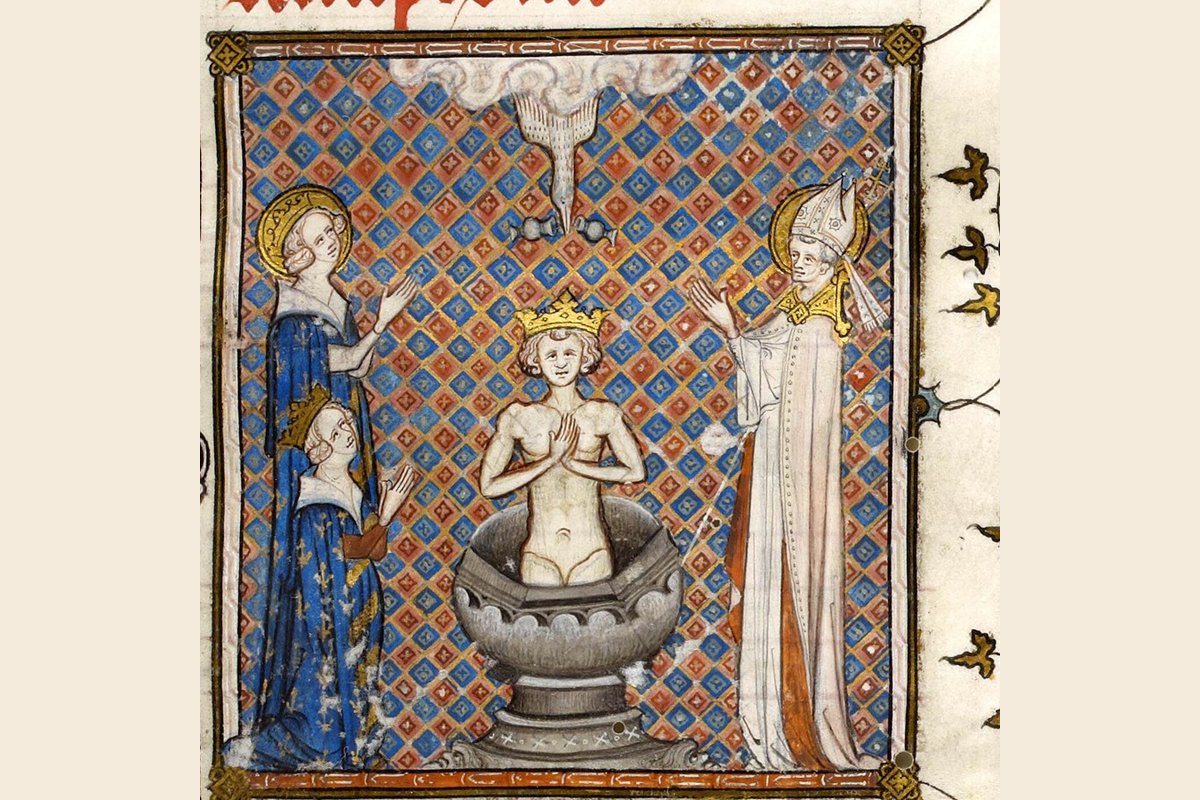
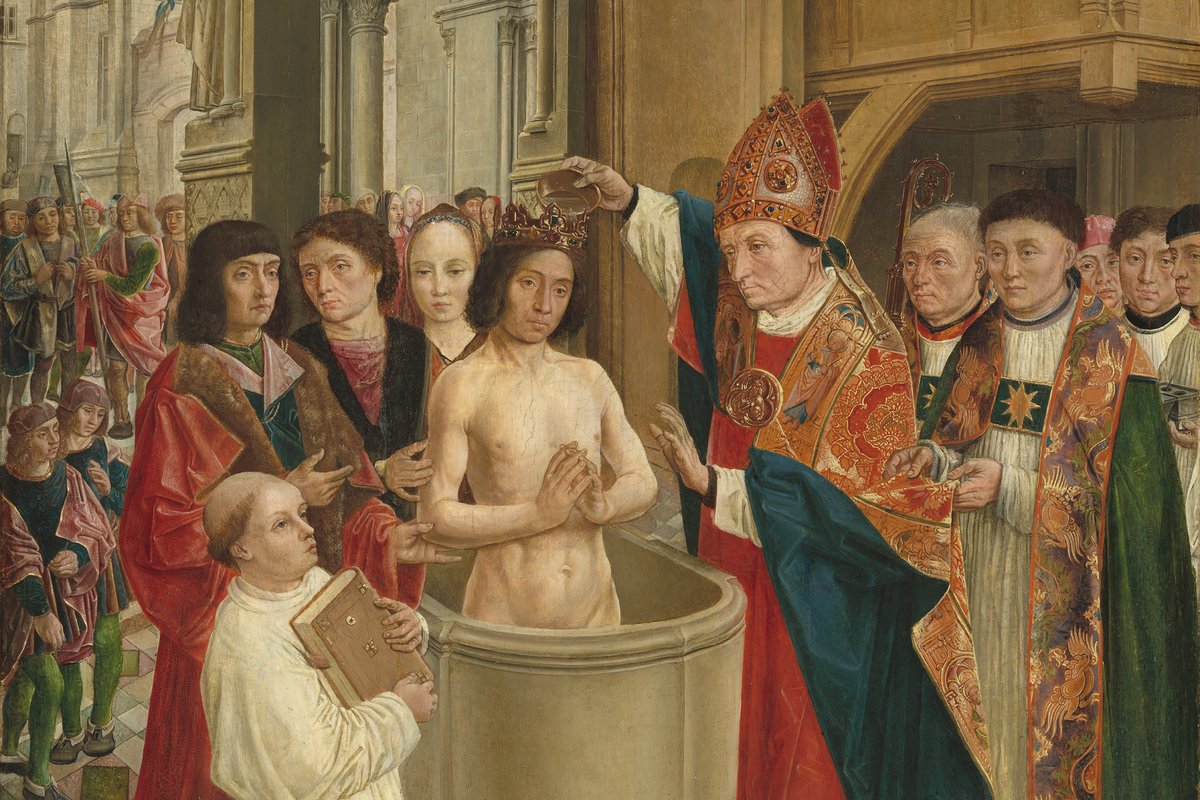
Baptism of Clovis, illuminated miniature from a 14th-century manuscript of the Vita sanctae Clotildis — public domain.
A conversion tradition rooted in Gregory of Tours
The story of how Clovis came to Christianity is almost entirely owed to one source: Gregory of Tours, a bishop and chronicler writing decades after the events he describes, in a style that mixed genuine historical record with the devotional instincts of a churchman eager to tell an edifying story. According to Gregory, Clotilde spent years persistently urging her husband toward baptism, unwilling to let his paganism simply stand as the permanent condition of their marriage. What tips this from plausible domestic pressure into full legend is the specific story Gregory tells about how it was finally resolved: facing likely defeat in battle against the Alemanni, Clovis is said to have prayed to "Clotilde's God" for victory, promising conversion in exchange — and, having won, kept his word.
That battlefield-vow narrative deserves the same caveat any devotional chronicler's account deserves: it comes from Gregory, writing well after the fact, and it isn't independently corroborated by any contemporary record. What is treated as reasonably solid history, by contrast, is the baptism itself — Clovis was baptized at Reims by St. Remigius in 496, alongside 3,000 of his warriors, a mass conversion with enormous long-term consequences for the religious future of what would become France.
Widowhood at the tomb of St. Martin
Clovis died in 511. Rather than remain enmeshed in the court politics of the kingdom he left behind, Clotilde withdrew to live near the tomb of St. Martin of Tours, devoting the years that followed to prayer and charity — a retirement that, on its own, would read as a fitting, quiet close to a life spent advancing Christianity within a still-pagan warrior culture. It didn't stay quiet.
A dynasty's violence, documented plainly
What happened next belongs to the darker, thoroughly documented pattern of Merovingian dynastic politics, and it deserves to be told without softening it. In 524, Clotilde's son Clodomir was killed. His young sons — Clotilde's own grandsons — should by rights have inherited his portion of the kingdom. Instead, according to the record, Clotilde sent the boys to her surviving sons Childebert and Clotaire in good faith, apparently believing they would be crowned. Childebert and Clotaire murdered two of them instead, dividing Clodomir's kingdom between themselves. A third grandson, Clodoald, managed to escape the purge; he later abandoned any claim to power and became a churchman, remembered today as Saint Cloud.
Gregory of Tours also credits Clotilde with inciting her sons toward a war of revenge against her cousin, King Sigismund of Burgundy, over her own father's earlier murder — a claim some historians regard as embellished or apocryphal rather than solid fact, and worth naming as such rather than folding it into her biography uncritically. Taken together, the murder of her grandsons and the alleged revenge campaign against Sigismund place Clotilde at the center of exactly the kind of dynastic violence that defined Merovingian rule, not somehow above or outside it — a genuinely difficult thread in the life of a woman also remembered, credibly, for decades spent advancing her husband's conversion and closing her own life in prayer near a saint's tomb.
Why Clovis's baptism mattered beyond one family
It's worth pausing on the scale of what that 496 baptism actually set in motion. Most other Germanic kingdoms carved out of the collapsing Western Roman Empire — the Visigoths in Spain, the Ostrogoths in Italy, the Vandals in North Africa — had adopted Arian Christianity, a form of the faith that denied the full divinity of Christ and had already been rejected as heresy by the wider Church at the Council of Nicaea in 325. Clovis's conversion went the other way, aligning the Franks directly with the Nicene Christianity of Rome and the papacy rather than with Arianism. That single choice gave the Frankish kingdom a religious kinship with the Gallo-Roman population it ruled over and with the bishops of Gaul, an alignment historians point to as one reason the Franks, alone among the major post-Roman kingdoms, built a lasting state that eventually became France. Clotilde's decades of quiet pressure, however legendary some of its details, sits at the root of that outcome.
A quiet cult built on a complicated life
Clotilde died at Tours on June 3, 545, and has been venerated since the early medieval period without ever passing through a formal canonization process — the same kind of immemorial cultus that recognizes many saints from this era. Her feast is kept on June 3. Her patronage today is modest and rooted in folk tradition rather than sweeping formal decree: widows invoke her, drawing on her own long widowhood after Clovis's death, and parents and mothers seeking a child's conversion turn to her as well, a patronage that tracks directly back to the project she spent her own married life pursuing. Readers interested in the broader story of the Franks' conversion may also want to read this blog's article on Saint Remigius of Reims, the bishop who baptized Clovis at the center of Clotilde's own story.
Trivia
Who was Saint Clotilde?
Did Clotilde really convert her husband Clovis to Christianity?
What happened to Clotilde's grandsons?
Was Clotilde formally canonized?
What is Saint Clotilde the patron saint of?
You May Also Like

Related Reading