Saint Cuthbert of Lindisfarne

A vision on the night Aidan died
Cuthbert was born around 634 or 635 somewhere in Northumbria, in what's now northern England, and raised by a foster mother named Kenswith rather than his own parents — the sources say little else about his early family life. Before his conversion to monastic life, tradition remembers him as a shepherd boy on the hills above the River Tweed, an active, physically capable young man rather than a bookish child, which makes the discipline he later imposed on himself as a monk all the more striking a contrast.
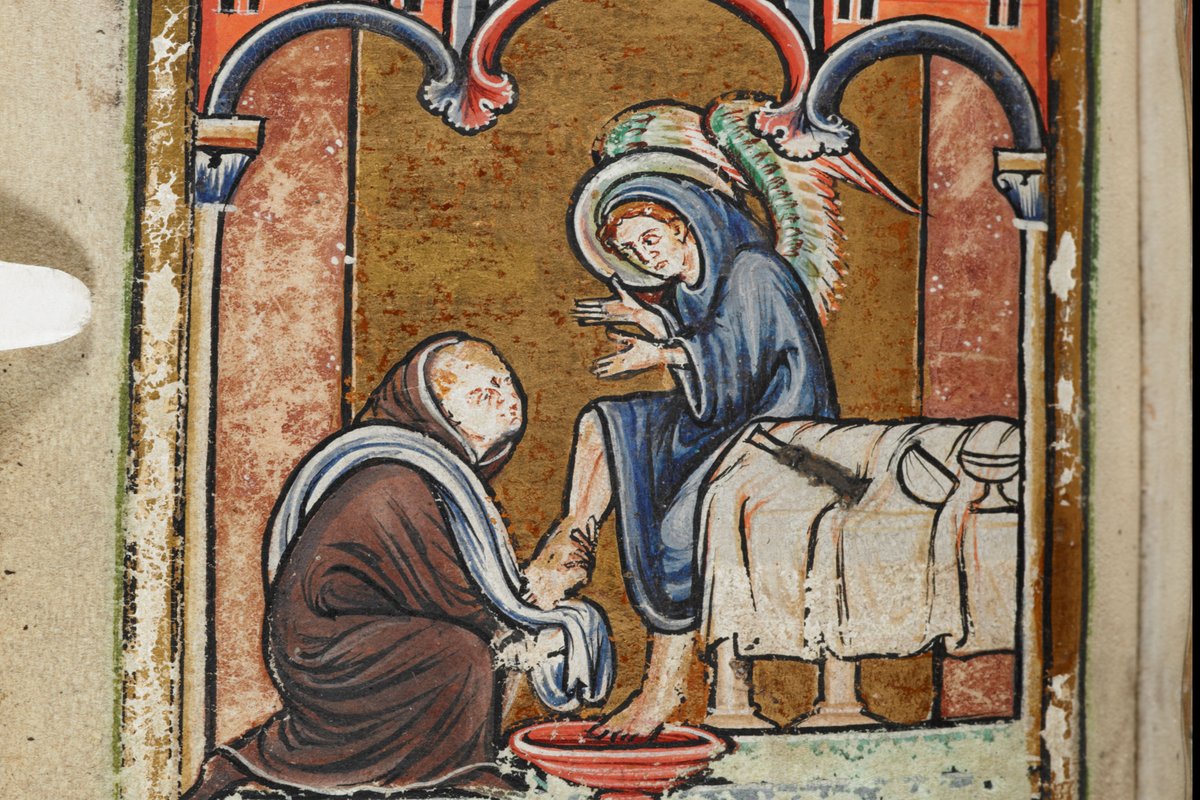
Miniature from Bede's Prose Life of St Cuthbert, British Library, Yates Thompson MS 26, late 12th century — public domain.
The turning point came in 651, on the night the great missionary bishop Aidan of Lindisfarne died. Aidan had come from the Irish monastery of Iona to found Lindisfarne and re-establish Christianity in Northumbria after earlier missionary efforts had faltered, and by the time of his death he was already revered across the kingdom. According to tradition, Cuthbert — still tending sheep that night — saw a vision of a soul being carried up to heaven by angels, and when he later learned that Aidan had died at that very hour, he took it as a call and entered the monastery at Melrose, where the abbot Eata, himself one of Aidan's own disciples, received him into the community.
Cuthbert's monastic career advanced through hardship as much as achievement. In 661 plague swept through Melrose, striking Cuthbert himself and killing the monastery's prior — a loss that left Cuthbert, who survived, to succeed him in the role. He is said to have suffered lasting effects from the illness for the rest of his life.
In 664, Eata and Cuthbert transferred together to Lindisfarne, Eata as bishop and Cuthbert as prior, where Cuthbert instituted a notably strict rule of monastic life that some of the community found genuinely difficult to keep. That same year, 664, was also the year of the Synod of Whitby, the famous council at which the Northumbrian church chose to follow Roman rather than Irish/Celtic practices on matters like the dating of Easter. Cuthbert, trained in the Irish tradition through Aidan's foundation but personally committed to unity within the Church, accepted the synod's Roman ruling without the resistance some of his contemporaries showed — a detail historians often cite as evidence of his practical, unifying temperament rather than rigid party loyalty.
Twelve years alone on Inner Farne
After roughly twelve years at Lindisfarne, around 676, Cuthbert withdrew from community life altogether to become a hermit, building a small oratory on Inner Farne, the largest of the Farne Islands, roughly nine miles off the Northumbrian coast. It was there that Cuthbert developed the habit for which he's remembered as something close to an early wildlife conservationist: he took deliberate steps to protect the seabirds nesting around his hermitage, including the eider ducks that still breed on the Farnes today. The birds are nicknamed "Cuddy ducks" in Northumberland to this day — Cuddy being a familiar, affectionate form of Cuthbert's name — a small but genuinely charming and well-documented detail from a life otherwise thick with later legend.
It's in this same period that Bede's Life of Saint Cuthbert, written decades after Cuthbert's death, records its most famous miracle story: that after Cuthbert spent a full night praying while standing in the cold sea, otters came out of the water to warm and dry his feet with their fur. Saint Bede the Venerable, the monk-historian who wrote that account, is a comparatively careful, near-contemporary source by early medieval standards, which is why the core facts of Cuthbert's biography — his offices, his decisions, the major turning points of his life — are treated as reliable history. But a story like the otters belongs to a different category entirely: hagiographic legend meant to illustrate a hermit's holiness and harmony with creation, not a documented event.
Cuthbert's care for the wildlife around his hermitage went well beyond that one famous story, and this part of his reputation rests on firmer ground. He is recorded as having laid down rules protecting the eider ducks nesting on Inner Farne, forbidding anyone from disturbing them during their breeding season — making him, by a fair reading of the evidence, one of the earliest named conservation figures in European history. The eiders nesting on the Farne Islands today are still protected, now under modern British bird law rather than a hermit's personal rule.
A reluctant bishop
Cuthbert's solitude didn't last. In 684, King Ecgfrith of Northumbria appointed him Bishop of Hexham, a role Cuthbert reportedly accepted with real reluctance after years spent deliberately withdrawing from public life; tradition holds that it took a personal deputation of nobles and clergy traveling out to his island hermitage to persuade him to accept at all. The following year, 685, he exchanged sees with Eata and became Bishop of Lindisfarne instead — a return, in a sense, to the community where he'd spent his monastic career.
As bishop, Cuthbert kept up the pastoral energy for which Aidan's foundation at Lindisfarne had originally become known, traveling on foot through remote parts of his diocese to preach and administer the sacraments to people who otherwise saw little of any priest. He was also credited with several instances of prophecy and healing during these years, recorded by Bede in the same spirit as the otter story — episodes meant to illustrate sanctity more than to serve as a strict historical record, but genuinely part of how his own generation understood him. His health began failing by 686, and he resigned his bishopric after less than two years in office, returning one last time to his hermitage on Inner Farne, where he died in 687, tended in his final days by a small community of monks who had rowed out to be with him.
The incorrupt body and the founding of Durham
Cuthbert's story didn't end with his death. When his tomb was reopened eleven years later, in 698, the monks who cared for his relics reported finding his body preserved and undecayed — a claim of incorruption that carried enormous weight in medieval Christian devotion as a sign of unusual sanctity. That reported discovery is best understood as a significant historical episode of the era's relic veneration, not a modern-verified medical fact, but its effect on history was real regardless.
The community guarding Cuthbert's relics did not stay at Lindisfarne to enjoy that reputation in peace. Viking raids on the Northumbrian coast, beginning famously with the sack of Lindisfarne itself in 793, eventually forced the monks to flee inland, carrying Cuthbert's coffin with them on a journey that tradition remembers lasting years and covering much of northern England before the community finally settled. That long search for a safe, lasting home for Cuthbert's relics eventually brought his community to the city of Durham in 995, where the shrine built around them grew, over the following centuries, into Durham Cathedral, one of the great architectural achievements of medieval England and still Cuthbert's resting place today.
Cuthbert's feast is kept on March 20, and he remains, alongside Bede himself, the central figure in Durham's religious identity — a hermit-bishop remembered equally for his stern discipline, his tenderness toward wild birds, and a body that, by report, refused to decay.
Trivia
Who was Saint Cuthbert of Lindisfarne?
Why is a species of duck named after Saint Cuthbert?
Are Bede's stories about Saint Cuthbert historically reliable?
Why is Saint Cuthbert connected to Durham Cathedral?
What is Saint Cuthbert the patron saint of?
You May Also Like
Related Reading