Saint Eugene de Mazenod

A childhood undone by revolution
Eugene de Mazenod was born on August 1, 1782, in Aix-en-Provence, into a family with real standing in French aristocratic society. That standing evaporated almost overnight. When the French Revolution reached its most dangerous phase for families like his, the de Mazenods fled the country — Eugene was only eight years old. What followed wasn't a brief interruption but more than a decade of genuine hardship: the family moved from city to city across Italy, living as poor refugees with no stable income and no fixed home, dependent on the uncertain generosity of relatives and the Italian communities that took them in. Eugene didn't return to France until he was around twenty, an adult shaped less by the privileges of his birth than by the years he'd spent without them.
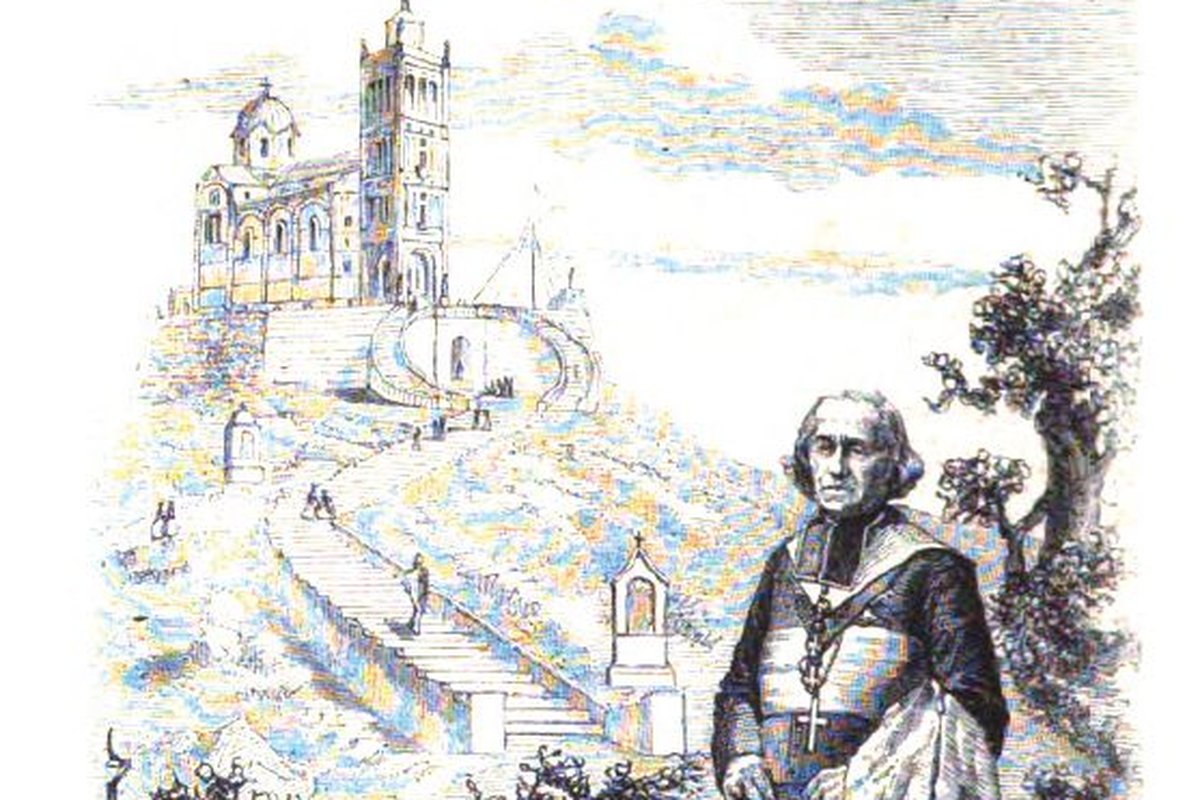
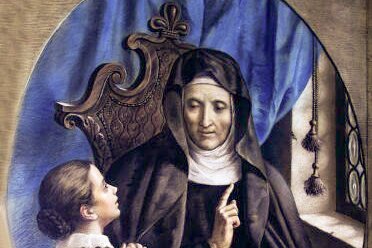
Hand-colored engraving of Monseigneur Charles-Joseph-Eugène de Mazenod, Bishop of Marseille 1837–1861, founder of the Oblates, before Notre-Dame de la Garde, Marseille, 19th century — public domain.
Asking to serve the poor, not a parish
Eugene was ordained a priest around 1811–1812, and what he did immediately afterward says a great deal about the direction his exile had already set for him. Rather than accepting a conventional parish assignment, he specifically asked his bishop to let him work instead with youth, prisoners, and the rural and urban poor — the populations that post-Revolutionary France's rebuilding Church was, in practice, most likely to neglect. It wasn't an abstract commitment. Eugene spent his early priesthood directly among people whose lives looked, in outline, like the poverty and displacement he himself had lived through as a child.
A youth confraternity, first
Before there was any missionary order, there was a smaller, more local experiment. In 1813, back in Aix-en-Provence, Eugene organized a confraternity of young laymen — a lay association meant to form its members spiritually and keep them engaged with the Church at a time when Revolution-era disruption had left an entire generation with little religious formation at all. It was modest work, mostly catechism and prayer meetings for local youth, but it taught Eugene something he carried into everything he built afterward: that rebuilding faith in post-Revolutionary France meant going directly to the people the reconstituted Church structures were least reaching, rather than waiting for them to come to a parish on their own.
Founding the Missionary Oblates of Mary Immaculate
That ministry grew into something more permanent. Eugene founded a community of missionary priests dedicated to exactly the work he'd requested — preaching, forming, and serving the poor and the religiously neglected — and Pope Leo XII formally approved the congregation, the Missionary Oblates of Mary Immaculate, on February 17, 1826. Its motto, drawn from Luke's Gospel, states its purpose plainly: "He has sent me to evangelize the poor." Eugene led the order himself as Superior General for the next thirty-five years, guiding its growth from a small French community into a missionary body that would eventually work across multiple continents, until his death in 1861. Within his own lifetime, Oblate missionaries were already being sent to Canada, Sri Lanka, and southern Africa — a global reach Eugene himself never traveled to see firsthand, directing it instead entirely through correspondence from Marseille.
Alongside his work founding and running the Oblates, Eugene became Bishop of Marseille in 1837, a see he served until the end of his life in 1861 — combining, for over two decades, the demands of running a diocese with those of leading the religious order he'd built from nothing. As bishop, he championed the rebuilding of Notre-Dame de la Garde, the hilltop basilica that still watches over Marseille's harbor and appears behind him in the engraving illustrating this article; laying its cornerstone in 1853 gave visible, physical form to the same instinct that drove the rest of his ministry — building something durable for a city and a people he'd committed himself to serving.
Canonized on the First Sunday of Advent
Eugene de Mazenod died in Marseille on May 21, 1861. His path to sainthood moved through the usual stages of Church recognition: Pope Paul VI beatified him on October 19, 1975, and Pope John Paul II canonized him on December 3, 1995. The date carried its own significance — it fell on the First Sunday of Advent, and in his canonization homily John Paul II specifically called Eugene a "Man of Advent," a title tying the saint's own life of waiting through exile and hardship to the liturgical season of hopeful waiting itself. His feast is kept on May 21, the anniversary of his death.
A patronage built from his own history
The patronages attached to Eugene de Mazenod read almost like a direct transcript of his biography: bishops and founders, certainly, given the offices he held, but also exiles, broken homes, families in crisis, and troubled marriages — the last several tracing a clear line back to a childhood spent as a displaced refugee in a family stripped of everything it once had. It's a genuinely coherent patronage in a way not every saint's list of causes turns out to be: a man who lost his home as a child built, as an adult, an entire missionary order around ministering to people who had lost theirs too.
Trivia
Who was Saint Eugene de Mazenod?
Why did Saint Eugene de Mazenod's family leave France?
What order did Saint Eugene de Mazenod found, and why?
When was Saint Eugene de Mazenod canonized?
What is Saint Eugene de Mazenod the patron saint of?
You May Also Like
Related Reading