Saint Francis Xavier

A Navarrese nobleman in Paris
Francis Xavier was born on April 7, 1506, at Xavier Castle near Sangüesa, in the Kingdom of Navarre — a small, contested territory caught between Spain and France, which his own family had fought to defend a few years before his birth. He left for the University of Paris around 1525 to study, and it was there, rooming with a older, more intense fellow student named Ignatius of Loyola, that his life changed direction. Ignatius pressed him for years with a single question drawn from the Gospel of Mark — what does it profit a man to gain the whole world and lose his own soul — until Xavier finally gave in. On August 15, 1534, in a small chapel on Montmartre, Xavier was one of seven companions who took vows of poverty and chastity alongside Ignatius, the founding act of what would become the Society of Jesus.
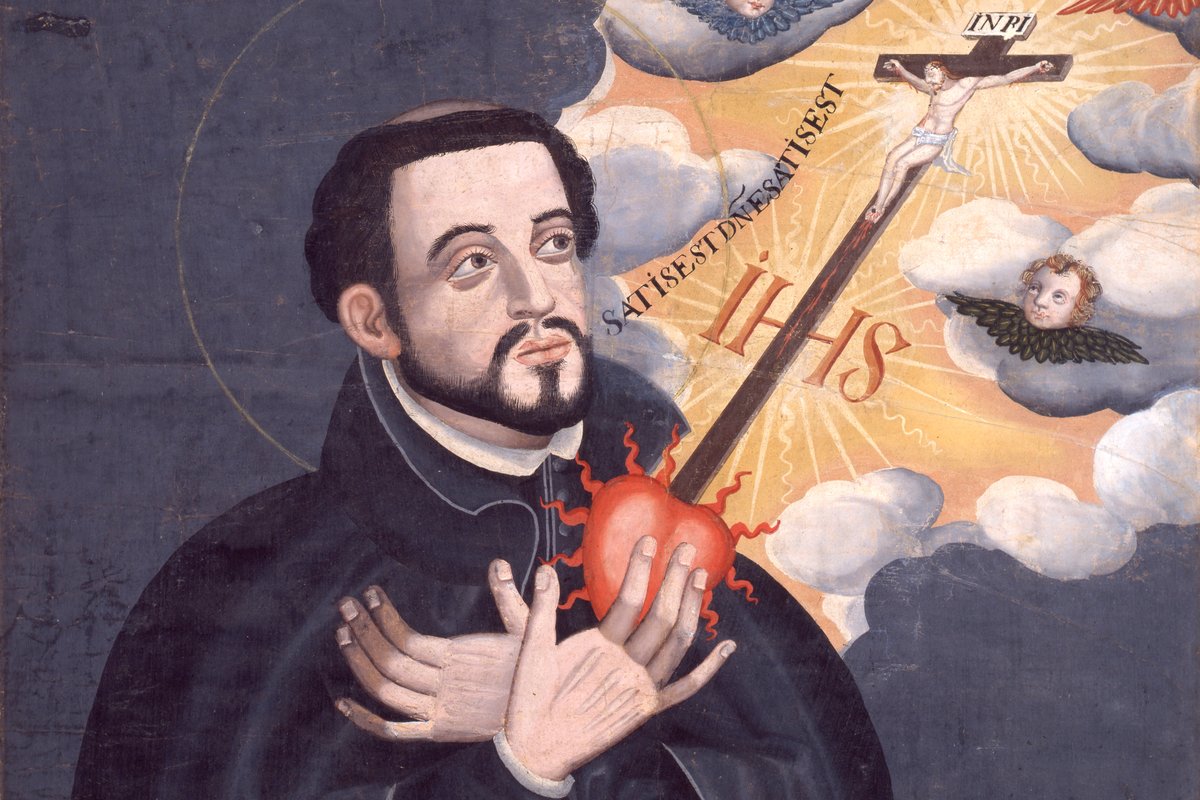
Unknown artist, Portrait of Saint Francis Xavier, early 17th century, Kobe City Museum, Japan — public domain.
Sent east, and never coming back
In 1540, at the request of the King of Portugal, Xavier was sent to the East as a papal legate — a decision that effectively ended his life in Europe. He sailed from Lisbon in April 1541 and reached Goa, the capital of Portuguese India, in May 1542, after a voyage of over a year. From there he never really stopped moving. He ministered to Portuguese settlers and pearl fishers along the coast of southern India, worked among communities in the Malay Archipelago (in what is now Malaysia and Indonesia), and in 1549 sailed for Japan with two Jesuit companions and a Japanese man named Anjirō — the same India mission field that a later Jesuit, Saint John de Britto, would take up a century afterward, a fugitive he had met and baptized in Goa who became his guide, translator, and one of the first Japanese converts to Christianity.
Among the Paravas, a fishing community along India's southeastern coast, Xavier reportedly baptized thousands within a short span, though he was candid in his letters about the practical limits of that work — he had no fluency in the local Tamil language beyond simple translated prayers and formulas, and openly worried in his correspondence about how much sustained catechesis a new convert could really receive from a single traveling missionary stretched across so many scattered coastal villages. That tension between the scale of his evangelizing and the depth he could realistically provide runs through nearly all his surviving letters, and it's part of why he wrote home so insistently begging for more men to be sent.
Two years in Japan
Xavier landed at Kagoshima in August 1549 and spent a little over two years working across Japan, learning enough to adapt his preaching to a culture entirely unlike anything else he'd encountered in Asia — a genuinely striking effort for a man with no prior grounding in Japanese language or society. He initially tried to explain Christian teaching using Buddhist vocabulary borrowed from Anjirō, only to discover partway through that the terms carried very different meanings in local usage than he'd assumed, forcing him to rework his preaching approach on the fly. He also noted, with evident respect in his letters, the intellectual seriousness and courtesy of the Japanese audiences he encountered, a marked contrast to some of his earlier expectations about the region.
He left Japan in 1551 believing that reaching China, which he saw as the intellectual and cultural center that shaped the wider region, would open the way for Christianity across all of East Asia. China at the time barred foreigners from its mainland, so Xavier arranged passage to Shangchuan (Sancian) Island, just off the Chinese coast, to wait for a way in. He fell ill there and died on December 3, 1552, having never reached the mainland he'd spent his final months trying to enter. His body, according to accounts from the period, showed no signs of decay when it was later exhumed for transport — a detail that fed devotion to him even before his formal canonization seven decades later.
"There is nobody to make them Christians"
Xavier was a prolific letter-writer, and a substantial number of his letters survive, giving historians an unusually direct record of his own voice — a contrast with many earlier missionary saints known mainly through later hagiography. In one letter to Ignatius of Loyola, later incorporated into the Church's own Office of Readings for his feast, he wrote: "Many, many people hereabouts are not becoming Christians for one reason only: there is nobody to make them Christians." He went on, in the same letter, to imagine himself storming the universities of Europe: "Again and again I have thought of going round the universities of Europe, especially Paris, and everywhere crying out like a madman, riveting the attention of those with more learning than charity: 'What a tragedy: how many souls are being shut out of heaven and falling into hell, thanks to you!'" It's a rare, vivid piece of a real historical figure's own frustration, not a line invented for him after the fact.
Canonization and legacy
Francis Xavier was beatified in 1619 and canonized on March 12, 1622, by Pope Gregory XV, in the same ceremony that canonized Ignatius of Loyola — the two men who had shared a room in Paris decades earlier became saints on the same day. In 1927, Pope Pius XI named him, together with Thérèse of Lisieux, co-patron of all foreign missions, a title that reflects how thoroughly his decade in Asia came to define the Jesuit missionary identity for the centuries that followed. His remains are kept at the Basilica of Bom Jesus in Goa, India, where they remain a major site of pilgrimage.
Trivia
Who was Saint Francis Xavier?
Did Francis Xavier actually reach China?
How is Francis Xavier connected to Japan?
When was Francis Xavier canonized, and what is he patron of?
What is Francis Xavier's connection to Saint Peter Claver?
You May Also Like

Related Reading