Saint Isidore the Farmer

A laborer's life, thinly documented
Isidore was born around 1070 near Madrid and spent his life working the land as a day-laborer, married to a woman remembered today as Saint María de la Cabeza. Tradition holds that the couple had one son who died young after falling into a well — and that Isidore and María's prayers were credited with the water miraculously rising in the well to save the child, one of several water-related miracles later attached to his memory. After their son's death, later legend holds, the couple agreed to live in continence for the rest of their marriage, devoting themselves more fully to prayer and to caring for the poor around them, a detail that later shaped how both were remembered devotionally as a married couple who pursued holiness together rather than through the separate religious vocations more commonly celebrated in medieval hagiography.
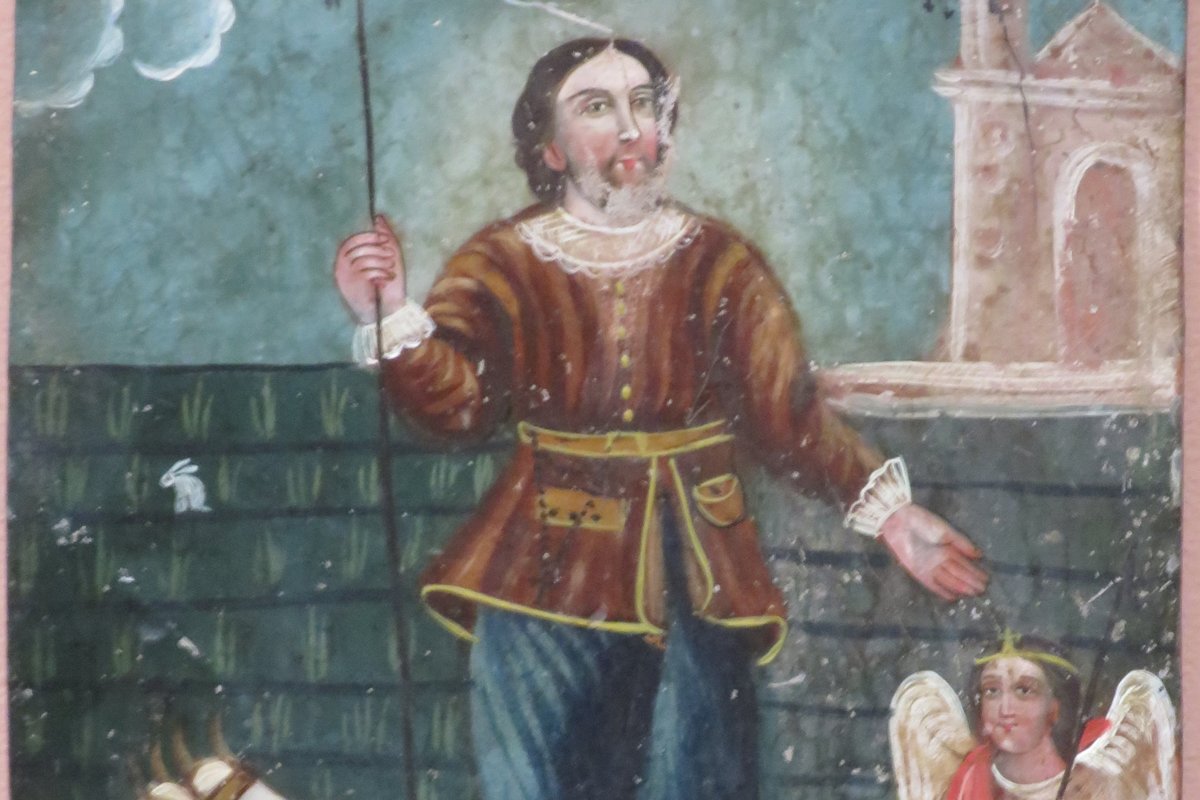
Donaciano Aguilar, "Saint Isidore the Farmer," oil on tin retablo, 1841, El Paso Museum of Art — public domain.
That's close to the full extent of what can be stated about him with real historical confidence. Unlike saints whose lives come down to us through detailed contemporary biographies, letters, or official church records, Isidore's story survives mainly through devotion passed down over centuries — which means the honest starting point for any account of his life is admitting how much of it rests on tradition rather than documentation. He is said to have worked for the same landowning family, the Vargas, for most of his working life, a detail consistent with the kind of long, settled agricultural service common among laborers tied to a single estate in medieval Castile.
The legend that defined his image
The story most associated with Isidore concerns his work habits. By tradition, his employer noticed that Isidore often arrived at the fields later than expected, having stopped along the way to pray, and eventually grew frustrated enough to go check on him personally. What he found, according to the legend, was an angel plowing the field in Isidore's place while Isidore himself knelt nearby in prayer, seemingly untroubled by the work left undone. It's a striking image, and it's the reason plows, angels, and oxen appear so often in art depicting him — but it belongs to popular legend, not verified biography, and should be understood that way rather than presented as settled fact.
Other stories cluster around the same period of his life: that Isidore regularly shared his own meager food with the poor and with animals, sometimes leaving himself with less than half of what he'd started with, and that his generosity was rewarded rather than punished by an unexplained abundance that somehow remained in his pot or sack afterward. These accounts follow a recognizable pattern found in the folklore of many medieval agricultural saints across Europe — miraculous provision rewarding radical charity — which doesn't make them false so much as difficult to verify as specific historical events distinct from that broader storytelling tradition.
Canonized alongside giants of the Counter-Reformation
Whatever the gaps in his documented biography, Isidore's popular veneration grew substantial enough that he was formally canonized in 1622 — in the very same ceremony as Saint Ignatius of Loyola, founder of the Jesuits; Saint Francis Xavier, the Jesuit missionary to Asia; Saint Teresa of Ávila, the Carmelite mystic and reformer; and Saint Philip Neri, the joyful "Apostle of Rome." Being canonized in the same ceremony as four towering figures of the Counter-Reformation says something about how far Isidore's popular devotion had spread by the early 17th century, even for a simple farm laborer with no theological writings, no religious order, and no dramatic missionary career to his name.
Patron of the fields and of the city he never left
Isidore's feast is celebrated on May 15, and he's venerated today as the patron saint of farmers and day-laborers everywhere, as well as the specific patron of Madrid, the city near which he lived his entire life. That local, rooted quality is part of what makes his devotion distinctive — he isn't remembered for traveling far or achieving anything dramatic in the ordinary sense, but for the quiet, steady combination of manual labor and prayer that his legend so pointedly illustrates.
His patronage has traveled well beyond Spain, particularly into the agricultural communities of Latin America and the American Southwest, where his feast is still marked with blessings of fields, seeds, and livestock in many rural Catholic parishes. His image, plow and oxen included, became a familiar subject of the small devotional retablo paintings produced across Mexico and the American Southwest in the 18th and 19th centuries — including the piece that illustrates this article — reflecting how deeply his patronage of ordinary agricultural labor resonated in farming communities far removed from medieval Castile.
Devotion over documentation, and why that's fine
It would be easy to want more certainty about Isidore's actual life than what survives, and honest treatments of his story have to resist inventing detail the record doesn't support. But the thinness of his biography doesn't diminish what his devotion has meant to farmers and laborers for centuries — if anything, a saint remembered chiefly through legend and popular affection, rather than through official biography, reflects exactly the kind of ordinary sanctity his own life was built around.
Trivia
Who was Saint Isidore the Farmer?
What is the story about the angel plowing his field?
Was Isidore canonized alongside other famous saints?
What is Saint Isidore the patron saint of, and when is his feast day?
How much do historians actually know about Isidore's life?
You May Also Like

Related Reading