Saint Teresa of Avila

An ordinary nun before the mystical experiences began
Teresa entered a Carmelite convent in Ávila as a young woman, and for years her religious life, by her own later account, followed a fairly conventional path. That changed as she began experiencing intense mystical states — visions and periods of prayer so absorbing that they gradually reoriented her entire understanding of what a contemplative life could be, and what she believed her own order had drifted away from.
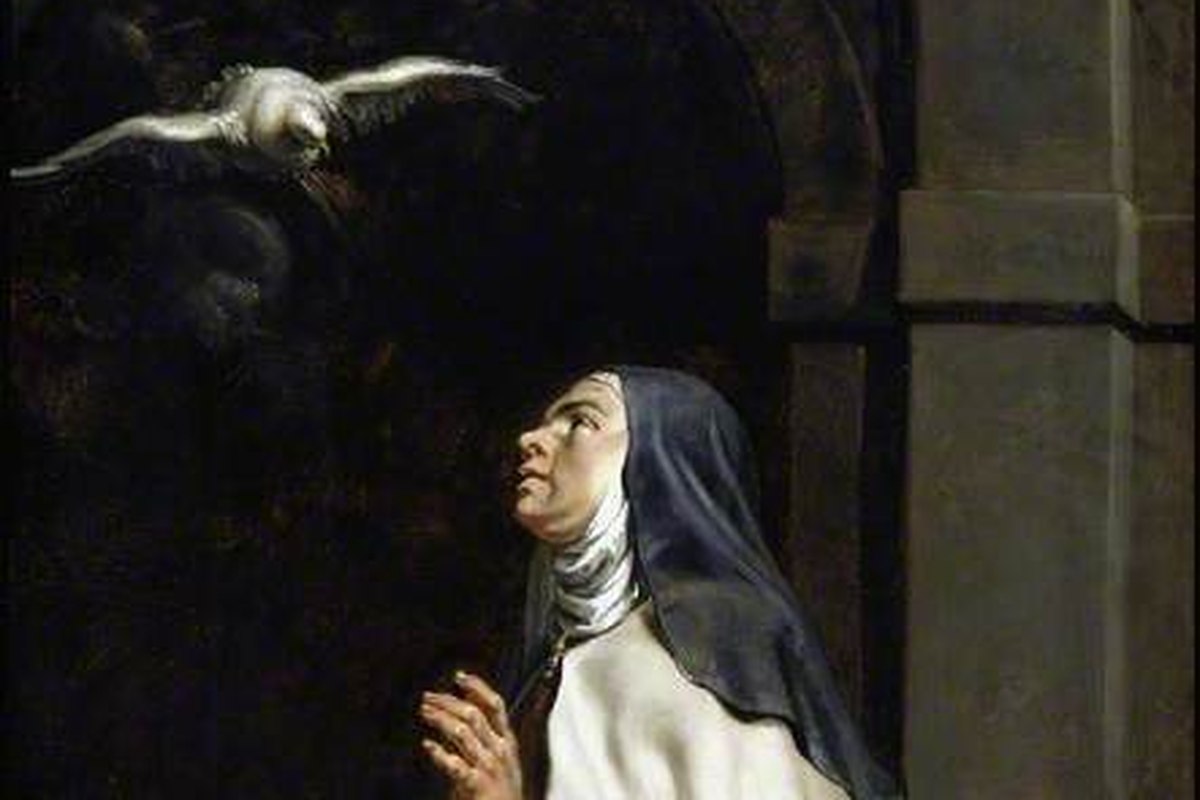
Peter Paul Rubens, "Teresa of Avila's Vision of the Dove," c. 1614 — public domain.
Reforming an order from the inside
Rather than simply writing about that conviction, Teresa acted on it. In 1562, with the pope's authorization, she opened the first convent of what became known as the Discalced Carmelites — a reform aimed at restoring a stricter, more austere, and more genuinely contemplative version of Carmelite life. She would go on to found convents across Spain, and the movement she began was soon joined by the younger friar and mystic Saint John of the Cross, cementing a reform that reshaped the order for centuries to come.
A heart pierced by fire
Among Teresa's mystical experiences, one in particular has endured most vividly in Christian art: the "transverberation," in which she described an angel piercing her heart with a fiery spear, leaving her simultaneously in intense physical pain and overwhelmed by divine love. The image captured centuries later in Bernini's sculpture "The Ecstasy of Saint Teresa" draws directly from her own written account of the moment — one of the clearest descriptions of mystical experience in the entire Christian tradition.
From convent walls to Doctor of the Church
Teresa's own writings — her autobiography, The Interior Castle, and The Way of Perfection — became foundational texts for how later generations would understand Christian mysticism and prayer. That lasting influence led, in 1970, to Pope Paul VI declaring her a Doctor of the Church, the first woman ever given that title in the Church's history. It was an extraordinary outcome for a woman whose religious life had begun, by her own description, in fairly unremarkable fashion.
A family shaped by conversion
Teresa's family background is itself part of the historical record worth noting alongside the mystical accounts: her paternal grandfather was a Jewish convert to Christianity in a Spain where such converts, known as conversos, faced ongoing suspicion and occasional prosecution by the Inquisition regardless of the sincerity of their faith. Historians generally agree this family history shaped the pressures Teresa's own household lived under, even though it goes unmentioned in her own writings. It's a detail that belongs to documented genealogy and archival record rather than to legend, and it adds a layer of social precariousness to a life usually remembered mainly for its interior, mystical dimension.
Illness, near-death, and a slow reawakening
Long before the mystical experiences that reshaped her religious life, Teresa suffered a severe illness in her twenties that left her partially paralyzed for a time and, by some accounts, so gravely weakened that she was mistakenly thought to have died. Her recovery was slow and, by her own telling, spiritually uneven — years passed in what she later described self-critically as a lukewarm, distracted prayer life before the more intense visions began. That honesty about her own spiritual mediocrity, rather than presenting herself as holy from the start, is a recurring feature of her autobiography and part of why later readers have found her writing so psychologically credible.
Iconography: the dove, the pen, and the pierced heart
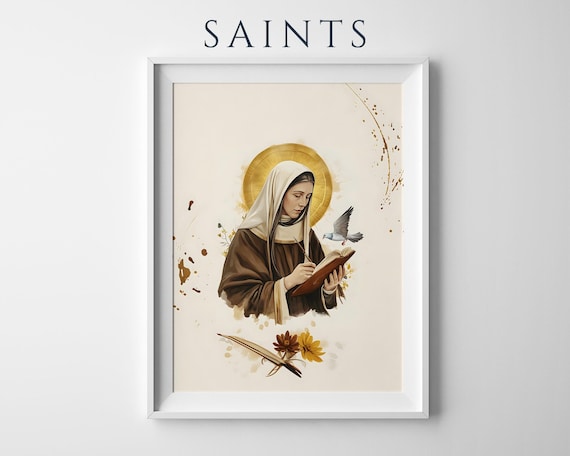
In religious art, Teresa is most often shown in the black-and-white habit of the Carmelites, holding a quill pen or an open book — recognition of how much of her legacy rests on her own written theology rather than on legend alone — with a dove hovering nearby, a reference to one of her recorded visions of the Holy Spirit, and sometimes an arrow or flaming dart piercing her heart, drawn directly from her account of the transverberation. Unlike saints known mainly through oral tradition, Teresa left behind a body of first-person testimony detailed enough that her attributes in art can be traced almost line by line back to her own descriptions of her interior experience.
A reform that survived imprisonment and controversy
Teresa's push to reform the Carmelites was not universally welcomed. Members of the unreformed branch of the order resisted the new Discalced houses, and the reform's other great figure, John of the Cross, was at one point kidnapped and imprisoned for months by Carmelite friars opposed to the changes — a documented, well-attested episode of internal Church conflict rather than pious embellishment. Teresa herself continued founding convents across Castile into old age, traveling under difficult conditions by the standards of sixteenth-century Spain, and died in 1582 at Alba de Tormes. Her relics were subsequently divided among several locations, a practice common for major saints of the era, and remain venerated today — her heart, bearing what devotees hold to be a visible wound, is kept at Alba de Tormes, while other relics are dispersed across Spain, a physical echo of a reform movement that likewise spread outward from a single Ávila convent to shape Carmelite life worldwide.
Trivia
What was the Carmelite Reform Teresa founded?
What was Teresa's 'transverberation' experience?
What did Teresa write?
Why was Teresa named a Doctor of the Church?
Is Teresa of Ávila a patron saint of anything?
Related Reading