Saint Macrina the Younger

The eldest of ten, in a family that produced saints
Macrina was born around the year 327, most likely near Caesarea in Cappadocia — a region in what's now central Turkey that would go on to produce an outsized share of the early Church's theology. She was the eldest of ten children born to Basil the Elder and Emmelia, and their family tree reads like a roll call of the 4th-century Church: her brothers included Basil the Great, Gregory of Nyssa, and Peter of Sebaste, all three later venerated as saints and bishops in their own right, and her grandmother — also named Macrina, and also venerated as a saint — had survived the Diocletianic persecution in hiding decades earlier. Being the eldest daughter in a family like that came with expectations. Macrina, it turns out, had other plans for how she'd shape it.
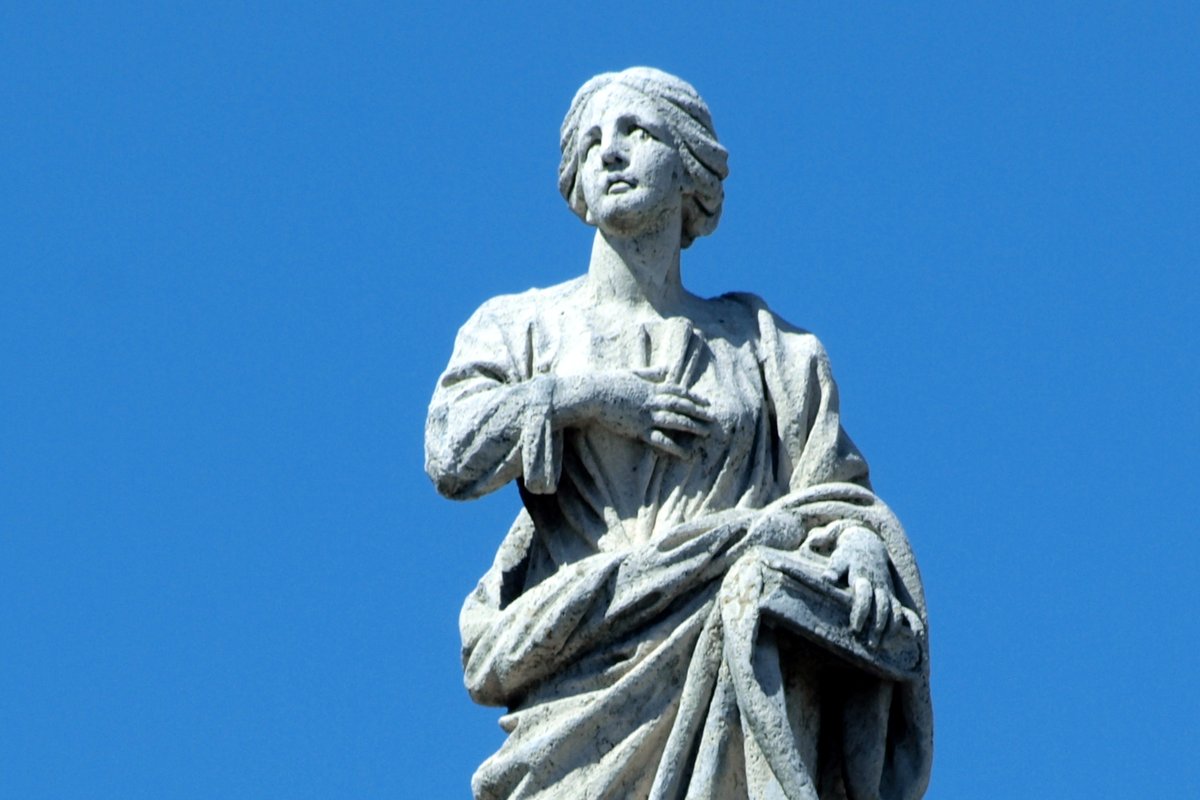
Statue of Saint Macrina, colonnade of St. Peter's Square, Vatican City, sculptor unknown, 17th century. Photograph by Alf van Beem, 2012 — public domain (CC0).
A bridegroom who couldn't die
Around age twelve, following the ordinary custom of the time, Macrina was betrothed to a young man her father had chosen for her. Before the marriage could take place, however, her fiancé died. For most young women in her position, that would simply have meant waiting for a new match to be arranged. Macrina refused every proposal that followed. Her reasoning, as her brother Gregory later recorded it, was striking: she considered the betrothal a real marriage before God, and since her intended husband was, in her view, only away rather than permanently lost, marrying someone else would amount to infidelity. She spoke of herself instead as bound to a bridegroom who could not die — language that pointed toward the consecrated, celibate life she was already choosing over any future arranged marriage. Her parents, notably, did not force the issue. Macrina got her way, and the rest of her life took shape around that early decision.
Turning the family estate into a monastery
With her widowed mother Emmelia, Macrina transformed the family's rural estate at Annisa, in the Pontus region, into a monastic community — one of the notable details of her story is that it welcomed women across the social spectrum on genuinely equal footing, at a time when class distinctions were rarely set aside so deliberately, even inside religious life. It wasn't simply a convent for well-born women retreating from the world; former household servants and women of Macrina's own aristocratic background lived and prayed side by side. Macrina ran the community for decades, shaping its rhythm of prayer and shared labor personally rather than through any wider monastic rule imposed from outside.
Her influence reached well beyond the walls of Annisa. She's credited with shaping the religious formation of her younger brother Peter of Sebaste, who grew up largely under her direction after their father's death. And according to Gregory of Nyssa's own account, it was Macrina who redirected their brother Basil — later Basil the Great, one of the towering figures of 4th-century theology — away from the secular ambition and rhetorical pride he'd brought home from his studies, and toward the ascetic, monastic path he became famous for. If Gregory's telling is accurate, the woman who shaped Basil's monasticism, and through him a good deal of Eastern Christian monastic practice, was his older sister, working quietly from a family estate in Pontus rather than from any public pulpit.
The student who became her biographer
Macrina's most detailed portrait comes from her brother Gregory of Nyssa, who wrote two works that feature her directly. The first, the Life of Macrina (Vita Sanctae Macrinae), is a biographical memoir composed shortly after her death in 379 — Gregory visited her as she was dying, and the text reads as both an eyewitness account and a devotional tribute to a sister he clearly regarded as his spiritual superior. The second, On the Soul and the Resurrection (De Anima et Resurrectione), is something rarer: a philosophical dialogue in which Macrina, not Gregory, is cast as the teacher, working through questions of death, the soul, and bodily resurrection while her grieving brother plays the role of the student pressing her with objections. It's one of very few surviving philosophical dialogues from antiquity in which a woman holds the lead teaching voice — a genuinely notable detail, independent of any question of sanctity, in the history of ancient philosophical literature.
A deathbed conversation, not a diary entry
Gregory's Life records Macrina's final hours in vivid detail, including words attributed directly to her. As she lay dying, he writes that she prayed aloud: "Thou, O Lord, hast freed us from the fear of death. Thou hast made the end of this life the beginning to us of true life..." And on seeing Gregory arrive at her bedside after a long absence, she is recorded as saying: "This favour also Thou hast granted me, O God, and hast not deprived me of my desire, because Thou hast stirred up Thy servant to visit Thy handmaid." These lines are worth reading with the right expectations: they come from Gregory's literary memorial of his sister, written after her death to edify readers of the Life, not from a diary or letter in Macrina's own hand. That doesn't make them worthless as history — Gregory was present, and ancient biography of this kind regularly incorporated remembered speech as a legitimate part of the genre — but it does mean the exact wording reflects Gregory's record of the moment rather than a verbatim transcript.
Fact, legend, and an honest reading of hagiography
Macrina's core biography — her family, the community at Annisa, her role in her brothers' formation, the circumstances of her death — rests on a genuinely strong foundation by the standards of ancient hagiography: a contemporary eyewitness source, written by a brother who knew her his entire life and was literally at her bedside when she died. That's considerably more solid ground than many saints from this period stand on. At the same time, the Life of Macrina is still hagiography in the technical sense — a text written to edify and to present its subject as a model of holiness, with the literary shaping that genre naturally involves. The honest reading holds both things at once: a well-documented life, filtered through a devoted brother's memorial art.
Macrina is venerated as a pre-congregation saint across the Roman Catholic, Eastern Orthodox, Oriental Orthodox, and several Anglican and Lutheran traditions, with her feast kept on July 19 in both the Roman and Byzantine calendars. She has no strongly established universal Roman patronage — she's sometimes informally invoked by women discerning religious life or students of Scripture, but that's popular custom rather than a formally promulgated title, worth noting as such rather than overstating. Her grandmother and namesake, Saint Macrina the Elder, is remembered on this blog too, for a very different kind of courage — surviving persecution in hiding rather than founding a monastery in peace. Between them, two generations of one family left an outsized mark on how the early Church thought about faith, learning, and the shape a religious life could take.
Trivia
Who was Saint Macrina the Younger?
Why did Macrina the Younger refuse to marry after her fiancé died?
What did Macrina the Younger have to do with Basil the Great becoming a monk?
What is the Life of Macrina, and is it a reliable historical source?
What is On the Soul and the Resurrection, and why is it notable?
You May Also Like
Related Reading