Blessed Natalia Tułasiewicz

A literature student in occupied Poland
Natalia Tułasiewicz was born April 9, 1906, in Rzeszów, Poland. She studied Polish literature and music at the University of Poznań, writing her thesis on the relationship between music and the poetry of Adam Mickiewicz, Poland's great Romantic national poet — the kind of academic subject that assumes a stable, functioning country with universities and cultural life intact. That assumption collapsed with the German invasion in 1939. By the early 1940s, Poland was under brutal Nazi occupation, and part of that occupation's machinery was the mass conscription of Polish civilians, especially young women, for forced labor inside Germany itself.
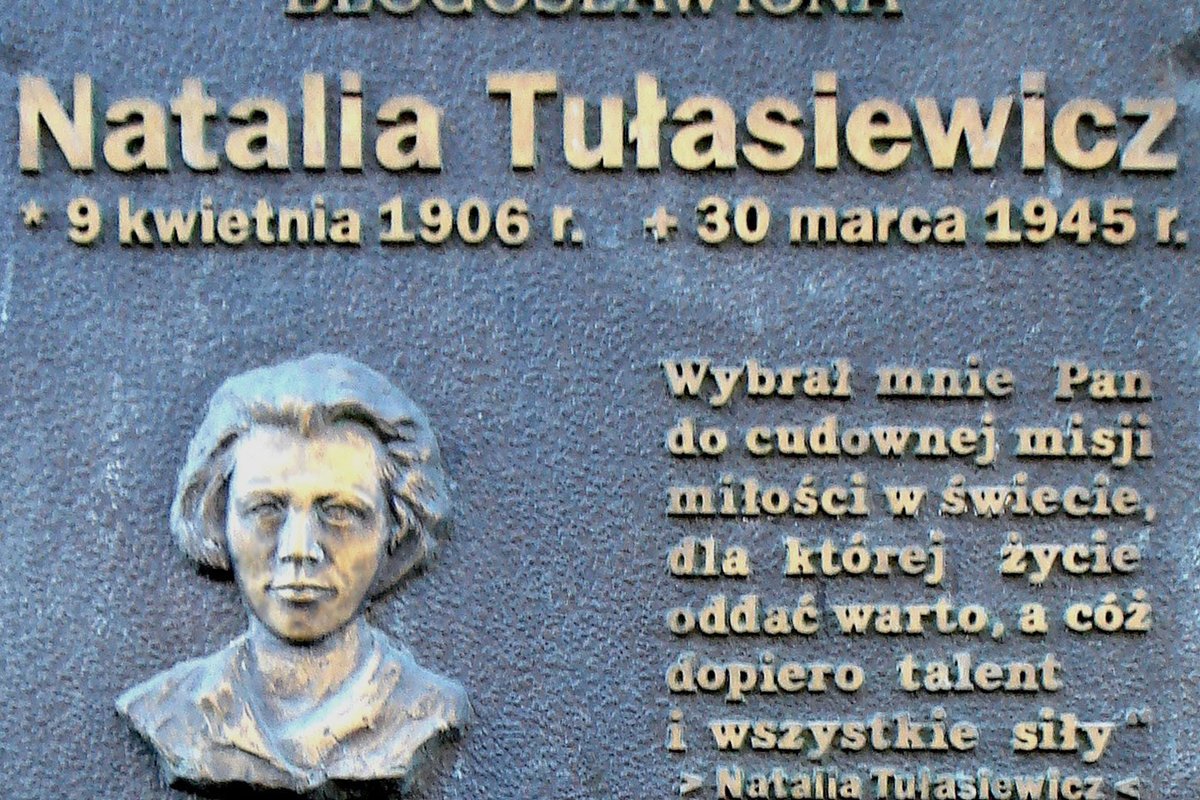
Memorial plaque with bronze relief portrait of Natalia Tułasiewicz, ul. Śniadeckich 30, Poznań (installed 2003), photographed by Wikimedia contributor "Jerzy," 2007 — public domain. No confirmed public-domain photographic portrait of her could be located, so this sculpted memorial likeness is used instead.
Before the war closed in, Natalia had already been active in lay Catholic circles in Poznań, involved in youth and educational work connected to the Church rather than pursuing an academic career in the narrow sense. That background mattered later. The skills that made her a capable literature teacher — patience, the ability to hold an audience's attention, a habit of finding meaning inside difficult texts — turned out to be exactly the skills a clandestine minister needed inside a labor camp, where there was no pulpit, no vestments, and no legal cover for anything resembling organized religious life.
Volunteering for deportation
In 1943, rather than wait to be swept up in that conscription or try to evade it, Natalia volunteered for it. She was assigned to the Günther Wagner Pelikan ink factory in Hanover, joining the ranks of Polish women sent to work in German industry under wartime conditions. Her reason for going wasn't submission to the occupying regime — it was the opposite. Connected to the Polish Home Army, the country's main underground resistance organization, she went specifically as an envoy: a trained laywoman positioned to offer the deported Polish women something the Nazi labor system had no intention of providing them — clandestine pastoral and spiritual support, delivered quietly, at real personal risk, inside a factory in the heart of the German war economy.
The danger wasn't abstract. Nazi occupation policy toward Poland treated any organized Catholic or nationalist activity among the deported labor force as a direct security threat, and discovery meant interrogation, the camp system, or worse — not a warning and a reassignment. Natalia went in fully aware of that calculus. Her role, as the resistance had shaped it, was to hold small, informal gatherings, to keep the deported women's faith and sense of identity intact under conditions specifically designed to strip both away, and to do it without leaving anything on paper that could be traced back to an organized network.
Arrest, torture, and Ravensbrück
That risk caught up with her. Her clandestine activity was eventually discovered, and Natalia was arrested and tortured before being sent to Ravensbrück, the concentration camp built specifically for women prisoners north of Berlin. Even there, by the accounts that survive her, she didn't stop the work she'd volunteered to do in the first place. On Good Friday of 1945, she reportedly climbed onto a stool in the barracks to give her fellow prisoners a talk on Christ's Passion and Resurrection — preaching, in effect, inside a death camp, on the specific feast that commemorates suffering that ends in life. She was killed in the gas chamber the following morning or the morning after, on Easter Sunday, March 31, 1945; some sources give March 30 instead, a small discrepancy typical of records from the camp's final chaotic weeks before liberation.
Ravensbrück itself was liberated by Soviet forces less than five weeks later, at the end of April 1945 — a detail that makes her death feel especially close to the edge of survival, cut short by days rather than by years. She was one of roughly 130,000 women who passed through the camp over its operational life, the great majority of them political prisoners, resistance members, and women targeted for their nationality or faith rather than for any individual crime.
One of only two laywomen among the 108 Polish Martyrs
Pope John Paul II beatified Natalia Tułasiewicz on June 13, 1999, as part of a group of 108 Polish Martyrs of World War II — Catholics from Poland killed under Nazi persecution during the war, beatified together in a single ceremony. Within that group of 108, a detail worth pausing on: Natalia is one of only two laywomen included, in a list otherwise dominated by priests, religious sisters and brothers, and bishops. It's a genuinely notable distinction. Her path to martyrdom didn't run through ordination or religious vows — it ran through a university literature degree and a decision to walk voluntarily into forced labor so she could minister to women the institutional Church had no other way of reaching.
Her individual feast is kept on March 31; the wider group of 108 Polish Martyrs is often commemorated on June 12. In 2022, the Vatican approved a request from the Polish bishops' conference formally naming her patroness of Polish teachers — a fitting, specific, and genuinely recent designation, tying together the literature classroom she trained for and the clandestine classroom-of-sorts she built for herself inside a German labor camp instead.
What makes her case stand out, even among the 108, is how ordinary her starting point was. She wasn't a bishop with institutional authority behind her, or a religious sister bound by vows and community. She was a young laywoman with a university degree who decided, on her own initiative, that the women being deported deserved someone willing to go with them. Her beatification recognizes that decision itself as heroic — not a dramatic single act, but a sustained, quiet willingness to keep ministering in a place built to make that impossible, right up to the night before she died. Readers interested in other saints who organized quiet, unglamorous ministry under difficult circumstances may also want to read about Saints Cyril and Methodius, missionaries who built up the Slavic church from nothing while navigating hostile political pressure of their own.
Trivia
Who was Blessed Natalia Tułasiewicz?
Why did Natalia Tułasiewicz volunteer for forced labor in Nazi Germany?
How did Natalia Tułasiewicz die?
What did Natalia Tułasiewicz do the night before she died?
Is Natalia Tułasiewicz a patron saint of teachers?
You May Also Like

Related Reading