Saint Margaret Mary Alacoque

A childhood marked by illness and a vow
Marguerite-Marie Alacoque was born on July 22, 1647, in Lhautecourt, a village in the Burgundy region of France. Her father died when she was only eight, and not long afterward she fell seriously ill — a paralyzing illness resembling rheumatic fever that confined her to bed for roughly four years. According to her own later account, the illness resolved only after she made a vow to the Virgin Mary, a recovery she attributed directly to Mary's intercession. It's the kind of formative episode that shows up again and again in the biographies of visionary mystics: a childhood shaped early by suffering, prayer, and a sense of having been personally rescued by heaven.
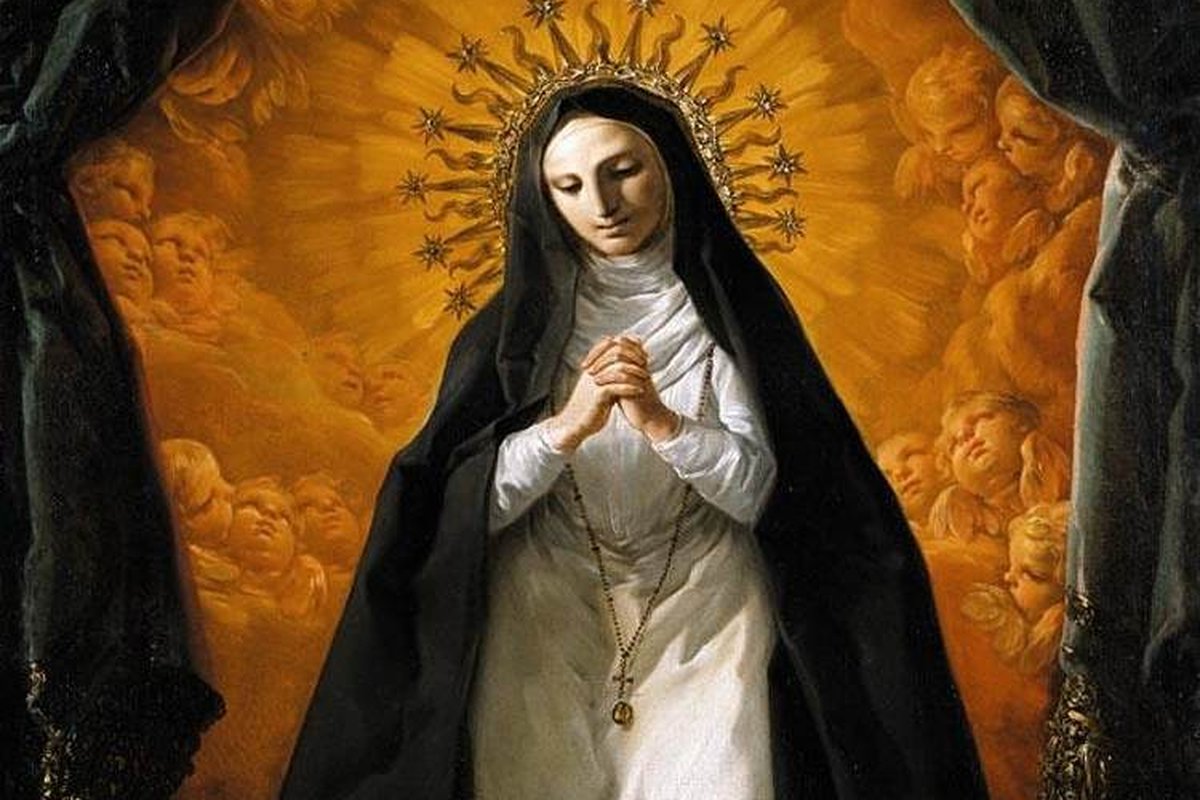
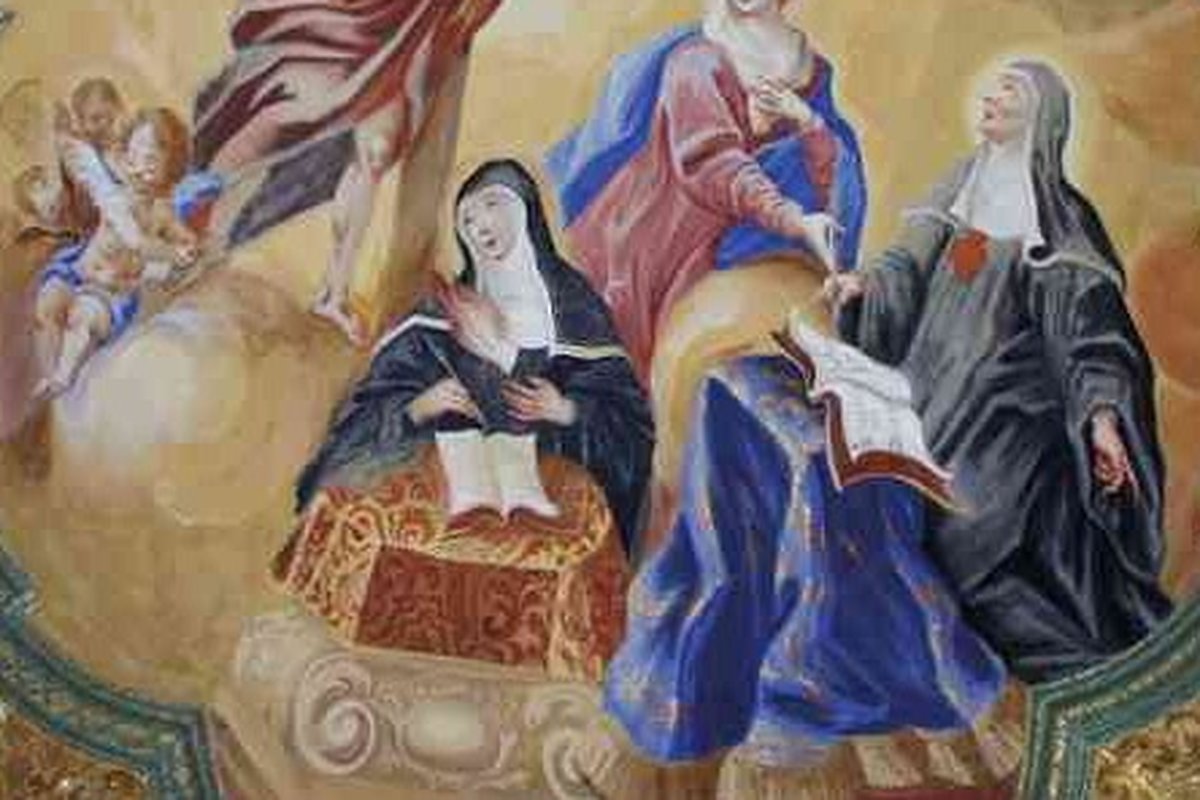
Corrado Giaquinto, Saint Margaret Mary Alacoque Contemplating the Sacred Heart of Jesus, oil on canvas, c. 1765 — public domain.
She entered the Visitation Convent at Paray-le-Monial on May 25, 1671, and professed her final vows the following November. Life in the convent suited her, though it would not stay ordinary for long.
What she reported, and why the framing matters
Between December 1673 and June 1675, Margaret Mary reported a series of apparitions of Christ, culminating in what later devotional literature would call the "Great Apparition," which she placed on June 16, 1675, during the octave of the feast of Corpus Christi. In her own written account — composed afterward at her spiritual director's request — she described Christ appearing to her and asking, in substance, for the institution of a feast specifically honoring his Sacred Heart, along with the practice of receiving Communion on the first Friday of each month as an act of reparation. A widely circulated line rendering Christ's words on that occasion — describing a heart that has loved so completely it has spared nothing of itself — traces back to her own account, but survives to us in French across multiple later English translations that don't always agree word for word, so it's presented here in substance rather than as a single fixed quotation.
This is precisely the kind of material Catholic theology categorizes as private revelation. Even though the Church has, over the following centuries, treated the Sacred Heart devotion with considerable warmth — extending its feast to the universal calendar and encouraging its practice widely — the apparitions themselves are not dogma, and no Catholic is obligated to believe the specific details of what Margaret Mary reported experiencing. The honest way to describe any of it is exactly as it should be read: she reported that Christ appeared to her and said these things; the Church has not certified the vision as objective historical fact, only judged the resulting devotion to be spiritually sound and worth encouraging.
Skepticism inside her own convent
None of this was accepted smoothly, even within her own community. Visionary claims from young nuns were treated with real caution in 17th-century religious life, and Margaret Mary met genuine resistance from other sisters at Paray-le-Monial, who were unconvinced by her accounts and, by most tellings, made her life within the convent considerably harder for a time. What changed the trajectory was the arrival of Saint Claude La Colombière as the convent's spiritual director in 1675. La Colombière took her reported visions seriously, offered her the pastoral and theological support she'd been missing, and helped her accounts gain a wider hearing beyond the walls of Paray-le-Monial. Without his backing, it's entirely possible the Sacred Heart devotion as it exists today would never have taken hold the way it did — a reminder that even devotions the Church later embraces broadly often survive their earliest years by the thinnest of margins, carried by one or two people willing to vouch for them.
From one convent to a devotion the whole Church would embrace
The road from a single nun's reported visions to a universal feast was neither quick nor smooth. The devotion spread gradually through the 18th century, gained ground unevenly, and only slowly moved from grassroots enthusiasm toward full institutional endorsement. Margaret Mary herself did not live to see the devotion in anything like its later form — she died on October 17, 1690, at Paray-le-Monial, still a relatively obscure figure outside her own religious circle.
Her own cause moved with comparable slowness. She was declared Venerable on March 30, 1824, by Pope Leo XII; beatified on September 18, 1864, by Pope Pius IX; and finally canonized on May 13, 1920, by Pope Benedict XV — two and a quarter centuries after her death. Her feast is kept on October 16, adjusted slightly from her actual date of death to fit the wider liturgical calendar.
A patronage rooted in devotion, not decree
Margaret Mary is recognized above all as the patroness of devotees of the Sacred Heart — a patronage that follows directly and unmistakably from her life's central episode. A looser, less formally codified association also links her to those suffering paralysis or polio, drawn from her own childhood illness and reported recovery. Whatever one makes of the visions themselves, the image she reported — of a heart she described as burning with love and largely unnoticed by the people it loved — has proven to be one of the most enduring devotional images to come out of the entire early modern Church, still recognizable in homes and churches around the world more than three centuries later.
Trivia
Who was Saint Margaret Mary Alacoque?
What did Margaret Mary Alacoque report seeing in her visions of the Sacred Heart?
Did the Catholic Church accept Margaret Mary Alacoque's visions right away?
Is the Sacred Heart devotion based on official Church teaching or on Margaret Mary's visions?
When is Saint Margaret Mary Alacoque's feast day, and what is she the patron of?
You May Also Like
Related Reading