Saint Philomena

What was actually found in 1802
Strip this story down to what can actually be documented, and it's short. On May 24-25, 1802, workers excavating the Catacomb of Priscilla in Rome broke into a sealed loculus — a burial niche cut into the catacomb wall — and found the skeletal remains of a girl, later assessed as roughly 13 to 15 years old at death. Nearby were three terracotta tiles, broken and out of sequence, inscribed "LUMENA / PAX TE / CUM FI." The workers who found them rearranged the fragments to read "PAX TECUM FILUMENA" — "Peace be with you, Philomena." A small glass vial was also found in the niche, which excavators of the period conventionally, though not reliably, took as a sign of martyrdom. That is the complete extent of the contemporary physical evidence. No date. No independent record of who she was, how she died, or whether the tiles and the skeleton even belonged together in the first place.
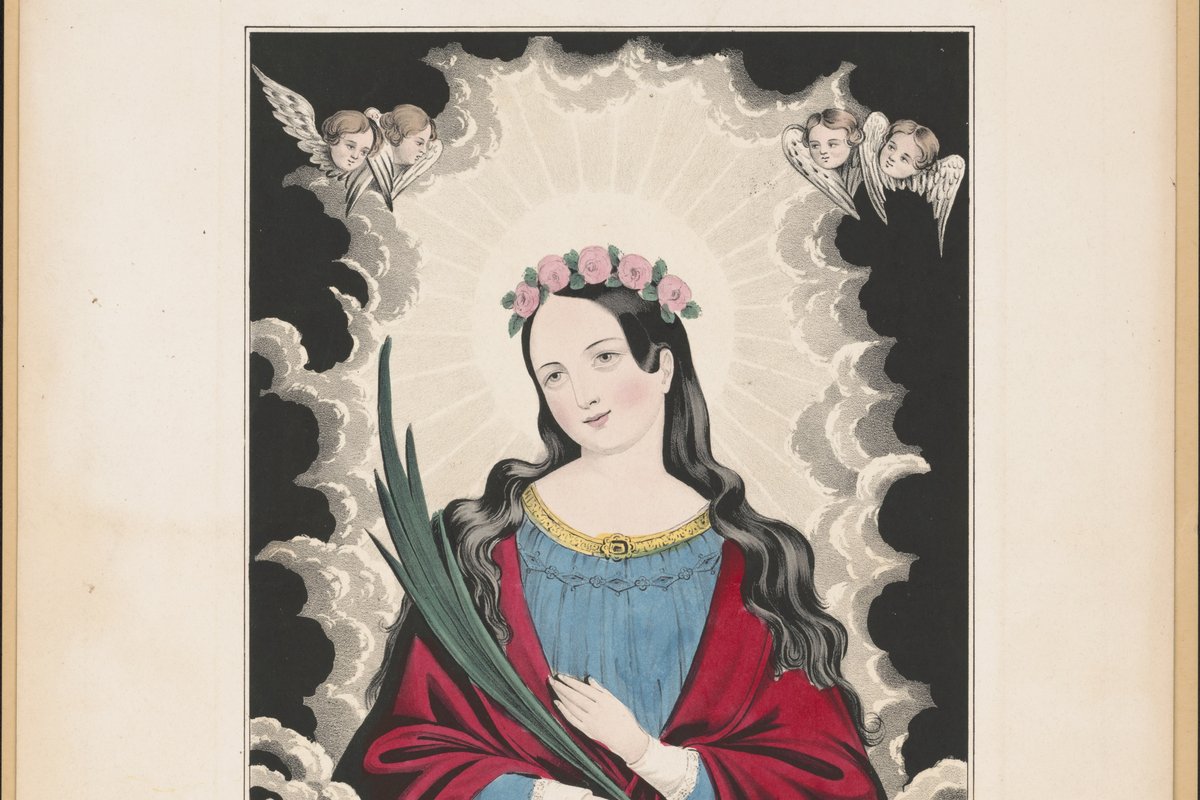
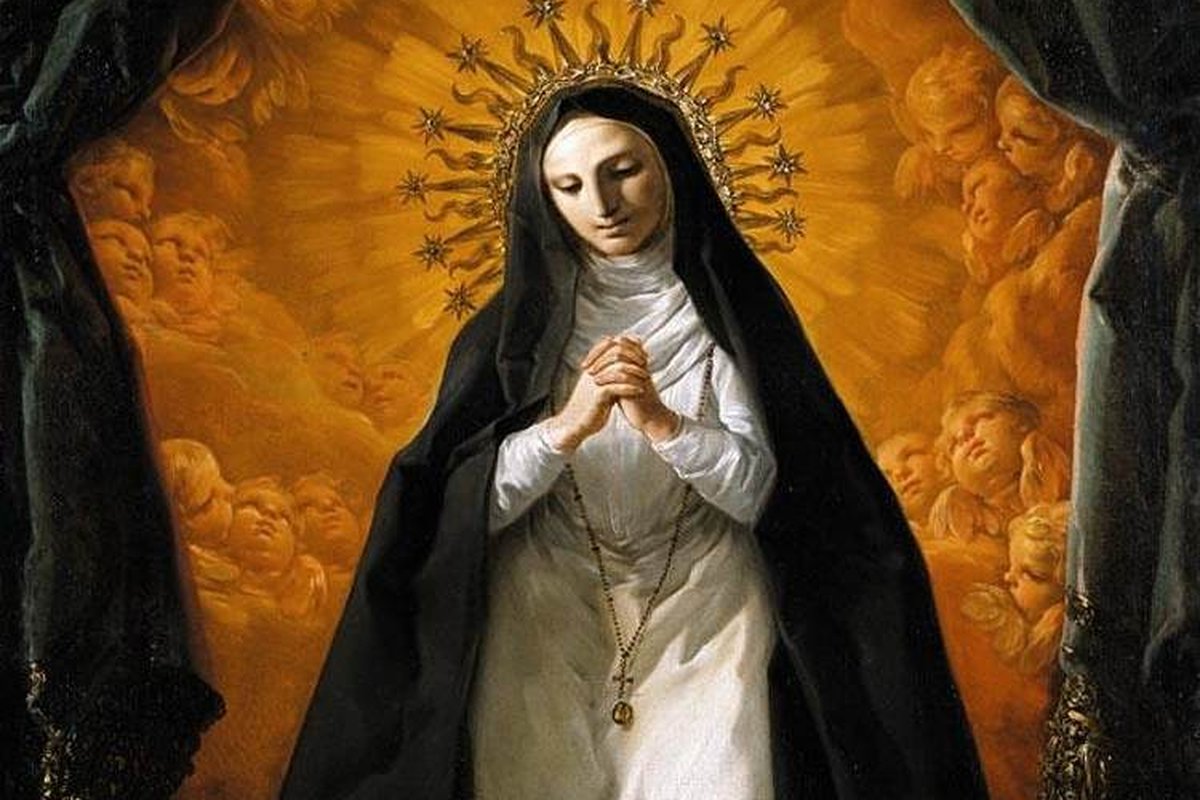
"St. Philomena," hand-colored lithograph, Popular Graphic Arts collection, Library of Congress, 1845 — public domain.
That last point matters more than it might seem. The tile inscription itself has been disputed by archaeologists — Orazio Marucchi, a respected early 20th-century Catholic archaeologist cited approvingly in the original 1911 Catholic Encyclopedia, argued that the tiles were reused fragments from an earlier, unrelated burial, stylistically dated earlier than the skeleton found with them. If Marucchi is right, the name and the remains may never have belonged to the same person at all.
From an anonymous burial to a named shrine
In 1805, the relics were given to a Neapolitan priest, Francesco di Lucia, who enshrined them at Mugnano del Cardinale, near Naples. For nearly three decades after that, devotion to the relics remained local and relatively modest — a set of bones and a reassembled name, venerated as a girl-martyr without a story attached. That changed starting in 1833, when a Neapolitan Dominican tertiary named Sister Maria Luisa di Gesù reported a series of private visions in which, she said, Philomena herself communicated a detailed account of her life: a Greek princess, daughter of a pagan king, who converted to Christianity, refused marriage to the Emperor Diocletian, and was tortured and beheaded for her faith.
It's worth being direct about what that narrative is and isn't. It has no independent historical or documentary support of any kind — no ancient text, no earlier tradition, nothing beyond the reported visions of one 19th-century nun, decades after the relics had already been found and enshrined. Every detail of the princess-martyr story — her royal birth, her refusal of Diocletian, the specifics of her torture — originates entirely in that private revelation. It should be read as a 19th-century devotional account of what one visionary reported being told, not as history, and this article deliberately doesn't narrate it as though it were a settled biography, because it isn't one.
How the devotion became enormous anyway
None of that historical thinness stopped the devotion from spreading fast. In 1835, Pauline Jaricot, founder of the Society for the Propagation of the Faith, reported a dramatic cure at the Mugnano shrine, and word of it fueled rapid growth in devotion to Philomena across Italy and then France. The single biggest driver of that growth was Saint John Vianney, the Curé of Ars, who promoted devotion to Philomena heavily among his own parishioners and built her a shrine in France — his enormous personal influence as a spiritual figure is a major reason her cult became as widespread as it did, well beyond what the historical record about her could have supported on its own. Between 1837 and 1961, various dioceses granted local or regional liturgical approval for her veneration, though she was never added to the universal Roman calendar.
A formal status unlike most saints
Here the distinctions matter and shouldn't be blurred. Philomena was never canonized through the Catholic Church's standard process — there was no formal declaration of sainthood built on a documented life, a review of virtue, and verified miracles attributed to her intercession as an identified historical person. What existed instead was local and regional permission for her cult, granted by individual dioceses over more than a century. On February 14, 1961, the Sacred Congregation of Rites removed her feast, previously kept on August 11, from all liturgical calendars, as part of a broader calendar reform — and did so explicitly because of the lack of historical evidence tying the 1802 relics to any specific, identifiable martyr. That's about as clear an acknowledgment as the Church's own institutions typically make of exactly the uncertainty described above.
She's still popularly called "Saint Philomena" today, through long-standing custom and regional liturgical permission that predates and has survived the 1961 removal — and she's still invoked, particularly for the young, though any patronage attached to her should be understood as devotional tradition rather than an established fact about a documented historical person. No writing or direct quotation from her is known to exist in any verifiable form. What can honestly be said is this: in 1802, a nameless girl's grave was opened in a Roman catacomb, and by the middle of the 19th century, an entire biography had grown up around her bones, drawn not from history but from one nun's account of what she said she'd been shown in prayer.
Trivia
Who was Saint Philomena?
Is the story of Philomena as a Greek princess historically true?
Why was Saint Philomena's feast removed from the Church's calendar?
Was Philomena ever formally canonized?
Why did devotion to Philomena spread so widely despite the uncertainty about who she was?
You May Also Like

Related Reading