Saint Mechtild of Hackeborn

Born into a noble family, raised in a remarkable convent
Mechtild of Hackeborn was born around 1241 or 1242 at the Hackeborn family's castle in Thuringia, in what is now Germany, the third daughter of a Thuringian baron whose family connections reportedly reached as far as Emperor Frederick II. She entered the convent at Helfta, in Saxony, as a schoolgirl and formally became a nun there in 1258. Helfta in this period was an unusually rich environment for religious women — it produced not only Mechtild but also Saint Gertrude the Great, and the community's intellectual and spiritual life left a mark on medieval mysticism well beyond its own walls.
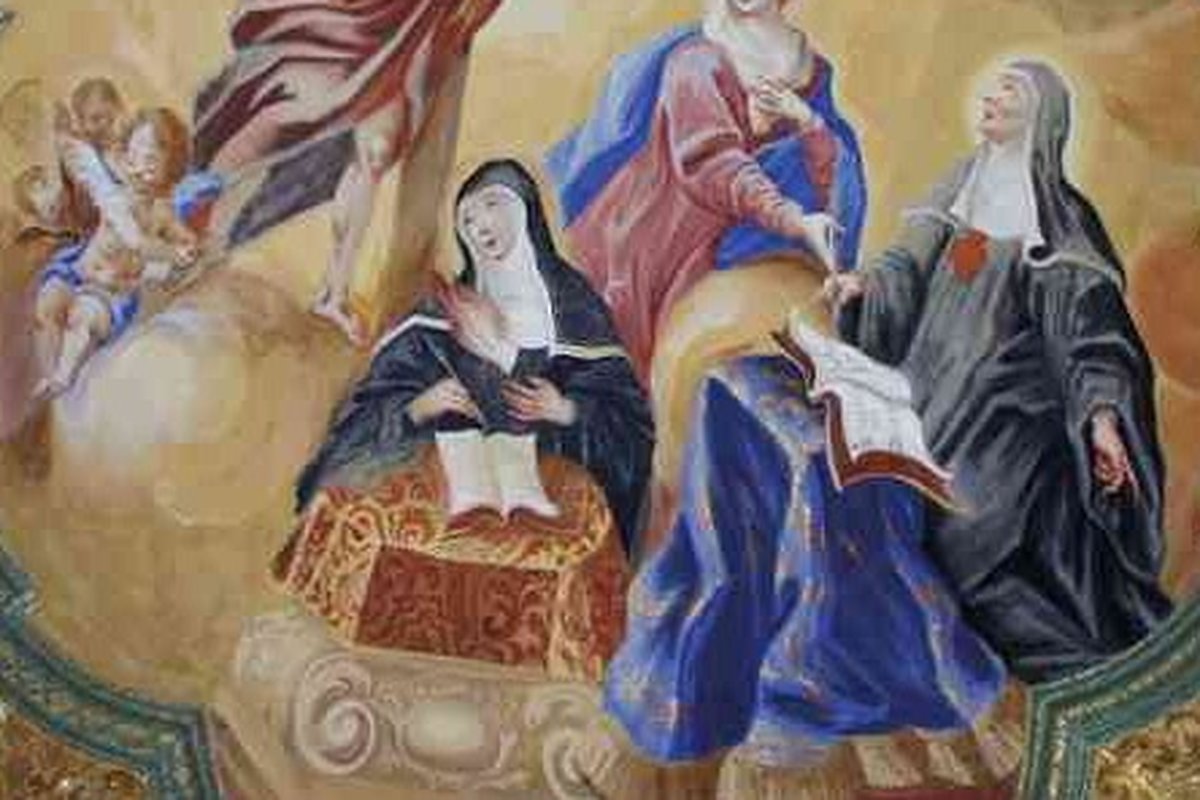
Innozenz Anton Warathy, ceiling fresco of Mechtild of Hackeborn and Gertrude the Great, 1720, library of Kloster Metten, Bavaria — public domain.
Within the convent, Mechtild rose to become choir director and chantress, and the beauty of her singing earned her the affectionate nickname "the nightingale of Christ" among her fellow sisters — a detail that says something about how her community actually experienced her, long before anyone thought to write down what she said about her interior life.
A family connection worth getting right
One point of genuine confusion in accounts of Helfta's history deserves clarifying directly: Mechtild's biological sister was Gertrude of Hackeborn, who served as abbess of the convent for roughly forty years and was instrumental in making Helfta the kind of community it became. This is a different person from Saint Gertrude the Great — properly Gertrude of Helfta — a younger nun who entered the convent around age five with no blood tie to either Hackeborn sister. Gertrude the Great became Mechtild's spiritual disciple and close confidante rather than her relative, and the two women's names get tangled in some secondary sources precisely because they lived, prayed, and are remembered together at the same convent during the same years.
Visions recorded without her knowledge
Around the age of fifty, Mechtild began confiding details of her visions to two of her fellow nuns during what she evidently believed were private conversations. What she didn't know was that the two sisters were writing down everything she told them. When the project eventually came to light — when Mechtild learned that her own reported words had been recorded and were being compiled into a manuscript — she was, by the account that survives, distressed rather than flattered by the discovery. It's a striking detail precisely because it cuts against the common assumption that medieval visionaries sought out or welcomed public attention for their mystical experiences; Mechtild's own reported reaction suggests the opposite.
The material those two sisters had gathered, with further involvement from Gertrude the Great, was eventually compiled into the Liber Specialis Gratiae — the "Book of Special Grace." Because of how it came together, the text presents Mechtild's visions largely in third-person, reported form, filtered through the sisters who transcribed them, rather than as a first-person spiritual autobiography written in her own hand. No short, first-person quotation from Mechtild could be confidently verified against a specific, accessible English edition for this article, so her reported visions are described here in substance rather than attributed to her in quotation marks.
Reading her visions as private revelation
The same theological framing that applies to other reported mystics applies here: Mechtild's visionary content is private revelation, not defined Church teaching, and it should be read that way throughout — she reported seeing and hearing certain things, and generations of readers have found the resulting text spiritually valuable, but none of it carries the weight of dogma the way a conciliar definition or a passage of Scripture does. The Liber Specialis Gratiae nonetheless became one of the most widely circulated and influential mystical texts of the later Middle Ages, read and copied well beyond Helfta's own community and translated into multiple vernacular languages within just a few generations of its compilation — a remarkable afterlife for a book its own subject reportedly never wanted written in the first place.
Helfta's place in medieval mysticism
What makes Mechtild's story more than an isolated curiosity is the community that produced it. Helfta, in the second half of the thirteenth century, became one of the most significant centers of women's mystical writing in medieval Europe, producing three major figures in close succession: Mechtild herself, her spiritual disciple Gertrude the Great, and, for a time, the visionary nun Mechtild of Magdeburg, who spent her final years there after leaving a Beguine community (a lay religious movement of women who lived communally without taking permanent monastic vows). Historians have puzzled over what made this particular convent, in this particular generation, so unusually fertile — theories point to the community's strong emphasis on liturgical music and scriptural study, an abbess in Gertrude of Hackeborn who actively encouraged learning among her nuns, and simply the rare coincidence of several extraordinary women living and praying under one roof at the same moment. Whatever the cause, the mystical literature to come out of Helfta in those decades shaped later devotional traditions across Europe, including popular devotion to the Sacred Heart of Jesus, a devotion Mechtild's and Gertrude's visions helped popularize well before it became a widespread liturgical feast in later centuries.
A pre-congregation saint, quietly venerated
Mechtild died at Helfta on November 19, 1298. Like most saints of her era, she never went through a formal Roman canonization process — she's venerated instead through a longstanding local and liturgical cultus that has continued uninterrupted for over seven centuries. Her feast is kept on November 19. No strongly established universal patronage attaches to her name, and none should be invented for the sake of tidiness; what endures instead is the text itself, and the quietly remarkable story of how it came to exist — two nuns, a private confidence, and a book its subject only discovered after the fact.
Trivia
Who was Saint Mechtild of Hackeborn?
What is the Liber Specialis Gratiae, and how was it written?
Was Mechtild of Hackeborn related to Saint Gertrude the Great?
How should Mechtild of Hackeborn's visions be understood theologically?
Was Mechtild of Hackeborn formally canonized, and when is her feast?
You May Also Like
Related Reading