Saint Paula of Rome

A senator's daughter, married and widowed young
Paula was born in Rome in 347 into the Furii Camilli, one of the wealthiest senatorial families in the empire — the kind of household with a mansion on the Aventine Hill and a name that opened every door in Roman society. At sixteen she married a nobleman named Toxotius, and the marriage produced five children, including two daughters, Blesilla and Eustochium, who would both go on to be venerated as saints in their own right. Toxotius died while their children were still young, leaving Paula a widow in her early thirties with a fortune and a household to manage on her own — the ordinary, expected trajectory for a woman of her class would have been to keep doing exactly that.
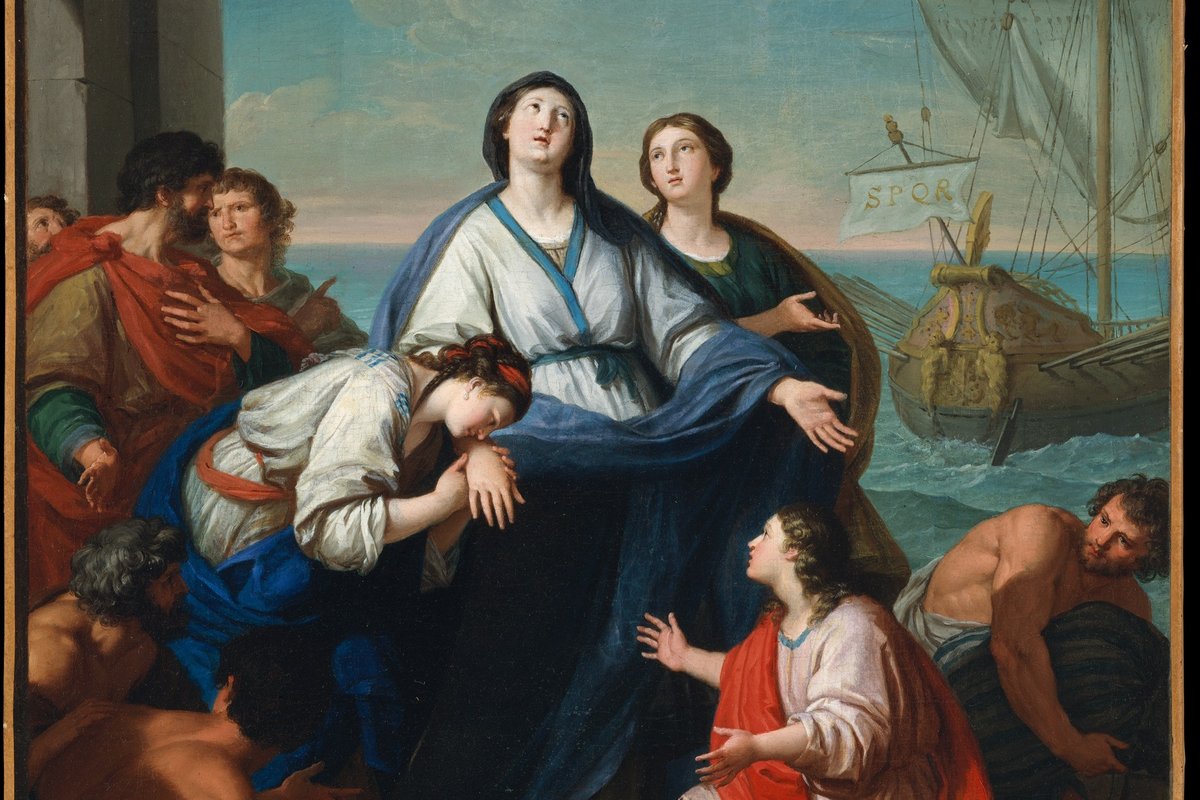
Giuseppe Bottani (1717–1784), "The Departure of Saints Paula and Eustochium for the Holy Land," 18th century, Metropolitan Museum of Art — public domain.
Instead, Paula moved into the orbit of Marcella, an ascetic widow who had gathered a circle of Christian women around her on the Aventine Hill, dedicated to prayer, study of Scripture, and a deliberately simplified way of life despite their wealth. It's through Marcella that Paula's story takes its decisive turn: in 382, Marcella introduced her to a visiting priest and scholar named Jerome, who had come to Rome at the invitation of Pope Damasus I. Paula and Jerome quickly became close collaborators, and by Jerome's own account in later letters, Paula and her daughter Eustochium were part of what pushed him toward the ambitious biblical scholarship that would define the rest of his life.
From Rome to Bethlehem
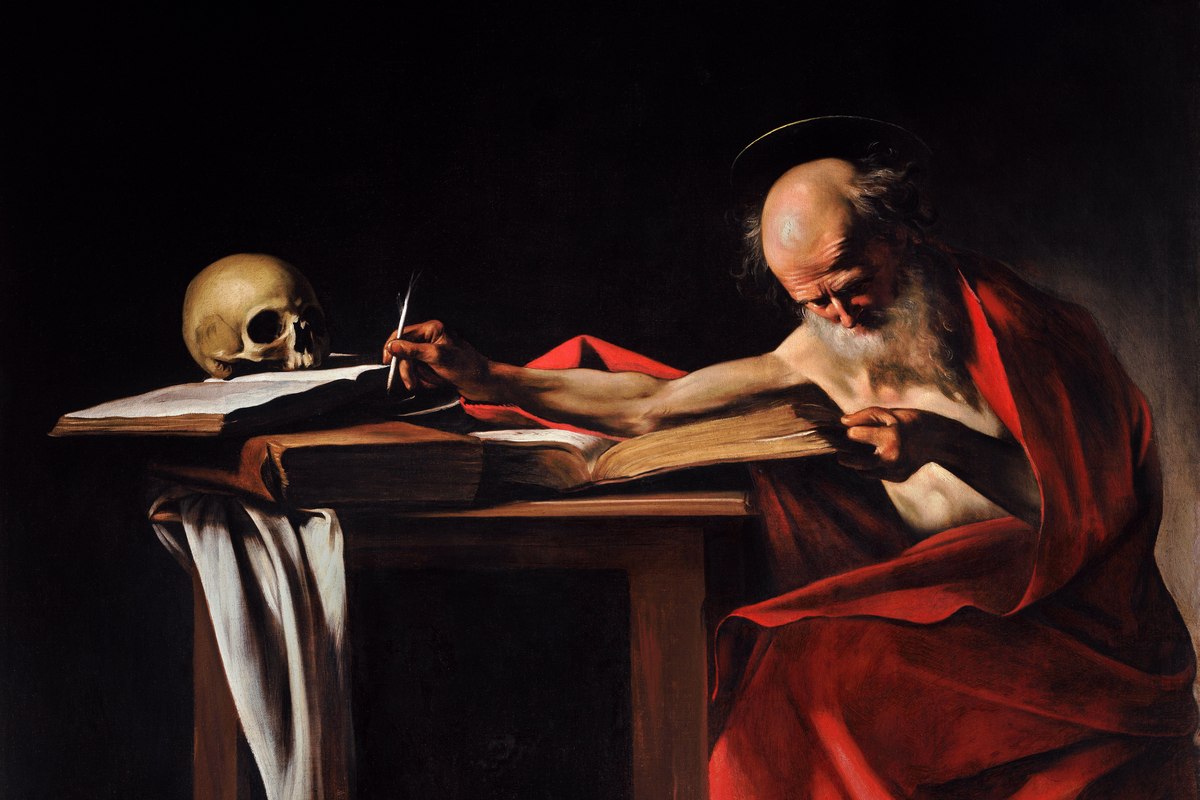
The turning point came in 385, after the death of Paula's eldest daughter Blesilla. Grieving and unsettled by the direction her life in Rome had taken, Paula left the city that same year, traveling east with Eustochium and with Jerome, who had also decided to leave Rome after growing opposition to his outspoken criticism of the city's clergy. The three toured monastic communities across Palestine and Egypt, visiting the desert hermits and ascetics whose way of life had already begun shaping Christian monasticism, before settling in Bethlehem, where Paula would spend the rest of her life.
It's easy to undersell what "settling" meant here. Paula used her considerable remaining wealth to fund the construction of twin monasteries in Bethlehem — one for men, one for women — along with a hostel for the pilgrims who came through the town on their way to and from the holy sites nearby. She personally oversaw the women's community. And she built Jerome a cell of his own, where he lived and worked for the rest of his life, producing the Latin Bible translation now known as the Vulgate — the standard biblical text of Western Christianity for the next thousand years. Bethlehem became the base for that work because Paula built it and paid for it to exist.
A collaborator, not just a patron
It would undersell Paula's role to describe her only as a wealthy woman who wrote checks. Jerome's own letters describe her as an active intellectual partner — someone who studied Hebrew and Scripture alongside him, pressed him with questions, and whose interest in a rigorous, accurate biblical text was part of what drove him toward the painstaking translation work he undertook in Bethlehem. That collaboration between an aristocratic widow and a famously difficult, combative scholar-priest produced one of the most consequential documents in the history of Western Christianity, and Paula's fingerprints are on it in a way that few patrons of any era can claim.
The Epitaph, and what it tells us
Paula died in Bethlehem on January 26, 404. Jerome, devastated, wrote a lengthy eulogy addressed to Eustochium — Letter 108, traditionally known as the Epitaphium Sanctae Paulae, the "Epitaph of Paula." It opens with a line that captures the tone of the whole document: "We do not grieve that we have lost this perfect woman; rather we thank God that we have had her." No writing in Paula's own voice is known to survive, so everything we have from her comes filtered through Jerome's account — but that account is itself an unusually rich, detailed, contemporary record, not a legend assembled centuries after the fact. For an ancient figure, Paula is remarkably well documented, and that alone sets her apart from many saints of her era whose stories survive only in much later, far less reliable retellings.
Paula was venerated as a saint essentially from the time of her death, through the local and ancient cultus that was the standard route to sainthood before the Church developed its formal canonization process centuries later. Her feast is kept on January 26. She's sometimes informally described as a patroness of widows, though that patronage isn't a strongly established, formal designation — it reflects popular devotion more than any specific papal decree. What's certain, and what the record actually supports, is simpler and in some ways more remarkable: a Roman aristocrat gave up the whole of her old life to make possible one of the most important scholarly projects in Christian history, and the man who completed it never let anyone forget that she was the reason it happened.
Trivia
Who was Saint Paula of Rome?
How did Paula meet Saint Jerome?
Why did Paula leave Rome for Bethlehem?
What is Jerome's Epitaph of Paula?
What did Jerome say about Paula after her death?
You May Also Like
Related Reading