Saint Jerome

From hermit to papal secretary
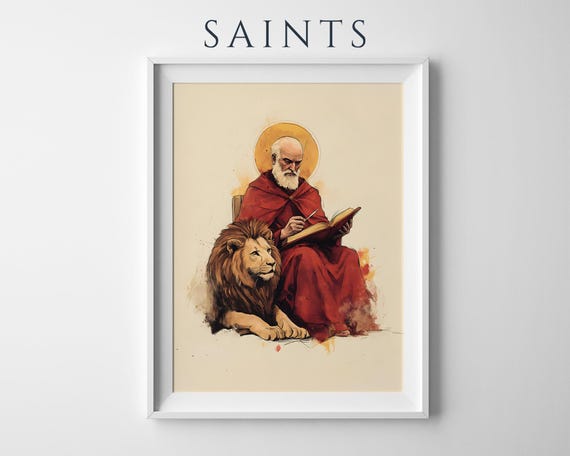
Jerome's path to becoming history's most consequential Bible translator ran through years of ascetic withdrawal. Born around 347 in Stridon, Dalmatia, he spent four or five years living as a hermit in the Syrian desert before eventually serving as secretary to Pope Damasus I in Rome — a role that placed him, almost by circumstance, in exactly the position needed for the project that would come to define his life.
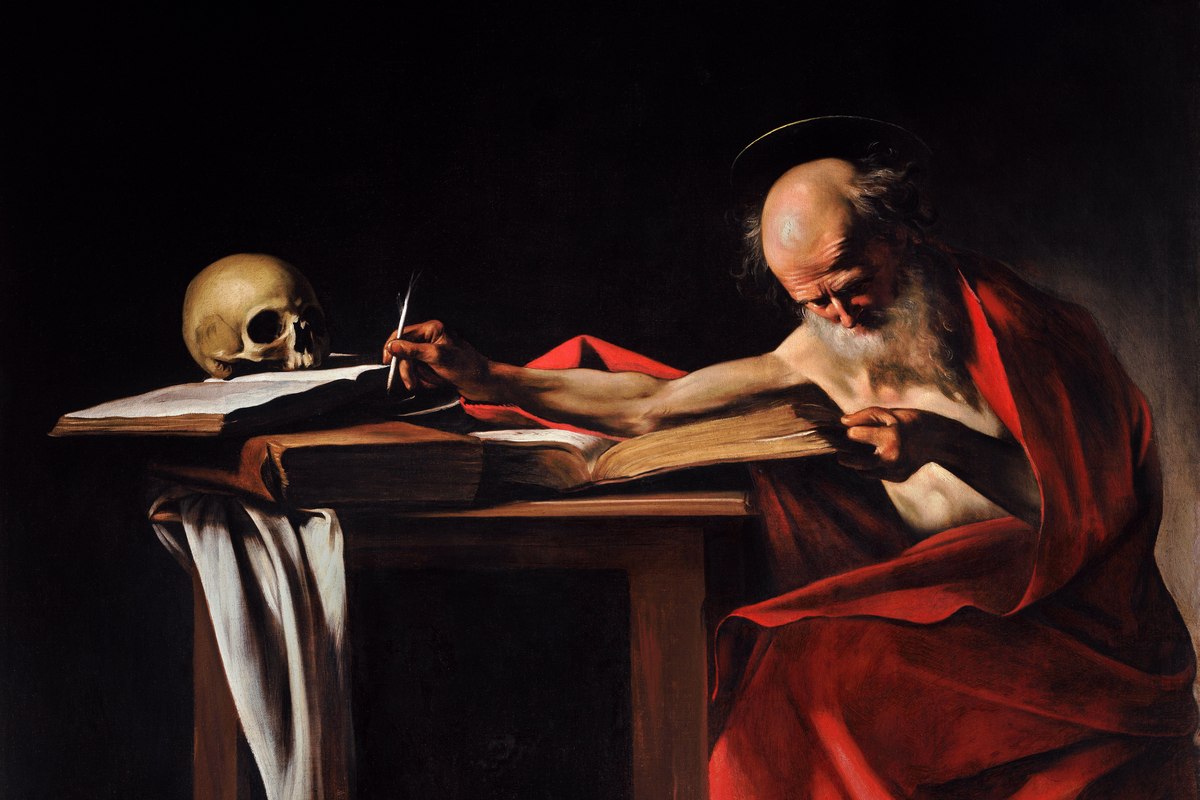
Caravaggio, "Saint Jerome Writing," c. 1605-1606 — public domain.
Jerome's earlier education had been thoroughly classical, steeped in the great pagan Latin authors like Cicero, and he later described a vivid dream in which he stood accused before a divine tribunal of being "a Ciceronian, not a Christian" — a dream so unsettling that he vowed, at least for a time, to give up secular literature entirely and devote himself only to Scripture. His years in the Syrian desert were themselves difficult, marked by illness, isolation, and what he described as intense inner temptation, but they also gave him the time to begin learning Hebrew from a converted Jewish monk — an unusual and demanding undertaking for a Christian scholar of his era, and the foundation for everything that followed.
A commission born of chaos
By the early 380s, the Latin Bible circulating across the Western Church had grown a mess of inconsistent, competing translations, none fully reliable and none uniform from region to region. In 382, Pope Damasus I commissioned Jerome to fix the problem: produce a single, accurate, standardized Latin version of the Bible. Jerome started with the New Testament, correcting the existing Latin text against the Greek — practical, careful editorial work rather than a wholesale new translation, at least at first.
Jerome's years in Rome working for Damasus were not without controversy. He became spiritual advisor to a circle of wealthy, devout Roman women, several of whom took vows of celibacy and embraced ascetic lifestyles under his direction, and his sharp, often combative writing style earned him powerful enemies among Rome's clergy, who resented both his influence and his outspoken criticism of what he saw as worldliness among the city's priests. After Damasus died in 384, Jerome's position in Rome grew untenable, and he left the city permanently the following year, traveling first to the Holy Land and eventually settling in Bethlehem in 386, where — with the financial support of Paula, one of the Roman noblewomen who had become his close collaborator and followed him into the Holy Land — he established the monastery that would remain his home and workshop for the rest of his life.
Learning Hebrew to translate from the source
The Old Testament called for something more radical. Around 390, Jerome made the controversial decision to translate the Hebrew Bible directly from its original Hebrew text, rather than from the Greek Septuagint that earlier Latin translations had relied on. It was a decision that required him to learn Hebrew as an adult, in a Christian scholarly world where that was far from standard practice, and it drew real suspicion from contemporaries who felt the established Greek-based tradition shouldn't be second-guessed. Jerome pressed on anyway, working from Bethlehem, where he had settled permanently, and completed the entire Bible translation by 405.
Among Jerome's fiercest critics on this exact point was Saint Augustine of Hippo, who worried in a lengthy exchange of letters that translating from the Hebrew, rather than the Greek Septuagint the early Church had used for centuries, risked introducing troubling discrepancies between Latin and Greek-speaking Christian communities, and that it implicitly questioned the authority of a text the apostles themselves had relied on. Jerome defended his approach forcefully, arguing that a translation should recover the sense of the original language as closely as possible rather than translate a translation, and history has generally vindicated his instinct, even as scholars today recognize that Jerome, like any translator, made countless judgment calls that reflect his own era and theological assumptions. He also grew increasingly convinced during this period that certain Old Testament books preserved only in Greek, not in the Hebrew canon used by Jewish communities of his day, belonged in a secondary category he called the Apocrypha — a distinction that would later feature prominently, centuries afterward, in disputes between Catholic and Protestant reformers over the proper contents of the Bible.
A translation that outlasted every objection
The result, eventually known as the Vulgate, overcame its rocky reception to become the standard Latin Bible of the Western Church for well over a millennium. The Council of Trent formally settled the matter in 1546, decreeing the Vulgate the exclusive authoritative Latin text of Scripture — a decision that meant generations of Western Christians, for the next several centuries, would encounter the Bible primarily through the words of a single scholar who had once been distrusted for learning a language no one had asked him to learn.
Jerome's later years in Bethlehem were prolific but far from peaceful. He continued a torrent of biblical commentaries, letters, and polemical writings against various theological opponents almost until his death in 420, and lived through the shock of Rome's sack by Visigothic forces in 410, an event he described as devastating news that reached him even in his distant Bethlehem monastery. Alongside Ambrose, Augustine, and Pope Gregory the Great, he is counted among the four original Doctors of the Church in the Western tradition, honored specifically for the scholarship that gave the Latin-speaking world direct access to Scripture in its original languages rather than through layers of prior translation — work still consulted by biblical scholars today, more than sixteen centuries after it was completed in a cave-monastery outside Bethlehem.
Trivia
Why did Pope Damasus I commission Jerome's translation?
How long did the Vulgate translation take?
Was Jerome's translation immediately accepted?
How long did the Vulgate remain the standard Bible?
What is Saint Jerome the patron saint of, and when is his feast day?
Related Reading