Saint Geneviève of Paris

A childhood consecration near Paris
Geneviève was born around 422 in Nanterre, just outside Paris, to a Gallo-Roman father and a Frankish mother — a mixed background typical of the world she grew up in, as Roman authority in Gaul was fading and Frankish power was rising in its place. According to tradition, she was only seven when Bishop Germanus of Auxerre, passing through the area on his way to Britain, singled her out from a crowd and consecrated her to a life of religious devotion, telling her parents she was destined for something unusual. Whatever exactly happened in that encounter, it set the direction of the rest of her life: after her parents died, she moved to Paris and lived there for decades, known for a genuinely austere personal life, consistent charity toward the poor, and — increasingly as she got older — real influence over how the city responded to crisis.
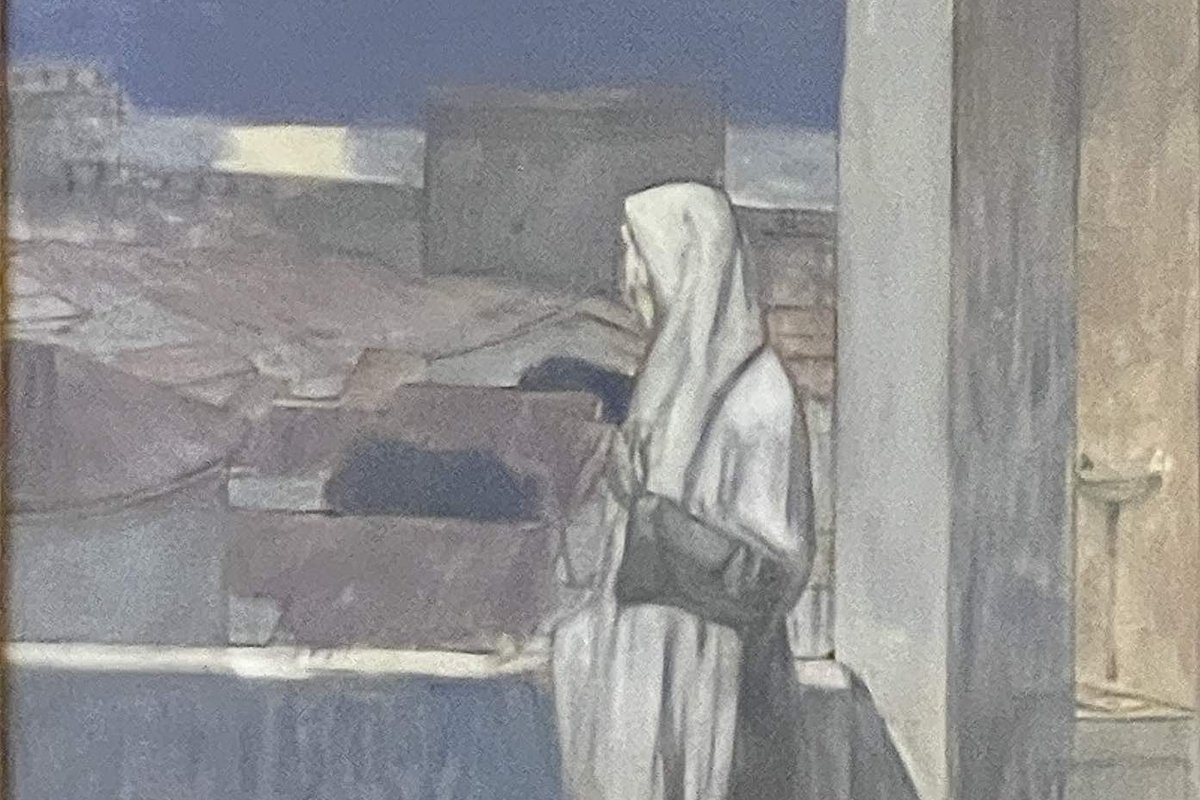
Pierre Puvis de Chavannes, Sainte Geneviève veillant sur Paris (study for the Panthéon mural), 1897 — public domain.
She never married and took no formal religious vows in the organized, communal sense that would later define convent life — there was no established order for her to enter in fifth-century Gaul. Instead she lived as what later centuries would call a consecrated virgin, a laywoman set apart for prayer and service while remaining in the world rather than withdrawing from it, a pattern common among devout women of the late Roman and early medieval periods before formal monasticism for women became widespread in the West.
The threat that didn't arrive
The defining moment of Geneviève's life came in 451, when Attila the Hun's army was moving across Gaul, leaving a trail of destroyed towns behind it. As word spread that Paris might be next, the city's residents did what frightened people in an undefended city generally do: many began preparing to flee, and others were ready to simply surrender rather than face what had happened elsewhere. Geneviève, not yet thirty at the time, is credited with standing against that panic — urging residents to stay in the city and turn to prayer instead of running.
It's worth being precise about how this story reaches us. The threat to Paris in 451 and the city's ultimate survival are solid historical fact. Geneviève's specific persuasive role — the substance of what she said, how she said it, how directly it changed people's minds — comes down through her hagiographical Life, written not long after her death but still a devotional text rather than an independent chronicle, and through the Church's own long-standing tradition about her. That doesn't make the core of the story doubtful; it's simply the appropriate way to hold a tradition this old, attributing the episode to her the way the sources themselves do — "credited with," "tradition holds" — rather than narrating it as a modern reporter would narrate an eyewitnessed event. What's beyond dispute is the outcome: Attila's forces turned away from Paris and moved on toward Orléans, where they were later checked in battle, and Paris credited Geneviève, by name, for the rest of its history.
A life of watching over the city
The Attila episode wasn't a single dramatic moment in an otherwise quiet life — it became the defining example of a pattern that continued for decades afterward. Geneviève is also remembered for helping provision besieged Paris by boat during a later siege by Frankish forces, getting food into a city that badly needed it at a moment when the ordinary routes in were cut off. She's likewise credited with encouraging the construction of a church over the burial place of Saint Denis, Paris's first bishop and, alongside Geneviève herself, one of the city's most important patron figures — a project that helped anchor Denis's cult and, by extension, the young Christian community's sense of its own place in the city.
Geneviève died around the year 500, having spent most of her adult life as a visible, trusted presence in a Paris that was navigating the end of Roman order and the rise of Frankish kingship around it. She lived to see Clovis, the first Frankish king to convert to Catholic Christianity, established in Paris, and tradition holds she had some personal influence with the Frankish court even as a private laywoman with no official standing — a reminder of how much authority a reputation for holiness alone could carry in that world. She's a pre-congregation saint — venerated continuously since antiquity rather than canonized through the Church's modern formal process — which is itself a testament to how immediately and consistently Paris held onto her memory.
Patron of a city that never let go
Of everything attached to Geneviève's name, her patronage of Paris is the least contested and the most central to who she is. It isn't a title she picked up centuries later through papal decree, the way some patronages develop — it's simply the plain outcome of a city crediting the same woman, generation after generation, with saving it once and sustaining it repeatedly afterward. Her original tomb became the heart of an abbey church built in her honor, later demolished, and her relics were scattered and largely destroyed during the French Revolution, when much of what survived was publicly burned as a rejection of the old religious order. What little remained was gathered afterward and is kept today at the church of Saint-Étienne-du-Mont in Paris, still visited by pilgrims. The Panthéon, originally built as a church dedicated to her before the Revolution repurposed it as a secular mausoleum, still bears murals depicting scenes from her life — a strange, telling monument to how thoroughly Geneviève and the city's own identity had become tangled together long before politics tried to pull them apart.
Her feast is kept on January 3. Readers interested in other saints associated with cities and the protective role attributed to them may also want to look at the article on patron saints for travelers and pilgrims, a related tradition of saints called on for safety in dangerous circumstances.
Trivia
Who was Saint Geneviève of Paris?
Did Geneviève really stop Attila the Hun from attacking Paris?
What else is Geneviève remembered for besides the Attila episode?
Was Geneviève formally canonized by the Church?
What is Saint Geneviève the patron saint of, and when is her feast?
You May Also Like
Related Reading