Saint Hilda of Whitby

Born into a kingdom, baptized into a new faith
Hilda was born around 614 in Northumbria, the great-niece of King Edwin of Northumbria, which put her close to power from birth in a kingdom still working out whether it would be Christian at all. That question was settled, for her personally, at Easter in 627, when she was baptized at thirteen alongside the rest of Edwin's household — a mass royal conversion of the kind that shaped how Christianity spread through much of early Anglo-Saxon England, arriving through kings and their courts rather than through individual missionary persuasion alone.
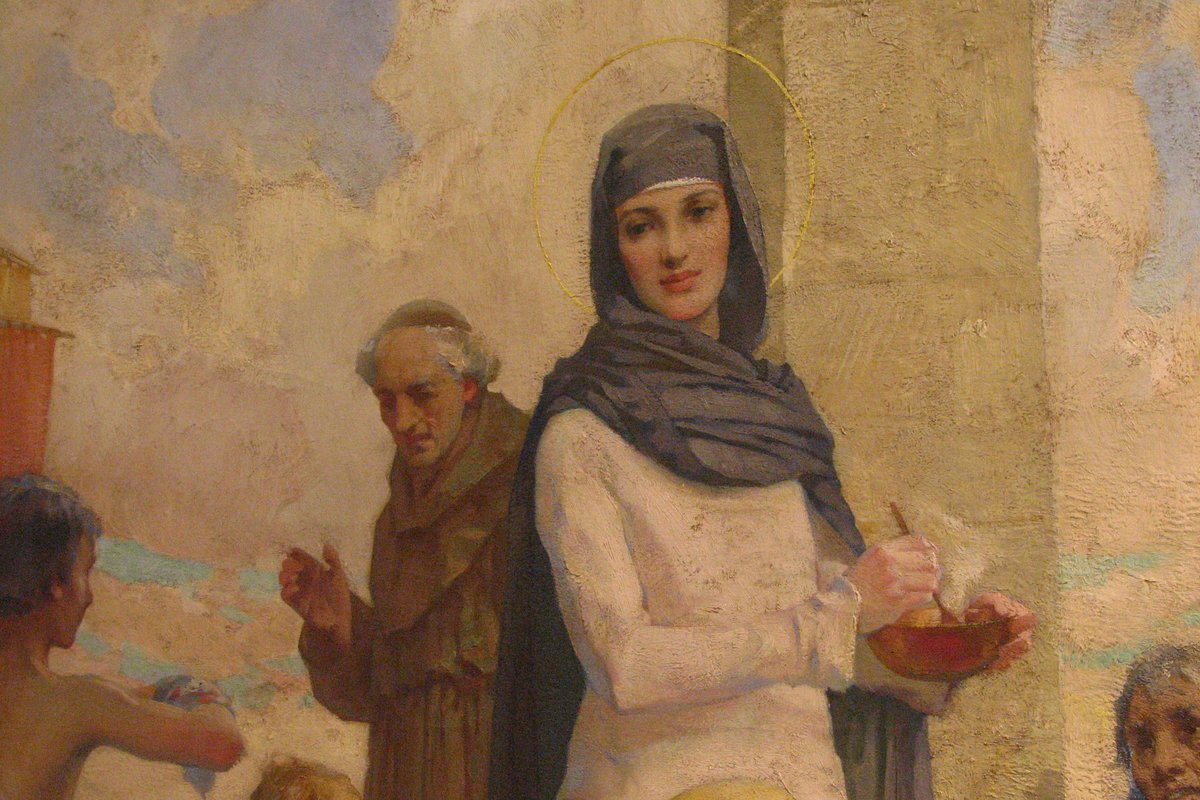
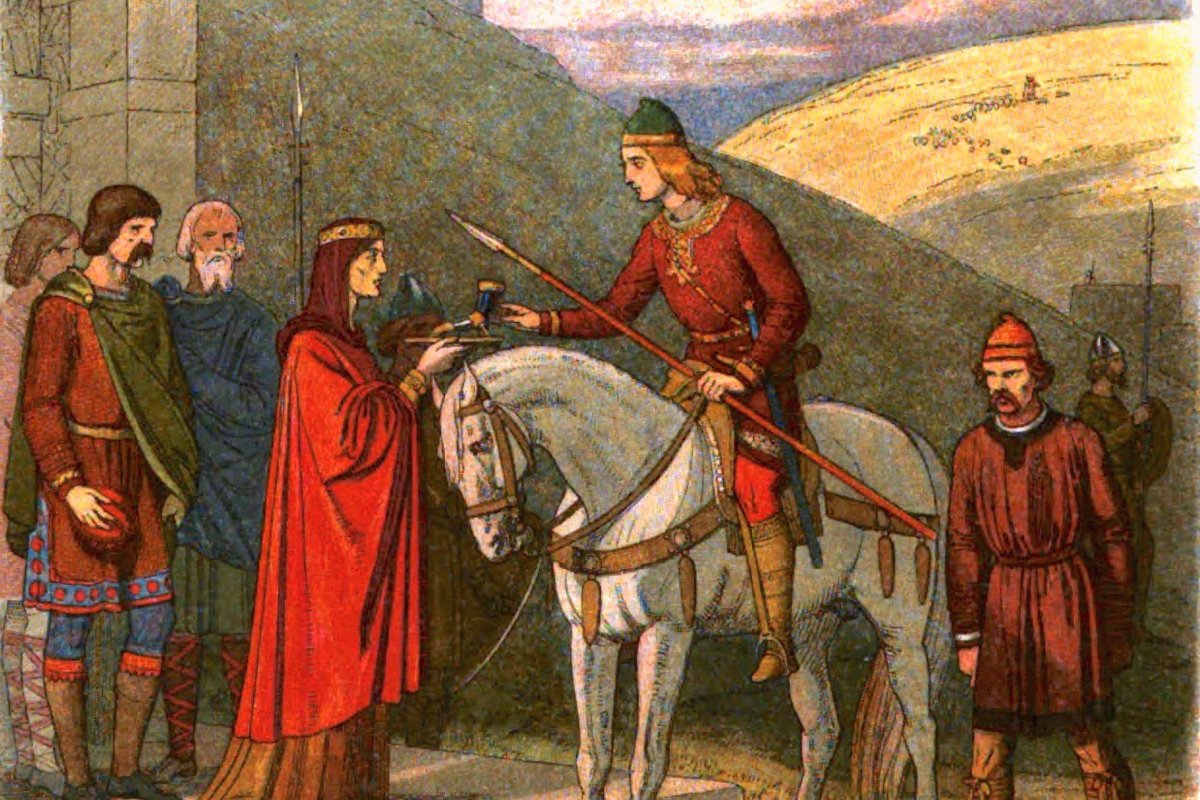
James Clark (1858–1943), detail from St. Hilda at Hartlepool, oil painting — public domain.
She became a nun and, over the following years, founded and led several monastic communities in Northumbria before taking on the role that would define her: around 657, she became abbess of the double monastery — housing both men and women, a common arrangement in the period — at Streonshalh, the settlement now known as Whitby. Under her leadership it became known for real scholarship and real discipline; several of the monks trained there went on to become bishops, and Bede's Ecclesiastical History records kings and nobles seeking her out specifically for her wisdom, not merely her rank.
Double monasteries like Whitby were governed by an abbess even though they housed monks as well as nuns, an arrangement that gave capable women religious leaders like Hilda genuine institutional authority over men in a period when few other paths offered women that kind of standing. Bede describes Hilda running Whitby with a strong emphasis on peace, charity, and the careful study of Scripture, insisting that everyone in the community, regardless of rank outside its walls, hold property in common and treat one another as equals — a discipline that produced, according to Bede, a house so orderly that no one there was ever found unworthy of ecclesiastical office.
The synod that decided Rome would win
The single most consequential thing that happened at Whitby happened in 664, and it's solidly documented history rather than legend — Bede wrote about it in detail, close enough to the events to have spoken with people who remembered them. Christian practice in Northumbria had developed two competing traditions: the Celtic Christianity that had come up through Iona and Irish missionary work, and the Roman Christianity arriving through Canterbury and continental contacts. The two traditions disagreed on real, practically significant points — most visibly the date of Easter, calculated differently by each side, and the correct form of monastic tonsure. A kingdom that couldn't agree on when to celebrate its central feast had an obvious problem, and King Oswiu of Northumbria convened a synod at Whitby to settle it.
Hilda's own sympathies, going into that synod, leaned toward the Celtic customs she'd grown up with — she hadn't hosted the meeting because she was already committed to the Roman outcome. Oswiu, after hearing arguments from both sides, ruled in favor of Rome. What happened next is the detail that makes Hilda's story more than a footnote to someone else's decision: she accepted the ruling and put it into practice at her own monastery, disciplining her own preferences to a decision made by the king rather than resisting or quietly ignoring it. It's a genuinely notable act of institutional discipline, made more notable by the fact that it ran against her own instincts.
The herdsman who became a poet
Hilda's monastery is also where one of the earliest and most remarkable stories in English literary history took place. Bede records that Caedmon, an illiterate herdsman working at Whitby, received in a dream the sudden, unexplained ability to compose religious verse in Old English — a gift he hadn't had before and, by his own account, hadn't sought. Rather than dismiss the claim, Hilda recognized something real in it. She had him formally instructed in Scripture so his poetic gift would have real theological substance behind it, and encouraged the vocation that followed. Caedmon's surviving hymn — Caedmon's Hymn — is the oldest poem known to survive in Old English, and it exists today largely because an abbess took a herdsman's dream seriously enough to educate him.
Wisdom sought by kings
Hilda died on November 17, 680, having spent more than two decades at Whitby building a monastery that mattered well beyond its own walls — a place where kings sent their children to be educated, where a national church settled its central dispute, and where an illiterate laborer's unlikely gift was recognized and cultivated rather than ignored. She's a pre-congregation saint, venerated since the early medieval Church rather than through the modern canonization process. Her feast falls on November 17, and she is honored today as a patron of learning and culture, and — through Caedmon — of poetry specifically. For more saints connected to scholarship, teaching, and the arts, see the Patron Saints Directory.
Trivia
Who was Saint Hilda of Whitby?
What was the Synod of Whitby, and why does it matter?
Did Hilda personally support the Roman side at the Synod of Whitby?
How is Hilda connected to Caedmon, the poet?
What is Saint Hilda the patron saint of, and when is her feast?
You May Also Like
Related Reading