Saint Thérèse of Lisieux

A short, mostly hidden life
By any ordinary measure, Thérèse Martin's life was small. Born in Alençon, France, on January 2, 1873, she entered the Carmelite convent in Lisieux at just fifteen, spent nine quiet years there, and died of tuberculosis on September 30, 1897, at only 24. She never traveled far, never led a public ministry, never built anything visible. What she left behind instead was a short spiritual memoir, written at her superiors' request — and it's that book, more than any external achievement, that carried her influence into the wider Church.
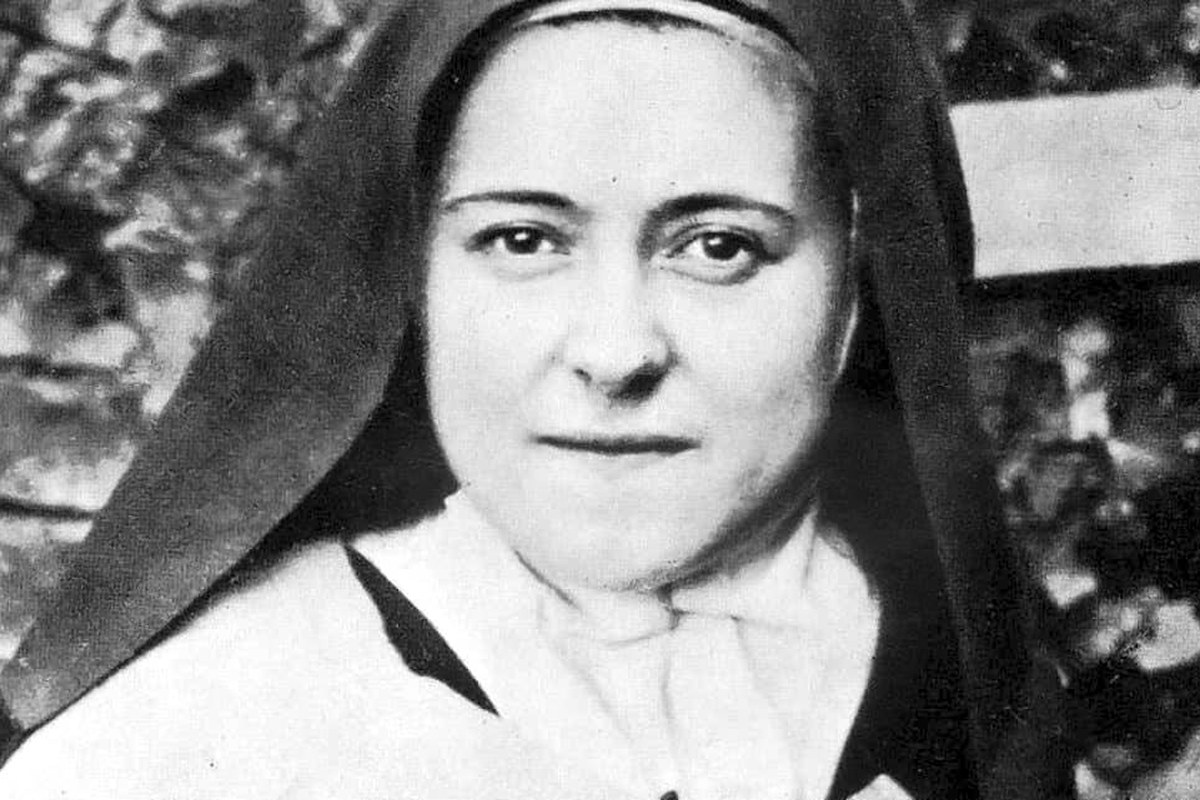
Photograph of Thérèse of Lisieux, c. 1890s — public domain.
She was the youngest of nine children born to Louis and Zélie Martin, a watchmaker and a lacemaker whose deep, ordinary piety shaped the whole household; four of the Martin children died in infancy, and the five who survived to adulthood all entered religious life, four of them as Carmelite nuns in the same convent at Lisieux. Both parents were later canonized themselves, in 2015 — the first married couple in Church history to be canonized together as a pair rather than individually, recognized specifically for how they raised their family. Thérèse's own mother died of breast cancer when she was only four, a loss that marked her deeply and that she later described as the end of what she called the "sunny" first phase of her childhood.
Getting into Carmel at fifteen was itself unusual; the ordinary minimum age was older, and Thérèse had to appeal in person, first to the local bishop and then, during a pilgrimage to Rome, directly to Pope Leo XIII himself, kneeling before him and asking permission even after being told not to speak. She got her way, entering the following year. Convent life was austere and physically demanding — long hours of prayer, manual labor, minimal heat in winter, poor food — and it was there, not in any public setting, that the illness that would kill her began to take hold.
A way built for ordinary days
The heart of that book is what's since become known as the "Little Way" — Thérèse's own term for a spirituality built not on dramatic sacrifice or visible accomplishment, but on small, deliberate acts of love done with genuine trust, the way a child depends on a parent without needing to understand every detail of the arrangement. It's a strikingly modest claim, and part of why it resonated so widely: it locates spiritual depth inside ordinary days rather than exceptional ones, available to anyone regardless of circumstance.
In practice, that meant things most people would never think to write down: picking up a pin off the convent floor as an offering, bearing another nun's small irritating habits without complaint, choosing to sit beside a sister she found personally difficult rather than one she liked. None of it was dramatic. That was the point — Thérèse was consciously reacting against a strain of spirituality in her own time that treated heroic, visible penances as the main road to holiness, and proposing instead that love shown consistently in small things carried just as much weight. She sometimes called this her "elevator" to God, a modern image for her era, contrasting it with the long, difficult "staircase" of extreme asceticism that some earlier saints had climbed.
Thérèse also endured what she described as a severe trial of faith during her final eighteen months, a period of interior darkness in which the consolations of belief seemed to disappear entirely, even as her body was failing from tuberculosis. She kept writing and kept trusting through it, and later readers, including several spiritual directors and theologians, have pointed to that period as evidence that her "Little Way" was never naive optimism — it was a discipline she held onto precisely when it stopped feeling comforting.
The Little Flower
Thérèse described herself, in her own writing, not as anything extraordinary but as a small, unremarkable flower among many — an image that gave her the nickname by which she's still widely known, "the Little Flower." The name fits both halves of her legacy: a life that looked unremarkable from the outside, paired with a spiritual teaching that insisted unremarkable was never the same thing as unimportant.
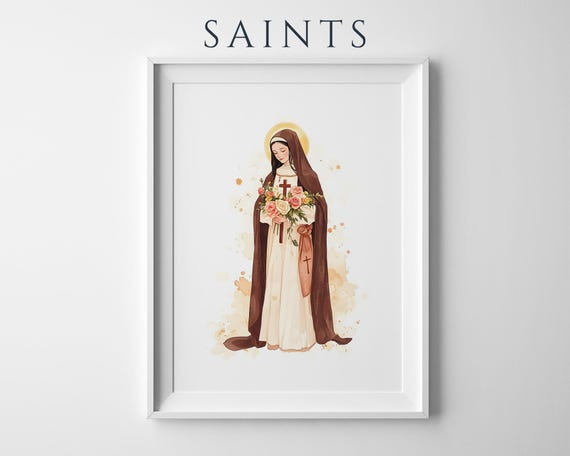
The image has stuck in devotional art and popular piety ever since: Thérèse is often pictured holding a bouquet or a single rose, and the custom of asking for a "shower of roses" — a sign, believers hold, that she has heard a particular prayer — traces directly back to her own promise, made shortly before her death, that she would spend her heaven doing good on earth. It's a piece of popular devotion rather than formal Church teaching, but it has become one of the most widely repeated traditions associated with any modern saint, reported by people across very different countries and backgrounds.
From an obscure convent to Doctor of the Church
What makes Thérèse's story so striking isn't only the content of her teaching, but how far it eventually traveled. That short spiritual memoir, published after her death as Story of a Soul, together with her letters and poems, became the entire basis for a case her bishop and Carmelite superior general formally petitioned Rome to consider — an unusual argument to make on paper, since she'd held no teaching post and had no formal theological training beyond ordinary convent instruction. On October 19, 1997, Pope John Paul II agreed, declaring her a Doctor of the Church through the apostolic letter Divini Amoris Scientia ("The Science of Divine Love"), deliberately timed to the centenary of her death — a formal title recognizing a saint's significant contribution to Christian teaching, held by only a small number of figures in the Church's entire history. She is one of just four women ever given that title, alongside Teresa of Ávila, Catherine of Siena, and Hildegard of Bingen, and remains the youngest person ever named a Doctor — an extraordinary outcome for a nun who, by her own account, aspired to nothing more than small, faithful acts of love, largely unseen. Toward the end of her life, she told those around her, "I will spend my heaven doing good on earth" — a line that captures the same confident, unpretentious spirituality the doctorate was meant to recognize.
Her influence reached well beyond theology classrooms. Devotion to Thérèse spread with unusual speed in the decades after her death, carried largely by ordinary readers of Story of a Soul rather than by official Church promotion, and relics of hers have since traveled to parishes and prisons across dozens of countries, drawing crowds comparable to those for far more publicly prominent saints. Readers drawn to her example often find a natural next step in other saints known for interior depth over outward drama, such as Saint Anselm of Canterbury, another Doctor of the Church whose reputation rests on quiet, careful thought rather than public spectacle. Thérèse's own case remains a distinctive one in the Church's history: a woman who never preached, never taught formally, and never left her convent, whose only public act was a short book — and who ended up reshaping how millions of ordinary Catholics think about holiness itself.
Trivia
How long did Thérèse of Lisieux live, and how did she die?
What is the 'Little Way'?
Why is she called 'the Little Flower'?
When was she declared a Doctor of the Church, and how rare is that?
What is Thérèse of Lisieux the patron saint of, and when is her feast day?
Related Reading