Saint Anthony of Padua

A Portuguese noble who chose the Franciscans
Anthony was born Fernando Martins de Bulhões in Lisbon in 1195, into a family of some standing, and initially joined an order of Augustinian canons before transferring to the recently founded Franciscans — a much newer, far more radical movement built on poverty and public preaching. The move cost him his birth name; he took "Anthony" upon entering the Franciscan community, and it's that name history remembers rather than the one he was born with.
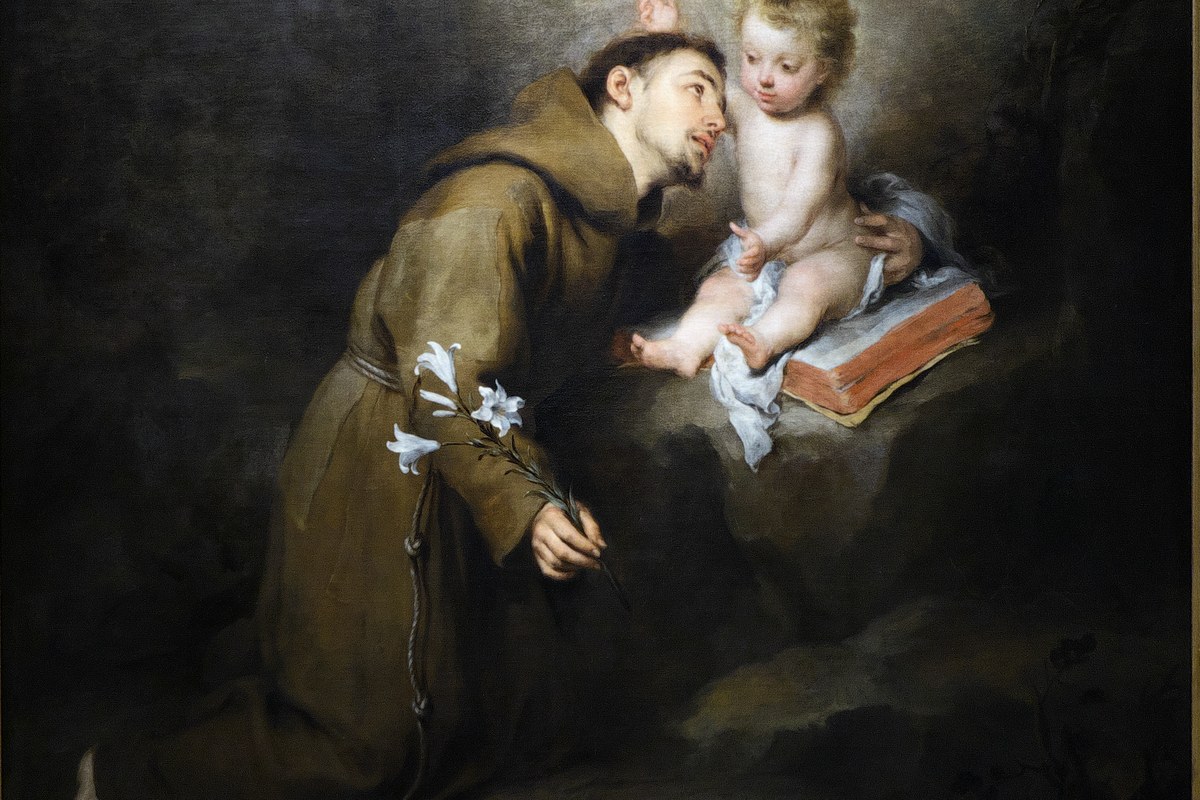
Bartolomé Esteban Murillo, "Saint Anthony of Padua with the Christ Child," 17th century — public domain.
Anthony's reasons for switching orders were partly personal. According to early accounts, he requested a transfer to the Franciscans after seeing the bodies of five Franciscan friars returned to Portugal, recently martyred while preaching in Morocco — a moment that stirred in him a desire for the same kind of radical, mission-driven life. He set out for Morocco himself shortly after joining the order, hoping for a similar fate, but fell seriously ill during the journey and was forced to turn back. The ship carrying him home was blown off course by a storm and landed instead in Sicily, an unplanned detour that brought him, indirectly, into the heart of Italy and eventually into contact with Francis of Assisi himself, whose growing order Anthony would spend the rest of his short life serving.
Discovered by accident
According to tradition, Anthony's gifts as a preacher were revealed almost by chance. At an ordination ceremony where no one else was prepared to deliver the sermon, Anthony — expected to live a quieter, more contemplative life within the order — was asked to speak instead. What came out surprised everyone present, including his own superiors, and it launched him rapidly into a preaching career across Italy and France that made him one of the most sought-after voices of his generation, admired as much for his knowledge of Scripture as for his ability to hold a crowd.
Francis himself recognized Anthony's gift for teaching and, in a surviving letter, gave him permission to instruct the order's other friars in theology — a notable endorsement, since Francis was famously wary of academic learning overshadowing simple piety within his young order. Anthony went on to lecture in theology at Bologna and other centers of learning, becoming known for a preaching style that combined deep familiarity with Scripture and a direct, urgent appeal to ordinary listeners — sermons aimed as much at moral reform as at theological instruction. Tradition also credits him with an unusual episode in which, preaching to a crowd of heretics who refused to listen, he turned instead to address a school of fish gathered near the shore, who reportedly surfaced and stayed still as though listening — a story read less as a literal claim than as a vivid illustration of how even the natural world, in the logic of the legend, responded to Anthony's preaching when human listeners would not.
The patron of lost things
Anthony's best-known patronage today has a specific, often-repeated origin story: a novice reportedly left the community, taking with him a psalter — a book of psalms Anthony used and valued deeply, likely containing his own notes and commentary. Anthony prayed fervently for its return, and tradition holds the novice, troubled by conscience, brought both the book and himself back. That story is the reason so many Catholics today ask for Anthony's intercession when searching for something misplaced — a patronage that grew out of one specific loss he felt personally and prayed about directly.
Recognized as a Doctor of the Church
Anthony died in 1231 at just thirty-five, and was canonized within a year — one of the fastest canonizations in Church history, a reflection of how immediately and widely his sanctity was recognized by those who had known him. In 1946, Pope Pius XII named him a Doctor of the Church, placing him alongside figures like Thomas Aquinas as one of the tradition's most authoritative teachers. It's a formal, scholarly honor for a man whose most enduring popular reputation is far simpler: the saint people turn to first when something they need has gone missing.
The lily and the Christ Child
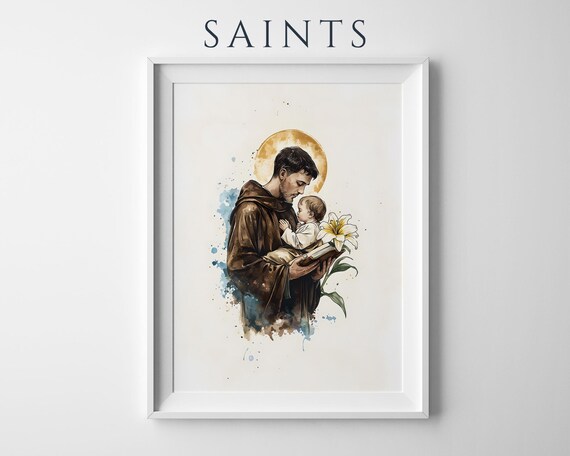
Devotional art almost always shows Anthony holding a white lily, a symbol of purity, and very often cradling the infant Jesus in his arms or gazing at a vision of the Christ Child, as in the Murillo painting above. That image traces to a reported vision late in Anthony's life, in which the Christ Child is said to have appeared to him during a night of prayer — an experience Anthony kept largely private during his lifetime but which became, after his death, one of the most recognizable and frequently painted images associated with any Franciscan saint. Anthony died near Padua in 1231, and when his tomb was opened decades later, his tongue was reportedly found still intact and incorrupt — preserved, tradition holds, as a sign of the gift for preaching that had defined his ministry. It remains today one of the most venerated relics in the Basilica of Saint Anthony in Padua, still a major pilgrimage site, drawing visitors on his feast day, June 13, each year to the city that has carried his name ever since.
Trivia
Where was Saint Anthony of Padua actually from?
How did Anthony become known as a great preacher?
Why is Anthony the patron saint of lost things?
Is Anthony of Padua a Doctor of the Church?
Related Reading