Saint Melangell

A story with no contemporary record behind it
Before telling any part of Melangell's story, it's worth being direct about what kind of story it is. Traditional accounts place her in the 7th or 8th century in Powys, in what is now Wales, but no contemporary record of her existence survives from anywhere near that period — her actual chronology is, plainly, unknown. Everything that follows here comes from a single medieval text, the Historia Divae Monacellae, and needs to be read as legend and local tradition, not as documented biography. That's not a small caveat tacked onto an otherwise solid account; it's the central fact about Melangell that has to shape how every other detail is read.
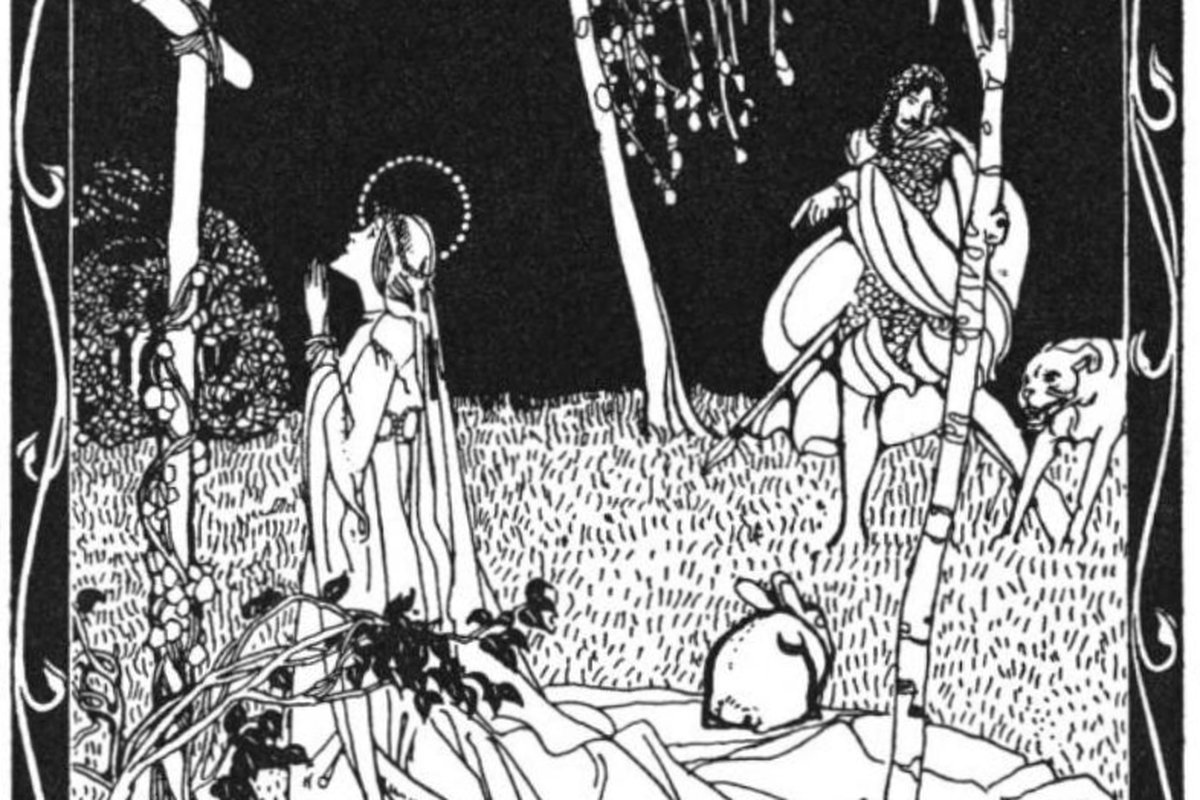
Willy Pogany, illustration of the legend of Saint Melangell, from W. Jenkyn Thomas, "The Welsh Fairy Book," 1907 — public domain.
The legend, as it's told
According to the Historia, Melangell was an Irish princess who fled to Wales to escape a forced marriage and settled as a hermit in the remote valley of Pennant, in Powys, where she is said to have lived alone for fifteen years. The story's central episode, and the one that made her memorable enough to be remembered at all, involves a hunting party: in the year the legend gives as 604, Prince Brochwel Ysgithrog was hunting with his hounds when he pursued a hare that fled into the valley and took shelter under Melangell's cloak as she knelt in prayer. The dogs, the story says, would not go near her. Struck by what he'd witnessed, Brochwel granted Melangell the valley as a permanent place of sanctuary and asylum, for people and animals alike. She is said to have gone on to found and lead a community of nuns there for roughly another 37 years.
It's a genuinely lovely story, vivid and specific in exactly the way that makes it memorable — and that specificity is also precisely why historians treat it with such caution.
Why the specific details don't hold up
The entire narrative — Melangell's Irish origin, the year 604, Prince Brochwel's identity, the hare episode itself — comes from the Historia Divae Monacellae, a text that survives only in manuscripts no earlier than the late 16th century, though scholars generally believe it was originally composed around the 15th century. Even on the more generous estimate, that means the surviving account of Melangell's life was written somewhere in the range of 700 years or more after she is supposed to have lived. Scholars examining the text have also noted that the specific date of 604 appears to have been borrowed, unreliably, from the writings of the Venerable Bede — a detail that further undermines any claim to precise historical chronology. None of this means Melangell herself didn't exist; it means the specific, colorful details attached to her name almost certainly can't be verified as historical fact, and should be presented as legend rather than biography.
What actually survives independently
The one piece of evidence that doesn't depend on the Historia is physical and archaeological rather than textual: a Romanesque shrine at the church of Pennant Melangell, dating to the 12th century. That shrine demonstrates something genuinely solid — that a local cultus honoring Melangell was already well established in that valley by the 1100s, centuries before the surviving version of her legend was ever written down. It's a useful reminder of how medieval sainthood often worked at the local level: veneration and a shrine could precede, by a long margin, any written account of why the person was being venerated in the first place.
Melangell never went through a Roman canonization process — she's a pre-congregation saint venerated purely through this ancient, local Welsh cultus, with no formal papal or diocesan process ever applied to her cause. No direct quotations from her survive or are attributed to her in any primary text, unsurprising given how thin the historical record actually is.
The church and shrine that kept her memory alive
The church of Pennant Melangell itself is unusual enough architecturally to deserve its own mention. Its 12th-century shrine, the physical evidence that anchors everything actually known about her cultus, was dismantled at some point after the Reformation-era suppression of saints' shrines across Britain and later reassembled — a fate shared by many medieval English and Welsh shrines that survived the period at all only in fragments, painstakingly reconstructed by later generations determined not to let the local devotion simply vanish. The restored shrine now stands again in the chancel of the church, and the site remains an active place of pilgrimage today, drawing visitors interested in Welsh saints, in the folklore of animal sanctuary, or simply in one of the more atmospheric small churches tucked into the Welsh hills. The circular shape of the churchyard, a feature common to many of the oldest Celtic Christian sites in Britain, is itself sometimes cited as indirect evidence of very early Christian use of the location, predating even the earliest plausible dates for Melangell's own life.
The patronage that outlasted the uncertainty
What has endured, remarkably intact, is Melangell's association with hares and small wild animals — by far her best-attested and most genuinely charming legacy. In the parish of Pennant Melangell, it was reportedly taboo to kill a hare well into the modern era, and local people traditionally referred to hares as "St. Monacella's lambs," a folk custom that persisted for centuries independent of any question about the historical reliability of the founding legend. Her feast is kept on May 27. Whatever the uncertainties surrounding her life, that one thread — a valley, a hunted animal, and a woman who offered it shelter — has proven durable enough to survive as living local tradition for thirteen centuries, even when the story explaining how it started can't be verified as history. For more on saints whose patronages grew out of vivid legend rather than documented fact, see the Patron Saints Directory.
Trivia
Who was Saint Melangell?
What is the story of Saint Melangell and the hare?
Is the story of Saint Melangell historically reliable?
What evidence for Saint Melangell actually survives from before the legend was written down?
What is Saint Melangell the patron saint of?
You May Also Like

Related Reading