Saint Titus Brandsma

A Friesland farm boy who became a philosophy professor
Anno Sjoerd Brandsma was born on February 23, 1881, on a farm near Oegeklooster, in the Friesland region of the Netherlands, and entered the Carmelite order as a young man, taking the religious name Titus in honor of his father. He proved to be a genuinely serious scholar: he earned a doctorate in philosophy from the Gregorian University in Rome in 1909, and went on to build an academic career in the Netherlands centered on mysticism and the history of spirituality, becoming a professor at the newly founded Catholic University of Nijmegen in 1923. In 1932 and 1933 he served as the university's rector magnificus — its chief academic officer — a position that made him one of the most visible Catholic intellectuals in the country.
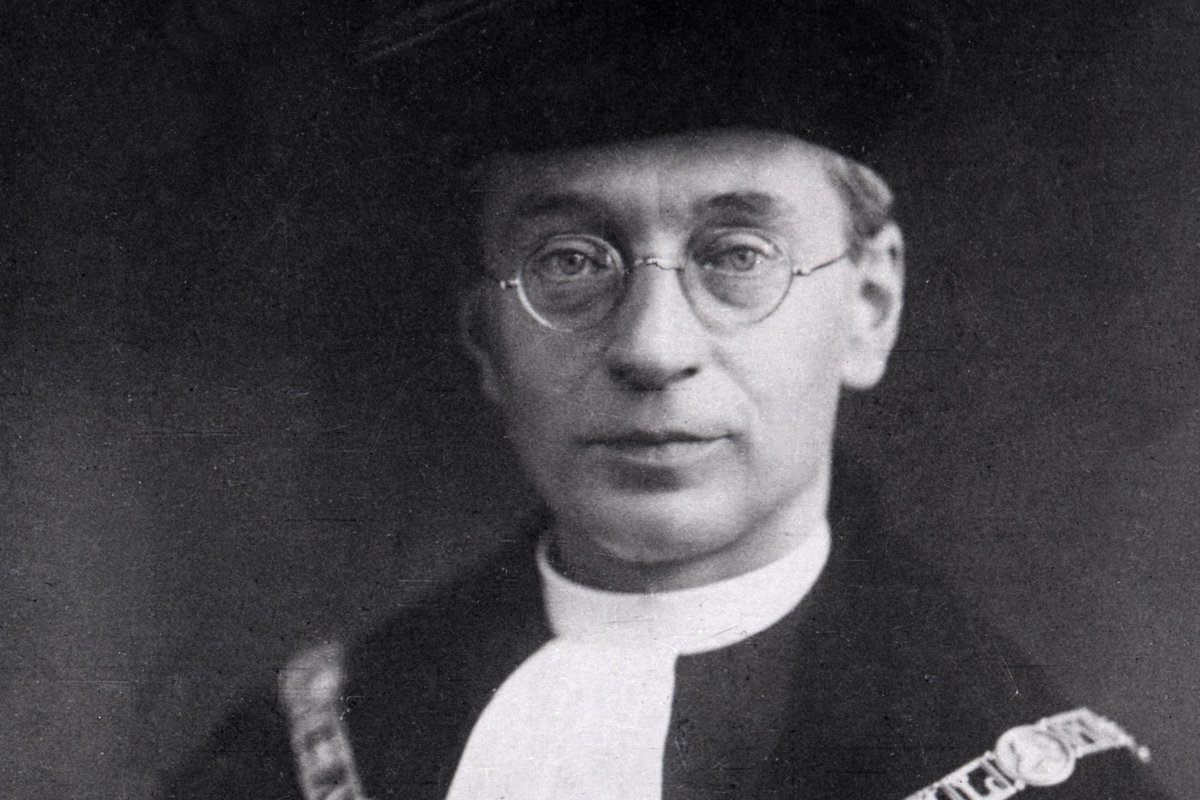
Photograph of Titus Brandsma as rector magnificus of the Catholic University of Nijmegen, 1932, Nationaal Archief (Netherlands), photographer unknown — public domain.
Alongside his academic work, Brandsma developed a long-standing personal interest in Esperanto, the constructed international language designed to ease communication across national and linguistic boundaries, and he remained an active supporter of the Esperanto movement within Catholic circles throughout his life — a detail that later gave rise to his informal association as a patron of Catholic Esperantists.
Organizing the Catholic press against Nazi propaganda
From 1935, Brandsma served as ecclesiastical adviser to the Dutch Catholic journalists' association, a role that put him in direct contact with editors across the country's Catholic press. His record of public opposition to Nazi ideology predates the occupation of the Netherlands itself — he spoke out publicly against Nazi antisemitic legislation as early as 1935, years before Germany invaded, at a time when such open criticism from a prominent Dutch Catholic academic carried real professional and personal risk.
When Germany occupied the Netherlands in 1940, the occupying authorities moved quickly to bring the Dutch press under propaganda control, ordering all newspapers, including Catholic ones, to print Nazi-authored material and advertisements. The Dutch Catholic bishops decided to resist, and Brandsma became the man tasked with delivering that resistance directly to the newsrooms that would have to carry it out. In January 1942, at sixty years old and in fragile health, he set out to personally visit the editors of all thirty Catholic newspapers in the Netherlands, hand-carrying a letter from the bishops instructing them to refuse the occupation's propaganda directives outright, whatever the consequences. He had reached fourteen editors in person before the Gestapo caught up with him, arresting him at the Carmelite monastery in Boxmeer on January 19, 1942.
From Scheveningen to Dachau
Brandsma was first held at Scheveningen prison, where — despite the isolation of a prison cell — he kept a diary that later became one of the most quoted pieces of his legacy. Writing under the title "My Cell," he described his imprisonment in strikingly serene terms: "I am already quite at home in this small cell... I am alone, certainly, but never was Our Lord so near to me. I could shout for joy because he made me find him again entirely." It's a remarkable statement to have written from inside a Gestapo prison cell, and it captures something genuinely central to how Brandsma's contemporaries and later biographers have understood him — not merely as a resistance figure, but as a man whose faith visibly deepened rather than broke under direct pressure from a totalitarian state.
While still at Scheveningen, in February 1942, Brandsma composed a devotional poem, "Before Thy Image" ("Voor uw Beeltenis"), meditating on a reproduction he kept in his cell of Christ Crucified — painted, by tradition, in the style of Fra Angelico, the Dominican friar-painter whose devotional frescoes were themselves created as private aids to a single friar's prayer, a fitting echo of the kind of contemplative art Brandsma turned to in his own final months.
From Scheveningen, Brandsma was moved through the Amersfoort and Cleves camps before being transferred to Dachau concentration camp on June 19, 1942. He survived only five weeks there. On July 26, 1942, a camp nurse administered a lethal injection that killed him — one of an enormous number of prisoners murdered at Dachau by similar means, distinguished in Brandsma's case only by the fact that his death would eventually be formally investigated and recognized by the Church as a martyrdom.
Beatification, a confirmed miracle, and full canonization
Pope John Paul II beatified Titus Brandsma on November 3, 1985, recognizing him as a martyr killed out of hatred for the faith his press resistance represented. The path to full canonization required a confirmed miracle attributed to his intercession, and the Vatican eventually approved one: the healing of an American Carmelite priest, Father Michael Driscoll, from an aggressive form of skin cancer, confirmed by Vatican investigators on November 25, 2021. Pope Francis canonized Brandsma as a full Saint of the Catholic Church on May 15, 2022 — in the same ceremony as Charles de Foucauld, another twentieth-century figure whose path to the altar ran directly through violence rather than around it. His feast is now kept on July 27, the day after the anniversary of his death.
Since his canonization, Brandsma has been increasingly promoted as a patron of Catholic journalists and journalism, a natural fit given the press resistance work that led directly to his arrest and death, though it remains a modern and still-developing patronage rather than one with centuries of established devotional tradition behind it. His association with Catholic Esperantists rests on similar ground — a real and documented personal commitment during his lifetime, now being carried forward as an informal patronage in the years since his canonization.
Trivia
Who was Saint Titus Brandsma?
Is Titus Brandsma a Blessed or a fully canonized Saint?
What exactly did Titus Brandsma do to resist the Nazi occupation?
How did Titus Brandsma die?
What is Titus Brandsma the patron saint of?
You May Also Like
Related Reading