The Archangel Choir

The only choir with real names attached
Every other rank in this series is a category: a Throne, a Dominion, a Power, known collectively rather than individually. The Archangels are different. Daniel describes "Michael, one of the chief princes" coming to his aid (Daniel 10:13, RSV-CE); Jude refers matter-of-factly to "the archangel Michael" disputing with the devil (Jude 1:9, RSV-CE); Gabriel introduces himself to a startled priest in the Temple with his own name: "And the angel said to him in reply, “I am Gabriel, who stand before God. I was sent to speak to you and to announce to you this good news." (Luke 1:19, RSV-CE). No Throne or Dominion gets a line of dialogue like that anywhere in Scripture. This site covers all four of the most commonly named archangels individually — Michael, Gabriel, Raphael, and Uriel — while this article looks instead at what it means for "archangel" to be a rank at all.
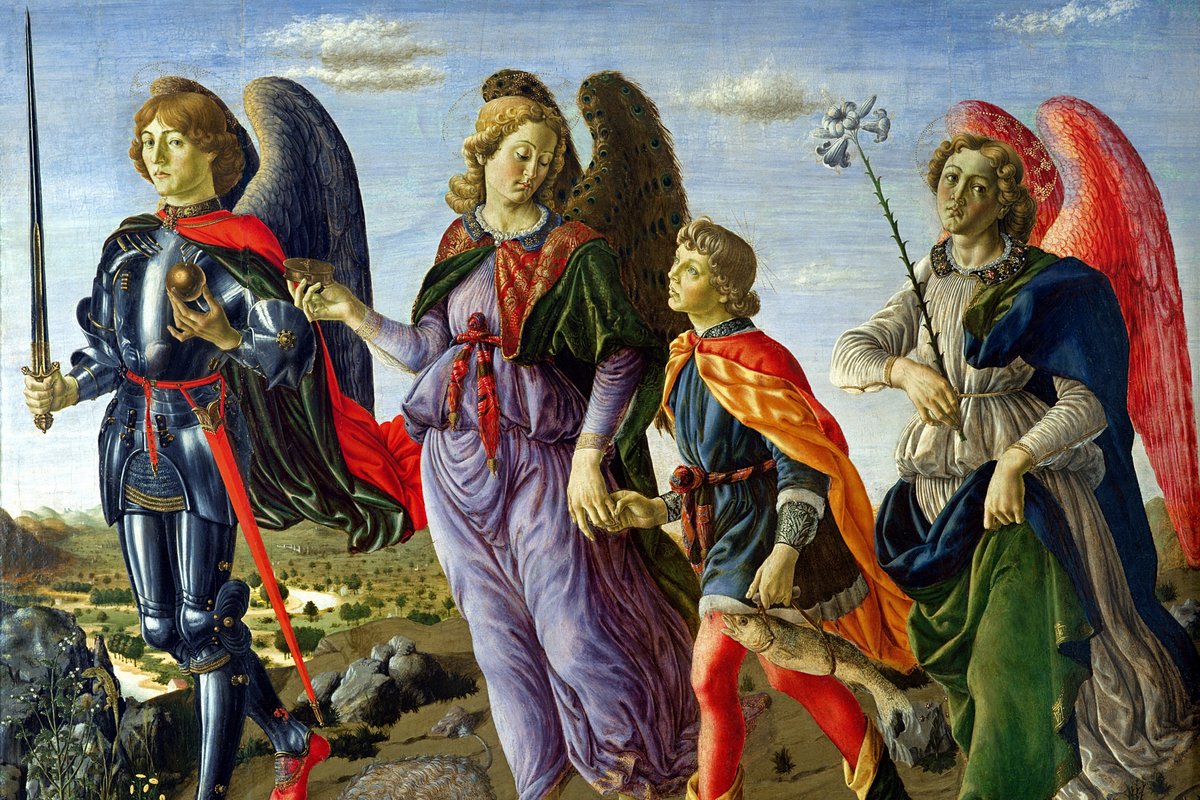
Francesco Botticini, "The Three Archangels and Tobias," c. 1470, Uffizi Gallery, Florence — public domain.
Not all four rest on equally solid biblical ground
It's worth being precise about something that often gets flattened in casual description: these four names don't all carry the same scriptural weight. Michael and Gabriel appear in books every Christian tradition — Catholic, Orthodox, and Protestant alike — accepts as canonical Scripture. Raphael is different: he's named throughout the Book of Tobit, which is part of the Catholic and Orthodox Old Testament but excluded from the Protestant canon, so his biblical status genuinely depends on which canon a reader is using. Uriel stands furthest out on that spectrum — he isn't named in any canon used by a major Christian tradition today, appearing instead in 2 Esdras (also known as 4 Ezra), a Jewish apocalyptic text outside every major Christian canon. None of that makes devotion to Raphael or Uriel illegitimate within the traditions that honor them — but it does mean "the four archangels" is a devotional grouping built across several different levels of textual authority, not four names with identical scriptural footing.
"One of the seven"
Tobit itself hints that the tradition once imagined even more named archangels than the familiar four. Speaking to Tobit and his son, Raphael identifies himself directly: "I am Raphael, one of the seven angels who stand and serve before the Glory of the Lord." (Tobit 12:15, NRSVCE). Seven is a suggestive number, and later Jewish and Christian tradition did propose additional names to fill it out — but Scripture and the wider canon of accepted texts never actually settle on all seven, which is a large part of why popular devotion has stayed focused on the small handful of archangels who do have clear names and stories attached to them.
The other names later tradition tried to add
Raphael's line about being "one of the seven" left a gap that various later writers, mostly within Jewish apocalyptic literature and Eastern Christian tradition, tried to fill. Beyond Michael, Gabriel, Raphael, and Uriel, names like Selaphiel, Jegudiel, and Barachiel show up in later Eastern Orthodox devotional lists of archangels, sometimes alongside a seventh, Jerahmeel. None of these additional names appears in any canon of Scripture recognized by Catholics, Orthodox, or Protestants — they belong to a layer of tradition even further removed from settled biblical text than Uriel's already-thin footing in 2 Esdras. Western Catholic devotion has, by contrast, stayed almost entirely centered on the three archangels with clear roles in universally or widely accepted Scripture — Michael, Gabriel, and Raphael — which is why most Catholic art, liturgy, and popular prayer names only those three by comparison to the broader and more variable Eastern lists.
Warriors, messengers, and healers — not interchangeable roles
It's worth noticing that the archangels who do have names and stories aren't simply duplicates of one another in a shared job description. Michael appears consistently in a martial role, described leading the heavenly armies against the dragon in Revelation 12:7 and contending directly with the devil in Jude 1:9 — he is, in the tradition's own language, a protector and a fighter. Gabriel's appearances, by contrast, are entirely about delivering news: to Daniel, explaining a vision (Daniel 8:16, 9:21), and to Zechariah and Mary, announcing the births of John the Baptist and Jesus (Luke 1:19, 1:26) — a messenger's role rather than a warrior's. Raphael, in Tobit, combines guidance, protection on a journey, and healing, restoring Tobit's sight and driving off a demon threatening his son's marriage. That variety matters: the tradition isn't describing one job performed by four interchangeable beings, but distinct kinds of ministry gathered loosely under the same rank.
What "archangel" means as a rank
The word itself comes from the Greek archangelos — "chief" or "ruling" angel — sharing its root with Principalities, the choir directly above it in the traditional nine-rank system first laid out by Pseudo-Dionysius the Areopagite in the 6th century. In that system, Archangels rank eighth of nine: above the ordinary Angels who make up the lowest and final choir, but below the Principalities, in what tradition calls the "third hierarchy" — the tier most directly engaged with ministering to the created world and to humanity, rather than the closer contemplation of God assigned to the highest tier of Seraphim, Cherubim, and Thrones. That ranking, like every other in this series, is the work of later systematic theology reading between the lines of scattered scriptural references — not a hierarchy the Bible spells out on its own.
Why this rank feels different from the rest
There's a simple reason the Archangels feel more vivid than the other eight choirs: named beings with dialogue and a plotline are, for most readers, inherently more memorable than an unnamed category glimpsed once in a list. Michael leads armies; Gabriel announces a birth; Raphael walks the length of a journey disguised as a fellow traveler. That's the advantage of a story over a category — and it's worth remembering, while reading about the Dominions, Virtues, Powers, or any of the other unnamed ranks in this series, that their comparative obscurity says more about how Scripture happened to record them than about their standing in the traditional hierarchy itself. See our companion article on the Nine Choirs of Angels for how the Archangels fit into that full hierarchy.
Trivia
Which archangels are actually named in the Bible shared by Catholics and Protestants?
Is Raphael in the Bible?
Is Uriel named in the Bible?
What does the word 'archangel' actually mean?
Where do the Archangels rank among the nine choirs of angels?
You May Also Like
Related Reading