Saint Cyril of Jerusalem

A bishop in a contested city
Cyril was born around 313, likely in or near Jerusalem, at a moment when the city was rapidly becoming the center of Christian pilgrimage following the discovery of the traditional site of Christ's tomb and the construction of the Church of the Holy Sepulchre under Emperor Constantine. That timing mattered enormously for Cyril's later career: before Constantine's conversion and the peace he brought the Church in the early 4th century, Jerusalem had been a relatively minor see, well behind Antioch, Alexandria, and Rome in prestige. Within Cyril's own lifetime, it was transformed into the destination pilgrims crossed the empire to visit, and its bishop found himself, almost overnight, responsible for teaching and shepherding people arriving from every corner of the Christian world.
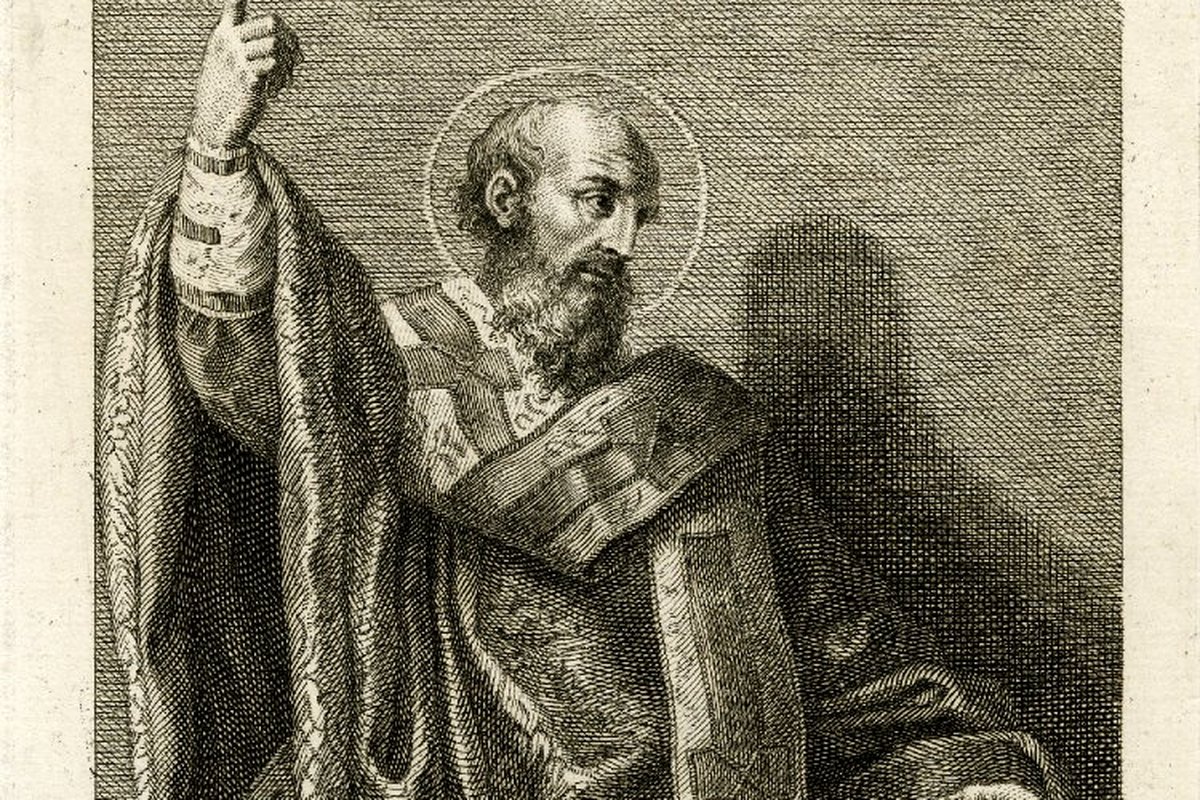
Francesco Bartolozzi, after Domenico Zampieri (Domenichino), Saint Cyril of Jerusalem, engraving, 18th century — public domain.
He was ordained a priest and became bishop of Jerusalem around 350, inheriting a see that was gaining enormous prestige precisely as the wider Church was tearing itself apart over Arianism — the teaching, associated with the Alexandrian priest Arius, that denied Christ was fully and equally divine with God the Father, holding instead that the Son was a created being, greater than any creature but still less than God. Cyril's own theological position wasn't always crystal clear to his contemporaries, which left him vulnerable to both sides of the dispute at different points in his career, a tension that would define the next three decades of his ministry. Modern scholars generally read him as consistently orthodox in substance even when his choice of words drew suspicion — he seems to have avoided some of the technical vocabulary favored by strict Nicene partisans, which was enough, in the charged atmosphere of the time, to make him a target for both sides.
Teaching the newly baptized, line by line
What Cyril left behind that mattered most wasn't a treatise aimed at fellow theologians — it was a set of lectures aimed at ordinary people. His Catechetical Lectures, delivered to candidates preparing for baptism, walk through the creed clause by clause, explain the sacraments, and address practical Christian conduct, almost certainly delivered in or near the Church of the Holy Sepulchre itself. A related set of talks, the Mystagogic Catecheses, addressed the newly baptized after Easter, explaining the meaning of the rites they had just undergone. Together, they form one of the fullest surviving records of how a major early Church actually prepared and formed new Christians — plainspoken, structured, and clearly meant to be understood by people encountering the faith's core teachings for the first time, not fellow clergy.
The lectures also give historians something rarer still: a detailed, on-the-ground description of how baptism itself was practiced in 4th-century Jerusalem, down to the gestures and symbolic actions involved — candidates facing west to renounce Satan, then turning east toward the rising sun to profess faith in Christ, before being led into the baptismal pool itself. Cyril explains the reasoning behind each gesture as he goes, treating catechesis not as abstract doctrine but as something meant to be lived out physically, in a specific place, at a specific hour, by people who could still remember the moment vividly. That level of practical detail is part of why historians of liturgy still return to Cyril's lectures today, well beyond their value as a theological source.
Exiled three times, returned three times
Cyril's tenure in Jerusalem was anything but stable. He was driven out of his see in 357, in 360, and again in 367 — sometimes over doctrinal suspicion from Arian-leaning authorities, sometimes over a long-running jurisdictional quarrel with the neighboring bishop of Caesarea, who claimed authority over Jerusalem. The jurisdictional dispute was as much about status as doctrine: Jerusalem's bishop technically answered to Caesarea's, an arrangement that had made sense when Jerusalem was a lesser see, but that Caesarea's bishops were increasingly unwilling to give up even as Jerusalem's own prestige, fueled by pilgrimage traffic, grew to rival and eventually surpass their own.
Each exile ended when political circumstances shifted, and Cyril returned to his post each time, eventually serving long enough to attend the First Council of Constantinople in 381, where the Nicene formula on the Trinity was reaffirmed as orthodox teaching. His theological reputation had been questioned for years by that point; his presence at Constantinople stands as a kind of vindication, and the council itself went on to formally recognize Jerusalem's growing prestige as a see in its own right, a recognition that would eventually lead to Jerusalem's elevation to one of the Church's five ancient patriarchates.
A Doctor of the Church, honored for teaching well
Cyril died in Jerusalem in 386, having spent much of his episcopate simply trying to hold his post against opponents on multiple sides. Pope Leo XIII declared him a Doctor of the Church in 1883, more than fifteen centuries later — an honor grounded less in any single dramatic theological breakthrough than in the surviving quality and completeness of his catechetical teaching, still read today by scholars trying to understand how the early Church actually instructed the people it baptized. His feast is kept on March 18, and he remains a natural point of reference for anyone interested in the roots of Christian catechesis, alongside figures like Saint Albert the Great, whose own teaching left a comparably lasting mark on the Church centuries later.
What sets Cyril apart from many other Doctors of the Church is exactly what made his career so difficult in his own lifetime: he wasn't a theologian who built grand speculative systems, but a working bishop trying to explain the faith clearly to ordinary catechumens while his own orthodoxy was repeatedly questioned by people with real power to remove him. That combination — pastoral clarity forged under genuine political pressure — is part of why his lectures still read as practical rather than merely academic centuries later, closer in spirit to a parish priest's careful, patient instruction than to a scholar's abstract treatise. Readers curious about the wider Trinitarian controversy Cyril was caught in the middle of may also find it useful background for Saint Basil the Great, another 4th-century bishop who spent much of his own career defending Nicene doctrine against Arian pressure from the imperial court.
Trivia
Who was Saint Cyril of Jerusalem?
What are Cyril of Jerusalem's Catechetical Lectures?
Why was Cyril of Jerusalem exiled three times?
When was Cyril of Jerusalem declared a Doctor of the Church?
What is Saint Cyril of Jerusalem's feast day?
You May Also Like
Related Reading