Saint Gregory of Narek

A monastery on the shores of Lake Van
Gregory was born around 951 near Narek, a monastery on the southeastern shore of Lake Van in historic Armenia, a region now within eastern Turkey. He entered religious life there as a boy, likely following an uncle who was already part of the community, and spent essentially his entire life within that one monastery, which functioned as a center of learning within the Armenian Apostolic Church — a body that had already been separated from both Rome and Constantinople since the fifth century over disagreements about how to define Christ's divine and human natures. Gregory was ordained a priest and taught at the monastery's school, but almost nothing in his surviving biography resembles the traveling, disputing, office-holding careers of most other Doctors of the Church. His significance rests almost entirely on what he wrote.
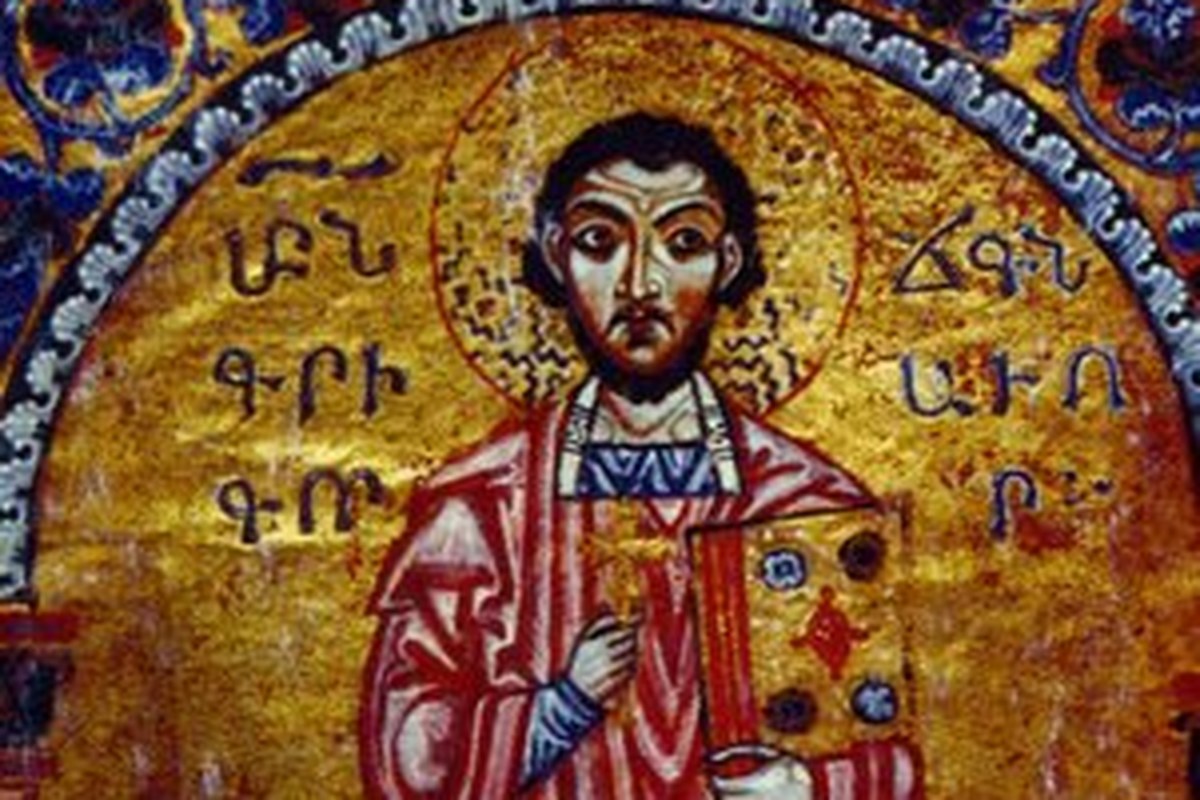
Unknown Armenian miniaturist, portrait of Grigor Narekatsi from Matenadaran Manuscript 1568, illuminated 1173 — public domain (Wikimedia Commons).
Armenia holds a genuinely distinctive place in Christian history: tradition and most modern scholarship agree it became the first kingdom in the world to adopt Christianity as its official religion, in the early 4th century, decades before Constantine's own conversion reshaped the Roman Empire's relationship to the faith. By Gregory's own lifetime in the 10th century, Armenian Christianity had developed a rich literary and theological tradition of its own, with its own alphabet — created specifically for translating Scripture — its own liturgical rite, and centuries of accumulated biblical commentary and hymnody that Gregory inherited and drew on throughout his writing.
The Book of Lamentations
Gregory's major work, generally known as the Book of Lamentations or simply Narek, is a cycle of 95 prayers composed toward the end of his life, written in a voice that swings between anguished confession of personal sinfulness and expansive, almost ecstatic praise of God. It became, and remains, one of the central texts of Armenian devotional literature — copied, illuminated, and read in Armenian churches and homes for nearly a thousand years, to the point that in Armenian folk tradition the book itself was sometimes treated as having protective power when kept in a household. Because so few of Gregory's biographical details survive with certainty, it is the Lamentations, more than any external record, that has carried his reputation across the centuries.
What distinguishes Gregory's prayers from a great deal of other medieval devotional writing is their unusually raw, first-person intimacy. Rather than writing in the formal, communal voice typical of much liturgical poetry, Gregory addresses God directly as "I," confessing his own weakness and unworthiness in strikingly personal terms before turning, often within the same prayer, to soaring expressions of hope in God's mercy. Armenian tradition often describes the book as written "from the depths of the heart," a description that has stuck precisely because readers across a thousand years, in vastly different circumstances, have kept finding their own struggles reflected in it — part of why it became, and remains, something closer to a devotional companion carried through daily life than a text studied only by scholars or clergy.
First Doctor from outside communion with Rome
On April 12, 2015, Pope Francis declared Gregory a Doctor of the Church, an act that broke sharply with precedent: the honor had, up to that point, only ever gone to figures who lived and died within churches in full communion with the papacy. Gregory belonged to the Armenian Apostolic Church, which separated from both Rome and the Byzantine church centuries before he was even born, over the Christological formula adopted at the Council of Chalcedon in 451. His declaration didn't reverse that historical separation or claim Gregory as something he wasn't in his own lifetime; it recognized, from the Catholic side, the depth of his theological and spiritual writing as something the wider Church could formally honor as a teacher, regardless of the institutional divide.
A monk remembered globally, centuries later
Gregory died around 1003, having spent his whole recorded life within a single monastic community on the edge of a lake that today lies in a different country than the one his monastery was part of. His 2015 declaration arrived nearly 900 years after his death, at a moment when Pope Francis was actively pursuing warmer relations with the Armenian Apostolic Church; he visited Armenia the following year, in 2016. Francis's original announcement of the declaration also carried unmistakable political weight, since it came during the centenary year of the Armenian Genocide, and the pope's related remarks describing those events explicitly drew renewed international attention both to that history and to the wider Armenian Christian tradition Gregory represents.
The Armenian Church keeps his memory on its own liturgical calendar, and in 2021 the Roman Catholic Church added an optional memorial for him to its General Roman Calendar on February 27 — a quiet monk from Lake Van now honored, in two different church calendars, as a teacher for the whole of Christianity. His case remains genuinely unusual among the roughly three dozen Doctors of the Church: nearly all the others left behind treatises, sermons, or systematic theology aimed at instructing fellow believers or defending doctrine against rivals, while Gregory's entire claim to the title rests on a single sustained work of personal prayer — proof, in the Church's own judgment, that profound theological teaching doesn't have to arrive in the form of an argument.
Trivia
Who was Saint Gregory of Narek?
Why is Gregory of Narek's declaration as a Doctor of the Church historically unusual?
What is the Book of Lamentations?
Did Gregory of Narek know Pope Francis would declare him a Doctor of the Church?
What is Saint Gregory of Narek's feast day?
You May Also Like
Related Reading