The Nine Choirs of Angels — A Full Guide to the Angelic Hierarchy

One system, drawn from scattered Scripture
The Bible mentions several distinct categories of heavenly being — seraphim in Isaiah's vision, cherubim guarding Eden and the Ark, thrones and dominions and powers in Paul's letters, archangels named in a handful of places — but nowhere does Scripture itself arrange them into a single ordered system. That organizing work came centuries later, from a Greek Christian writer of roughly the 6th century known today as Pseudo-Dionysius the Areopagite — a name that reflects a long-standing mistaken attribution to the Dionysius converted by Paul's preaching in Athens (Acts 17:34), rather than the actual, still-unidentified author. In a short treatise called The Celestial Hierarchy, he gathered every heavenly being named anywhere in the Bible and arranged them into nine ranks, grouped into three triads of three — a system later refined and popularized in the West by Thomas Aquinas, and one that has shaped Christian art and devotion ever since, without ever being formally defined as Church dogma.
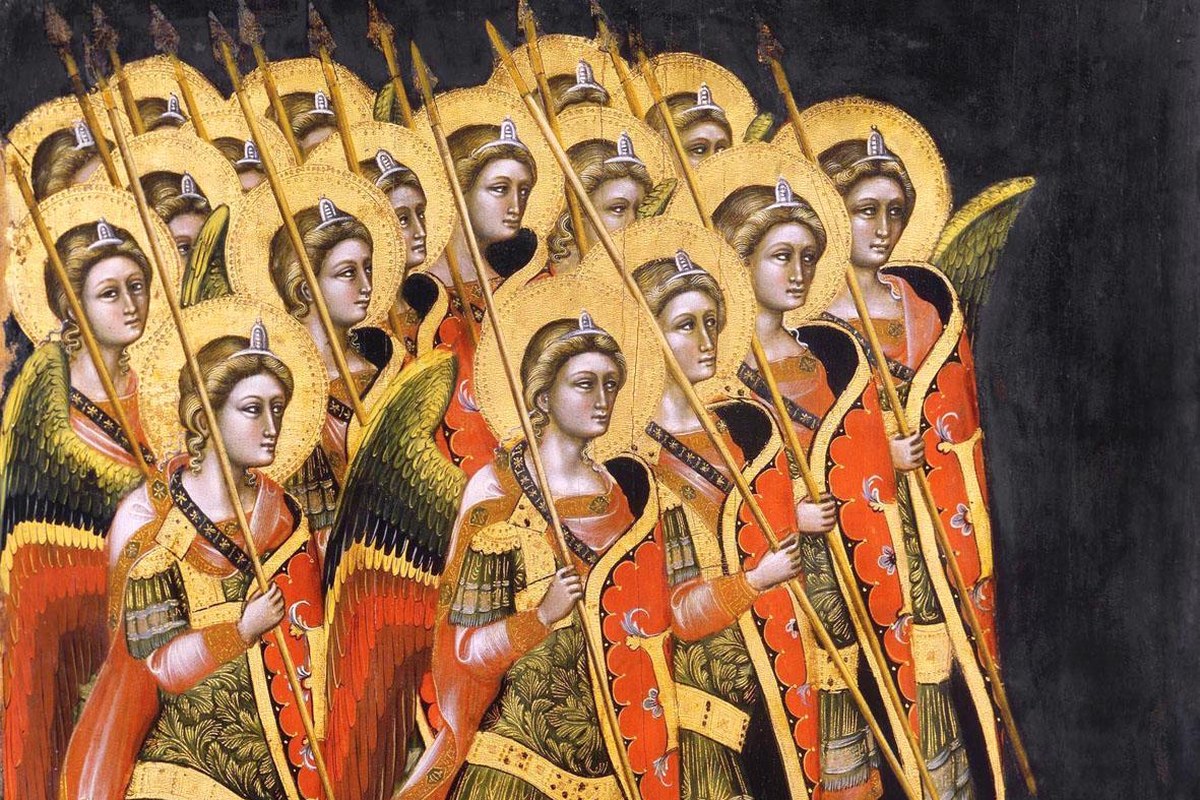
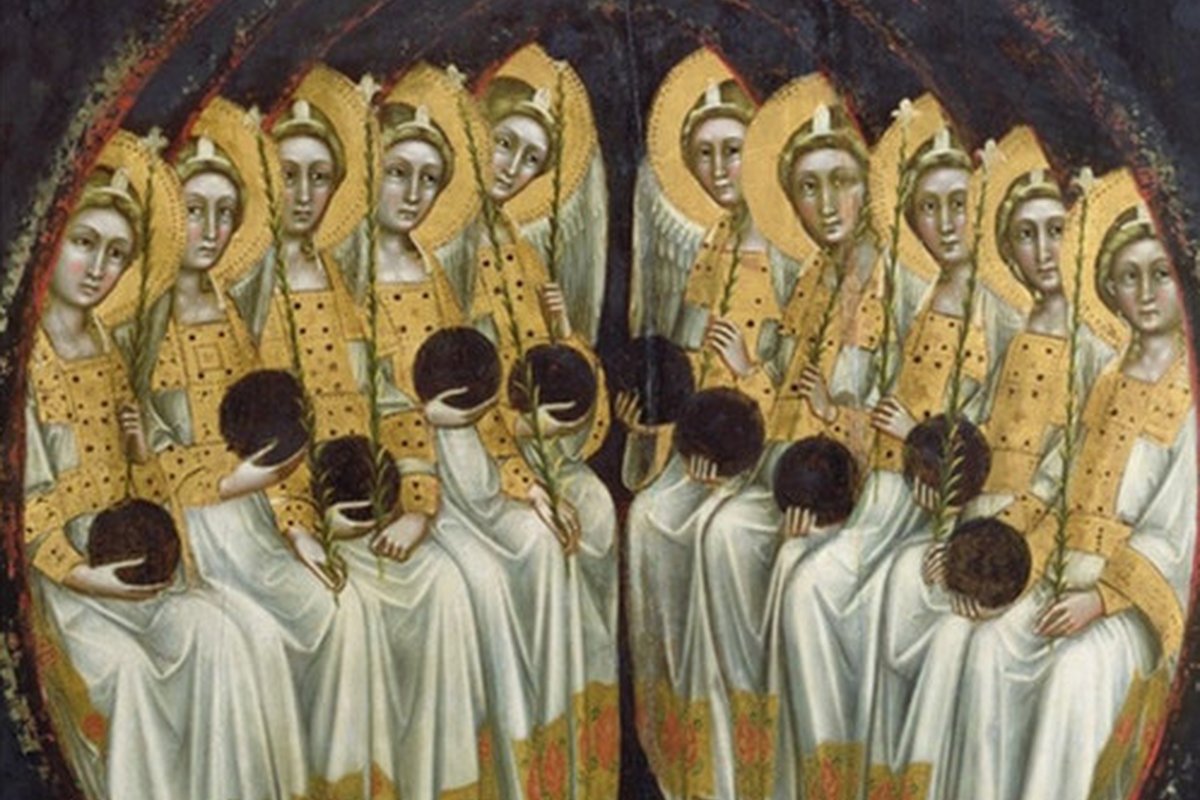
Guariento di Arpo, Angels' Army, 1360, Musei Civici di Padova — public domain.
Pseudo-Dionysius wasn't working in a vacuum. Earlier Church Fathers had already discussed various angelic ranks in passing — Saint Ambrose and Saint Jerome, among others, mention several of the terms Paul uses in his letters — but nobody before Pseudo-Dionysius had attempted to gather every scriptural term into one complete, ordered system. His broader theological project treated the structure of heaven as a kind of pattern for the structure of the Church itself: just as angels are arranged in ranks that mediate divine illumination downward from the highest choir to the lowest, Pseudo-Dionysius argued that human church hierarchy — bishops, priests, deacons, and laity — mirrors that same pattern of ordered mediation. That parallel, more than the angelology itself, is what made his work so influential on medieval Christian thought generally, well beyond just how people pictured angels.
It's also worth noting the system was never perfectly uniform even within Christian tradition. Pope Gregory the Great, writing in the West a few generations after Pseudo-Dionysius, proposed a similar but not identical ordering, swapping the relative positions of a couple of ranks in the middle tiers. Aquinas, writing in the 13th century, ultimately sided with Pseudo-Dionysius's ordering and it's his version, filtered through the Summa Theologiae, that became the standard reference point in Western Catholic tradition — which is the order presented below.
The first triad — closest to God
- Seraphim — the highest rank, named only once in Scripture, in Isaiah's vision of six-winged beings crying "Holy, holy, holy" around God's throne.
- Cherubim — guardians rather than the soft infant figures of later art, placed at Eden's gate after the Fall and depicted atop the Ark of the Covenant.
- Thrones — drawn from a single word in Paul's letter to the Colossians, later interpreted as the rank most closely associated with bearing up God's judgment.
This first triad is traditionally described as engaged in continuous, direct contemplation of God, without an active governing or messenger role toward the lower ranks or toward humanity — their purpose, in the framework Pseudo-Dionysius describes, is worship for its own sake, closest to the divine presence itself. That's part of why medieval and Renaissance art so often depicted seraphim and cherubim as faces surrounded entirely by wings, with no visible body doing any earthly work — a visual shorthand for beings whose entire existence is oriented toward gazing on God rather than acting in the world.
The second triad — governing the cosmos
- Dominions — also named in Colossians, traditionally understood as regulating the duties of the lower angelic ranks.
- Virtues — associated in tradition with governing the movement of the heavens and granting grace and courage.
- Powers — traditionally tasked with defending the created order against evil, sometimes depicted restraining demons underfoot.
Where the first triad contemplates and the third triad ministers directly to humanity, this middle triad is traditionally understood as the administrative layer of the angelic order — governing the movement of the natural world, regulating the activity of lower angels, and standing guard against the influence of fallen spirits. It's the least individually familiar of the three triads to most modern readers, since none of Scripture's brief references to Dominions, Virtues, or Powers comes with any narrative attached, unlike the archangels below, who each get a story.
The third triad — closest to humanity
- Principalities — associated with the guardianship of nations, peoples, and large institutions rather than individuals.
- Archangels — the rank that includes the only angels named directly in Scripture: Michael, Gabriel, and Raphael, along with Uriel, who appears only in later Jewish tradition rather than the Bible itself.
- Angels — the lowest and, by tradition, most numerous rank, and the one most directly involved in human affairs, including the familiar idea of a personal guardian angel.
A framework, not a dogma
It's worth being precise about what kind of authority this system actually carries. The Catholic Church has never formally defined the nine-choir hierarchy as dogma — it's a theological framework, deeply embedded in tradition and art history, refined over centuries by figures like Aquinas, but not a required article of faith. Catholics are free to find it a genuinely useful way of thinking about the variety of heavenly beings Scripture describes, without treating the specific nine-rank structure as settled doctrine. What is far better attested, across every rank, is the much simpler underlying claim: that Scripture describes an entire created order of beings, distinct from humanity, whose primary work is worship and service before God.
Trivia
Who came up with the nine choirs of angels?
What are the nine choirs of angels, in order?
Is the nine-choir hierarchy official Catholic dogma?
Which angels named in the Bible do people actually know by name?
Do Eastern Christian traditions use the same nine-choir system?
Related Reading